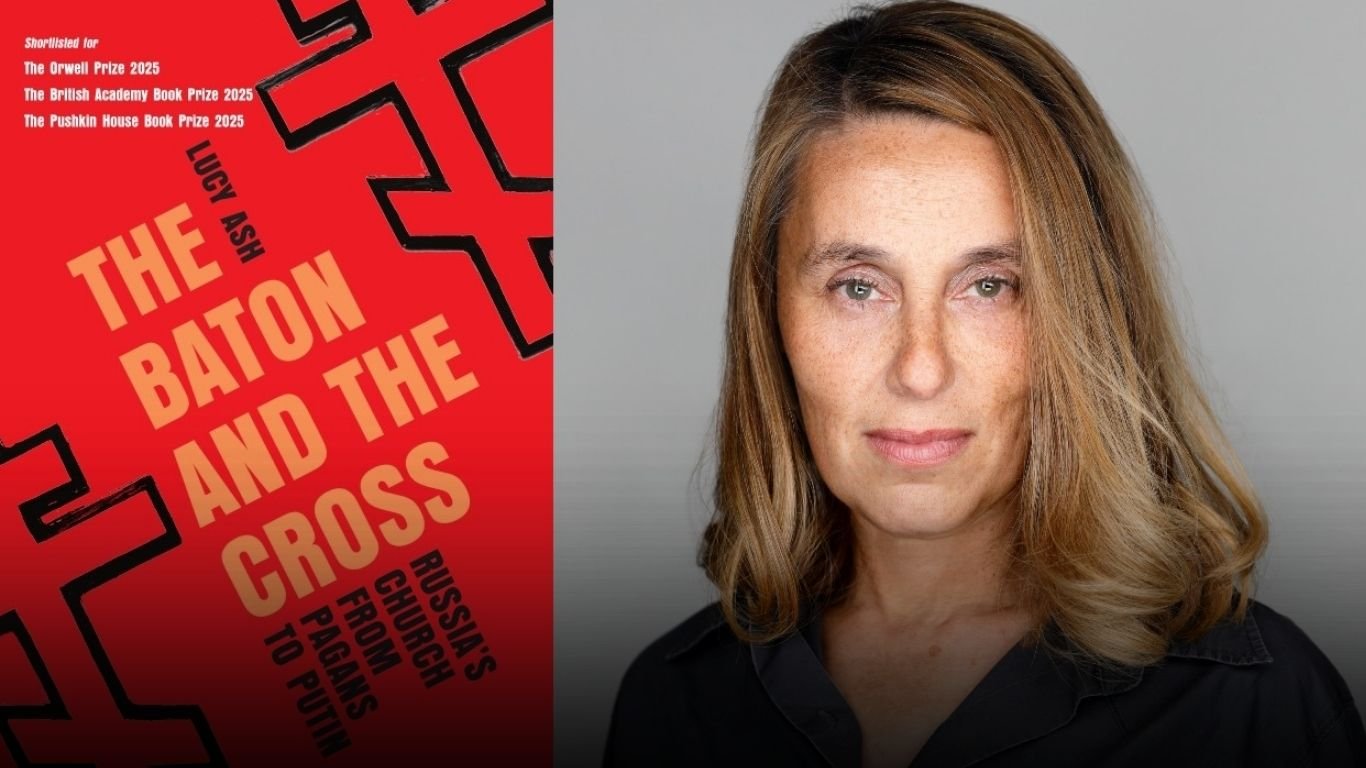
Lucy Ash is a British journalist who worked for the BBC for a quarter of a century. She is the author of “The Baton and the Cross: Russia ‘s Church from Pagans to Putin” a book devoted to the interdependence and influence of the Russian Orthodox Church and the Kremlin. Published in October 2024, it was recently reissued in paperback, supplemented by events from the last year of the Russian- Ukrainian war. Her book is the first Western journalistic investigation into the long-hidden and sensitive ties between the Kremlin and the Orthodox Church and breaks new ground in the dystopia that is Putin’s Russia
We decided to talk to Lucy about her book, her experience, and the union of the “Baton and the Cross.”
RUSSIA DOESN’T PASS A LAW ON DOMESTIC VIOLENCE, BUT REHABILITATES IVAN THE TERRIBLE
— Lucy, we congratulate you on the reprint of your book. We know you’ve been researching the Russian Orthodox Church for two decades. Why is it called “The Baton and the Cross”?
— The title of my book, “The Baton and the Cross,” was inspired by a poster I saw on a wall near a tram stop in St. Petersburg in 2017. It depicted a large black cross made of police batons, and beneath it the words “Repent!” I had previously studied the church and was struck by the aptness of the image: the fusion of religious symbols with state violence. It demonstrates how the Russian church has always stood close to the authorities. And for them, blind obedience proved more important than moral principles.
— Where does the interest in the topic come from?
— In the 2000s, I did a series of stories about Britons who had made careers in various regions of Russia, including Vladivostok and the North Caucasus. Among them was a British priest who converted to Orthodoxy and served in a Moscow church. Then I became interested in the church again with Pussy Riot’s protest. Remember how the young women in brightly colored balaclavas performed at the Cathedral of Christ the Savior, criticizing the relationship between Putin and Patriarch Kirill? I was struck by how many liberals, and even journalists among my good friends, didn’t initially understand their punk prayer. They said, “Yeah, let’s get rid of Putin, but why drag the Mother of God into it?” (The group’s performance included the words, “Mother of God, drive Putin away” – ed.) But they were completely missing the point: the women were criticizing the relationship between Kirill and the Kremlin, which seriously discredits the church. If you recall, this wasn’t a sudden or isolated action. In December 2021, they protested on the roof of a building across from a Moscow detention centre where opposition leaders like Alexei Navalny and Ilya Yashin were being held. After all, these events were preceded by the serious falsification of the State Duma elections, when people took to the streets in protest. Then came the humiliating announcement about the presidential elections, when Medvedev stepped down so Putin could run for a third term. In early February, Putin arrived for a meeting with the Patriarch in the Danilov Monastery, and Kirill called Putin’s leadership of Russia a miracle from God. This is the historical backdrop of these protests.
If mainstream society didn’t understand the punk prayer, it was manna from heaven for Putin; he called them puppets of the decadent West, while presenting himself as a defender of Orthodoxy. He then tightened repression shifted his focus from the economy to nationalism, and started portraying himself and Russia as champions of Christian values. But many of the traditionalists around him are hypocrites – for example Konstantin Malofeev, the Orthodox oligarch ditched his wife after 20 years even though he was preaching about the importance of a society built on the voluntary union of a man and a woman in a lifelong covenant of marriage.
Another turning point for me was the refusal in Russia to pass a law protecting victims of domestic violence (even though the problem is enormous, women are very vulnerable, and I made a film about it). Neither the church nor the government supported this draft law – in fact they did everything possible to bury it. And one Orthodox activist declared that a man should always have access to his home, even if he beat his wife and children, otherwise that would mean the genocide of the Russian family. It looked like the government and church wanted to follow the household rules of Ivan the Terrible. The current rehabilitation of Stalin with statues going up in some Russian cities looks like a bad sign for true Christians.
The Russian Orthodox Church has long acted as an extension of the Kremlin’s hand overseas. But the full extent of its complicity in the annexation of Crimea and the Donbas only became apparent to me a few years later.
Konstantin Malofeev brought the Gifts of the Magi to Sevastopol to cover a military-political operation. He then became a sponsor and ideologist of the separatists in Donbas. One of his employees, Igor Girkin, captured Slovyansk with militants and became the leader of the armed forces of the so-called Donetsk People’s Republic (DPR). This man himself proudly boasted that the monks of the Svyatogorsk Lavra served as his bodyguards.
While some books published in the UK and US have touched on the religious aspect of Russia’s invasion of Ukraine, my book is the first for a general readership to focus primarily on the Church’s role in legitimizing the war. And talking of hypocrisy – Putin’s attack on Ukraine violates Christ’s second most important commandment – to love your neighbour as yourself.
THE RUSSIAN ORTHODOX CHURCH HAS ALWAYS SAT AT THE RIGHT HAND OF THE AUTHORITIES AND DONE EVERYTHING NECESSARY FOR ITS SURVIVAL AND ENRICHMENT
— In your book , you touched on the profound topic of brainwashing your citizens. The Kremlin and the Russian Orthodox Church “crawl” into the minds of Russians , instilling in them a sense of superiority and exceptionalism. What specific tools, legends, narratives , and techniques do they use?
— To truly understand Putin’s thinking, we must return to the 16th-century monk Philotheus of Pskov, who formulated, or articulated, the idea of Russia as a superior civilization with a sacred mission to redeem humanity. It was he who called Moscow the “Third Rome” and portrayed it as an Orthodox superpower after the collapse of the Roman and Byzantine empires.
And this idea has gained strength in Russian literature. For example, in Dostoevsky’s “Demons,” listen to one of the characters, Ivan Shatov. He asks, “Do you know who is the only God-bearing people on earth, called to revive and save the world in the name of the new God? And to whom are given the key and the life of the new world? The answer is: the Russian people, of course.” And this sense of superiority is especially dangerous when mixed with resentment. Alexander Dugin, for example – the philosopher with some pretty hardline nationalist views argues that Russia is basically superior to other countries. He uses that idea to justify colonial-style thinking and to push for Russia to regain control over former Soviet republics, whether that’s through new alliances or conquest.
My book is essentially a history of Orthodox Christianity in Russia, which, of course, originated in what is now Ukraine. It is also a history of the close relationship between church and state. No matter who was in power, from princes to Mongol khans, tsars, the Politburo, and Putin, the Church has always sat at the right hand of power and, for a millennium has done whatever it takes to ensure its survival, influence, and enrichment.
A FRENCH THEOLOGIAN DESCRIBES THE RELATIONSHIP BETWEEN THE AUTHORITIES AND THE RUSSIAN ORTHODOX CHURCH AS A ROCKET AND CENSER
— The theme of Putin and his patriarch dominates the second part of this book. One French theologian describes the relationship between them as a union between a missile and an incense burner. This abusive co-dependency between church and state has persisted for centuries and is poisoning Russian society. I devoted much of The Baton and the Cross to history, going back one thousand years to show how this poison worked in the past and how it has resurfaced in the present. While there were occasionally courageous priests who protested, it was all too rare. In Russia, religious sentiments often border on superstition. When the Virgin Mary’s Belt was brought to Moscow people stood in long lines for hours to see it. Some believed it would cure diseases and help women to have babies. The initiators of the event claimed it was meant to boost the birth rate in Russia. Cynics might argue that it was a good way to distract them from the protests over election fraud, since it was happening at the same time.
I WAS HORRIFIED NOT ONLY BY THE RESULTS OF THE INVASION OF UKRAINE BUT ALSO BY THE WAY RUSSIAN PROPAGANDA MANIPULATES PUBLIC OPINION BY TALKING ABOUT THE PERSECUTION OF THE UOC-MP
— How did Russia’s full-scale invasion complement or change your book?
— As part of my research, I made three trips to Ukraine after the full-scale invasion, the last one in the summer (of 2025 – ed.). And, of course, I was horrified not only by the brutality of the invasion, but also by the way Russian propaganda attempted to divide and manipulate Western public opinion by exploiting the church. Patriarch Kirill and President Putin complain about the alleged persecution of the Ukrainian Orthodox Church, which is linked to the Moscow Patriarch. And this propaganda has proven so effective that figures in the US like Marjorie Taylor Greene, once very close to US President Donald Trump, claim that the Zelenskyy government is killing Christians. This is a distortion of the truth, since it is Russian troops who are kidnapping, torturing, and killing priests and destroying hundreds of churches across Ukraine. On January 5 (2026 – ed.), a Russian drone killed Archpriest Georgy Gorbenko of the Ukrainian Orthodox Church in the Kherson region.
Interestingly, when Putin was in Alaska this summer, he didn’t say that the Ukrainian Orthodox Church, historically linked to the Moscow Patriarchate, needed to be protected. He talked about protecting the Russian Church in Ukraine. In the first three years of the war, sixty-seven clergy were killed, and 643 religious buildings were destroyed. And I think the talk we heard from people like Marjorie Taylor Greene, is very dangerous, because many in the US don’t understand the full complexity of the situation on the ground – how and why some parishes change jurisdiction.
At the same time, Americans tend to be very sensitive to any perceived threat to religious freedom. Therefore, it’s very easy to play on all these emotions. And it’s frightening to think that Ukraine might not receive the necessary financial and military support because of disinformation about the alleged “persecution of the UOC-MP.” Lawmakers in the United States need to understand this. That’s why I write about this in the book, and in more detail in the updated version.
I hope this will attract more attention, because at first, many people said to me, “Lucy, why are you writing about this? You’re not even Orthodox, why do you want to do this? It’s a bit of a niche topic.” And I replied, “I don’t think this is a small topic. Religion has become very important, especially when it’s so instrumentalized by a regime which is waging the worst war in Europe since WW2.”
I remember how, step by step, Patriarch Kirill increasingly hardened his rhetoric, to the point that the World Russian People’s Council, which he headed, issued a document in the spring of 2024 in which he directly called the “Special Military Operation” a “Holy War necessary to protect the world from the West, mired in Satanism.”
All this talk of Satan is laughable but it’s far from funny when we see what’s happening in Ukraine. The sadism of Russian troops in Ukraine is all too obvious. Bucha opened the world’s eyes to what’s happening. I went there in September 2022 to meet with a priest, Father Andrei Galavin, who was forced to bury the bodies of some of his parishioners in a mass grave behind his church. And he showed me photographs that I will never forget. Even pensioners who were going to get humanitarian aid were killed. And since then, in this so-called “holy war,” countless atrocities have been committed.
And especially disgusting is Patriarch Kirill’s idea that Russian soldiers killed on the battlefield are washing away their sins. This has been called heresy by many Orthodox churches. I realise that Patriarch Kirill, is more cynical politician than clergyman but it is still shocking. It’s like jihad in the Russian church. Although in jihad warriors are called upon to kill infidels – those who don’t believe in Allah. In the current situation in Ukraine, it’s Orthodox Christians fighting their Orthodox brothers. And the church is helping to mobilize them, claiming that it’s an honorable thing to go to Ukraine and kill people there.
I deeply respect all the journalists, lawyers, and human rights activists who expose war crimes in Ukraine. And, of course, I believe that justice will prevail one day.
— Do you believe in the possibility of repentance of Russians and their church if they do not undergo the denazification process?
— Thinking about the Russian Orthodox Church, I believe it desperately needs to reflect on what it has done and speak the truth about past horrors. Remember how Metropolitan Sergius, in his declaration, promised to stand by the godless Soviet regime—”your joys will be our joys.” This is like murdering the soul of the Church. I believe Russia must be defeated and expelled from Ukraine. And then Russians themselves need to take a good hard look in the mirror and ask how this catastrophe happened.
Anna Jansone, LF