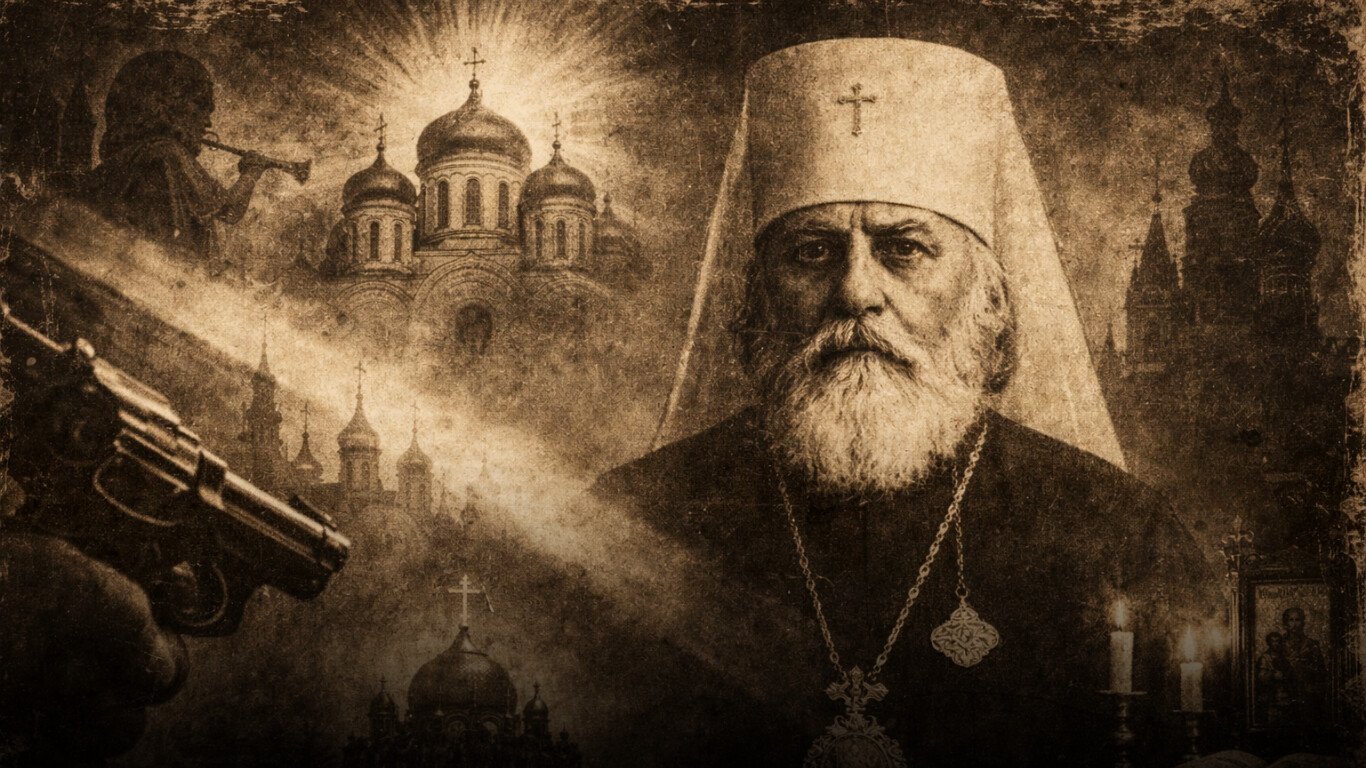
On 8 February 1923, an archimandrite of the Russian Orthodox Church, Smaragd (Latyshenkov), shot Metropolitan Georgii (Yaroshevsky). The gunshot sounded not merely as a private act of violence. It became the final point in one of the most troubling and controversial episodes in the struggle for church independence in Eastern Europe.
Stories of acquiring autocephaly are rarely peaceful. More often they resemble a chronicle of an internal war, where politics, personal faith, ambition, and fear are intertwined. In this case, the plot appears almost symbolic. A monk who remained loyal to the Moscow Patriarchate kills a metropolitan, Ukrainian by origin, who persistently paved the way toward a Tomos for the Orthodox Metropolis in Poland. The name of the killer was known immediately. Yet even a hundred years later the main question remains open. Was he a lone actor, or merely the final link in a long chain of чужой will, church intrigues, and political calculation.
AS SOON AS A STATE IS BORN, IT ENTERS THE PATH OF INDEPENDENCE
This tragedy was born of a time of collapse. The Russian Empire fell, leaving behind a vacuum of power, fear, and unclear borders. On its ruins new states emerged or, as in the case of Poland, old ones returned to life. Almost immediately they faced the question of what to do with Orthodox structures that for centuries had been subordinate to Moscow. Preserving this dependence meant not only continuing symbolic loyalty to the former imperial center, but also maintaining a direct channel of influence over domestic politics.
The more numerous the Orthodox population, the more dangerous this dependence became. Yet the desire to break free from Moscow’s jurisdiction manifested itself even where Orthodox believers were a small minority, as for example in Finland. The church question ceased to be purely religious. It turned into a matter of state security.
In Ukraine this logic appeared especially early and especially sharply. Here the question of church independence was raised even before the final consolidation of political independence. However, the first attempt proved unsuccessful. The All-Ukrainian Orthodox Council of 1918, convened by supporters of autocephaly, was in a sense blocked by a pro-Russian episcopate. This was a drama of the Ukrainian people. They wanted spiritual independence, while the leadership sent from Moscow did not.
For the Ukrainian secular authorities this was not enough. The Directory of the Ukrainian People’s Republic took a radical step. On 1 January 1919 autocephaly was proclaimed by an act of state authority. An attempt began to create an independent church governing center, the Synod. It was precisely here that future key figures of the Polish Autocephalous Church were invited, Bishops Georgii (Yaroshevsky) and Dionisii (Valedinsky).
For those unfamiliar, figures of church leadership are indispensable for the establishment of spiritual independence.
Yet behind the declarations lay a harsh reality. Across all of Ukraine there were only three bishops of Ukrainian origin. Only one of them was a ruling hierarch. The other two were vicars, bishops without sees, that is without real territories for which they were responsible and over which they ruled, and they lacked the full measure of real authority.
Meanwhile, outside Ukraine remained Ukrainian bishops who observed what was happening from a distance, but not indifferently. Among them was Archbishop Georgii. They had not yet made a final choice, but the very possibility of choice already turned them into figures of risk.
HOW AN ETHNIC UKRAINIAN SOUGHT TO HELP BOTH POLAND AND UKRAINE ACHIEVE INDEPENDENCE
For Bishop Georgii it was impossible to avoid being drawn into this vortex. From 1916 he headed the Minsk and Turov see, and after the Treaty of Brest part of his diocese found itself on the territory of the Ukrainian State. Delegates to the All-Ukrainian Council of 1918 were elected from there. From there also came requests, conflicts, and petitions, all of which required constant contact with the authorities in Kyiv.
Thus a hierarch who formally was outside Ukraine gradually found himself at the very center of a church-political drama that a few years later would end with a gunshot and become a prologue to autocephaly for another country.
Yaroshevsky was the son of a priest from the south of Podolia Province and a man with a fairly clearly formed Ukrainian national identity. At the same time he remained a pragmatist, rational, cautious, and in a sense a cool-headed politician. Detailed evidence of what he thought or felt in the turbulent year 1917 has almost not survived. However, after Ukrainian statehood took shape, meaning the period known as the Ukrainian Revolution and the Ukrainian People’s Republic, his interest in the Ukrainian project acquired very concrete forms.
In the summer of 1918 he began supporting Ukrainian activists of Prosvita in Minsk, for which he received official thanks from the Ministry of Confessions of the Ukrainian State, a kind of ministry of religions.
Later he sent greetings to the All-Ukrainian Orthodox Council of 1918. Then he personally came to Kyiv and entered into contact with the same Ministry of Confessions, which under the Directory was renamed the Ministry of Cults. He conducted correspondence with it in Ukrainian, emphasizing that he was “a Ukrainian by origin.”
After the defeat of the White movement, Bishop Georgii found himself in emigration. First Constantinople. Then the island of Chalki, where the theological school was located. Even two of his articles are known, published in Greek in a journal of the Ecumenical Patriarchate. This was a rare case. A hierarch of the Russian Church in exile tried to speak to the Orthodox world directly, bypassing customary channels.
Then the emigrant path led him to Serbia, where he settled in one of the monasteries. Yet there too no role was found for him, neither as a scholar or educator, in the past he had been rector of the Saint Petersburg Theological Academy, nor as an administrator. His experience, influence, and ambitions proved unclaimed.
At this moment his position was unexpectedly “saved” by Archbishop Evlogii (Georgievsky), who in 1920 received from the Patriarch an appointment to govern ROC parishes in Western Europe. Within these powers, Evlogii entrusted Archbishop Georgii with the administration of ROC parishes in Italy. The appointment was largely symbolic. It concerned literally only a few functioning churches.
For the active nature and large ambitions of Bishop Georgii this was clearly insufficient. And it was precisely then that a chance appeared, unexpected and probably not fully consciously anticipated.
Ukrainian statehood did not endure. But the Second Polish Republic not only repelled the Bolshevik offensive, it also managed to hold borders that extended far beyond territories with a dominantly ethnic Polish population. This meant one thing. The question of church organization on the ruins of several ROC dioceses, the creation of a unified center of governance, and the acquisition of autocephaly for Orthodoxy in Poland became inevitable.
In 1921, after the Treaty of Riga, the Polish government began searching for a formula to resolve these tasks. However, it quickly became clear how complex they were. The overwhelming majority of acting bishops, originating from the ROC, were categorically unprepared to support the idea of an independent Church in an independent state. Beginning the process of “ordering” and church self-determination, the Polish authorities could count on the loyalty of only one hierarch, Dionisii (Valedinsky).
An ethnic Russian who accepted the idea of Polish autocephaly, Dionisii proceeded from a simple but rigid principle. An Orthodox bishop must demonstratively be loyal to any lawful authority, even if it is the authority of a non-Orthodox state. What matters here is simply to note that ethnic origin did not automatically determine the positions of the participants in this drama. Among its active figures were the Russian Valedinsky and the Ukrainian Yaroshevsky, who together were building the Orthodox Church in Poland. And there was Smaragd (Pavel Latyshenkov), a Belarusian who, by his own later explanations, decided on the murder of the metropolitan precisely in order to stop the process of obtaining autocephaly.
At the moment of the restoration of Polish statehood it was not yet clear where its eastern borders would run. It was then assumed that the matter would concern regulating the situation only within the Warsaw, at most the Kholm, dioceses. In its full scope the problem arose only in 1921.
What did the Moscow Patriarch Tikhon intend to do in this situation. Tikhon was ready only for such concessions that under favorable circumstances could be quickly and painlessly reversed. You want independence. I can bless administrative autonomy. But, though it was not said aloud, it was implied that it should be arranged so that it could be eliminated if the political situation changed. When, in the words of one Russian opposition figure, the “great beautiful Russia of the future” would be reborn within its pre-revolutionary borders.
In other words, the Russian Patriarch continued to perceive himself as the guardian of imperial heritage and had no intention of abandoning it. It is telling that the Polish government at first did not fully understand his motivation, assuming that the head of the ROC persecuted by the Bolsheviks would, on the contrary, be more sympathetic to the desire to escape from the “Moscow” hand.
HOW THE POLES BYPASSED THE MOSCOW PATRIARCHATE AND CONTINUED THE PATH TO AUTOCEPHALY
However, the Poles deserve credit. They acted consistently and persistently, not allowing this process to be driven into a dead end, and did not yield to Tikhon’s attempts to turn the church question into yet another frozen imperial plot.
At that time the question was simply not posed otherwise. Formally Georgii was invited only to provide pastoral care to several parishes of the Minsk diocese that found themselves on Polish territory. However, it was obvious that the plans of the Polish government regarding him were from the very beginning far more ambitious. Georgii was an archbishop and senior by ordination among all Orthodox bishops located in the Second Polish Republic. But officials were interested in only one thing. Was there any compromising material on him, had he previously taken openly anti-Polish positions. For comparison, Dionisii himself had once been editor of the Pochaev Leaflet, where many anti-Polish and anti-Catholic materials were published.
In the end, only three bishops could be found to launch the “autocephalous project.” Besides Dionisii and Georgii there was one more, Panteleimon (Rozhnovsky). A remarkable and in many ways indicative figure. His father was an ethnic Pole, his mother Russian. He considered himself Russian, although he tried to play on his father’s origin in seeking Polish citizenship. Later Panteleimon aligned himself with opponents of creating a new Local Church.
It was these three bishops who signed a letter to Patriarch Tikhon, in which they declared their readiness to arrange church life on the principles of autocephaly, but exclusively on the condition that this would be permitted and blessed by the Patriarch himself. At the same time the Polish side proposed that Tikhon confirm the powers of Archbishop Georgii to govern the Warsaw and Kholm dioceses and appoint him his exarch.
In other words, to make him the “chief,” the first hierarch of the entire church region. After all, de jure none of the Orthodox bishops in Poland possessed authority to govern other hierarchs and issue binding directives to them.
From September 1921 to January 1922 a whole series of meetings took place between Polish diplomats and the Moscow Patriarch. The negotiations were difficult and harsh. The sides openly bargained. In the end Tikhon agreed to grant Georgii the necessary powers and elevate him to the rank of metropolitan. At the same time he proposed to the Polish government his own project for organizing the Orthodox Metropolis in Poland, naturally on principles of extremely limited autonomy.
It is unlikely that the Patriarch seriously expected the Poles to abandon the idea of autocephaly. Rather he hoped to suspend the situation in uncertainty for a long time. However, when information reached him that the process of church self-determination was continuing and not stopping, Tikhon flew into a rage and openly declared that under no circumstances would he agree to the granting of autocephaly.
But in May 1922 Tikhon himself was arrested by the Bolsheviks. This unexpectedly created a “window of opportunity” for the bishops who supported the idea of autocephaly. Already on 14 to 15 June 1922 Metropolitan Georgii convened a Synod, having first ensured a numerical advantage there of just one vote. Together with Dionisii they consecrated another bishop, Aleksandr (Inozemtsev), a disciple of Metropolitan Georgii.
It was these three hierarchs, two Russians and one Ukrainian, who announced that the Orthodox Church in Poland was embarking on the path of autocephaly. The Patriarch, we recall, was at that moment effectively removed from governance, and no other authority capable of challenging or blocking this decision simply existed.
From that moment the process was definitively transferred into a formal legal channel. During this period Metropolitan Georgii launched truly vigorous activity. He founded a powerful Synodal printing house and an official printed organ of the Metropolis, developed a project for an Orthodox theological faculty at Warsaw University. To launch it he tried to gather the best theological specialists, including from his alma mater, the Kyiv Theological Academy.
In less than half a year a new system of church governance was built, the most radical opponents of autocephaly were removed from their sees, and the selection of new cadres began. In this period, for example, Bishop Aleksii (Hromadsky) was consecrated. At the same time the accents also changed in how the final completion of the process of church self-determination was to be arranged. Already for February 1923 a visit to Poland by a delegation of the Ecumenical Patriarchate was planned.
Bishop Georgii indeed managed to accomplish astonishingly much in a very short time. His role in the acquisition of autocephaly proved underestimated, largely because of his early and violent death, which seemed to erase his contribution.
Moreover, the key to understanding some storylines probably should be sought not in Polish but in Russian archives, specific ones to which access is closed. The role of the Soviet diplomatic mission in Poland remains unclear. Meanwhile there are many indirect signs that Soviet special services were involved in this high-profile case. This, however, does not mean that Smaragd was a Soviet agent and acted strictly on Bolshevik instructions. Most likely Latyshenkov was simply manipulated and provided with certain “technical support.” It is notable that he never confessed where he obtained the revolver and who trained him to shoot. At the same time he answered most questions of investigators and prosecutors in detail and, apparently, quite sincerely.
There was a complex combination at work here, not a primitive scheme of a “contract killing.” Among the figures in the case and in Latyshenkov’s circle there were many people with vague status, strange connections, and broad capabilities.
For example, Archimandrite Tikhon (Sharapov), the holder of a Latvian diplomatic passport, who freely traveled between Warsaw and Moscow, moreover with the knowledge of the Soviet authorities. In his memoirs he directly wrote that all his movements were coordinated with the People’s Commissariat for Foreign Affairs and sometimes even personally with Chicherin.
Pavel Latyshenkov, in monasticism Smaragd, was from the Grodno region. At the trial he emphasized that he was “a Belarusian, a Polish citizen.” What exactly he put into this self-identification is difficult to say. But it is obvious that it referred to “Belarusianness” approximately in the same sense in which people then spoke of “Little Russianness,” that is within the concept of a “triune Russian people.”
He also had a motive of personal grievance.
Smaragd was a graduate of the Saint Petersburg Theological Academy and probably already then knew Bishop Georgii. However, he knew Bishop Dionisii much more closely, with whom he worked together in the field of “Orthodox missionary activity” in Galicia during the years of the First World War. Moreover, Smaragd’s initial personal conflict arose precisely with him and was connected with Dionisii’s attempt, then Bishop of Kremenets and vicar of the Volhynian diocese, to take control of the Kholm Theological Seminary, of which Latyshenkov was rector. The seminary in 1918 returned from evacuation in Russia and was located in Kremenets. The conflict was fierce. The archimandrite wrote numerous complaints and refused to recognize the authority of the local bishop over him. Thus Dionisii became his “personal enemy” even before Georgii’s arrival in Poland.
This episode is important for understanding a key nuance of the “terrorist act” of 8 February 1923. Both autocephalist bishops were to become its victims, and it is still unclear which of them Latyshenkov hated more. Witnesses among the staff of the metropolitan chancery claimed that after shooting Metropolitan Georgii, Latyshenkov ran with the revolver in hand to look for Archbishop Dionisii. Only when he failed to find him in the building did he decide to surrender. In his first testimonies Smaragd confirmed this, but later, on the advice of lawyers, he retracted these words.
The “personal” dimension of the conflict with Georgii was also connected with Smaragd’s failed elevation to the episcopal rank. Back in February 1921 he received from the Council of Bishops of all Ukraine a nomination as Bishop of Dubno. However, it proved impossible to realize this appointment. The Polish government would not have recognized him. The Poles did not want to have among the church generalate a bearer of Moscow consciousness.
Later Patriarch Tikhon changed the proposed see. Latyshenkov was to become Bishop of Slutsk on the territory of Soviet Belarus. But here a paradox arose. The consecration was supposed to be performed in Poland, but it was unclear whether the new bishop would go to his place of service. By that time he already had Polish citizenship and was not subject to forced deportation, as happened with some opponents of autocephaly.
To prevent the appearance of a new, uncontrollable hierarch, Metropolitan Georgii, using a formal pretext, prohibited him from priestly service. De facto the archimandrite was faced with a choice. Either he voluntarily leaves Poland and becomes a bishop, or he stays but will not be able to realize his nomination. Latyshenkov chose the latter and joined active struggle against the church leadership of the Orthodox Metropolis.
He became a participant in all the “underground” meetings of opponents of autocephaly, signed their appeals and proclamations, and traveled around the country agitating. At the same time he formally did not violate the imposed prohibition. He did not serve the liturgy, although he considered the prohibition unjust and uncanonical.
Naturally, the police kept him “under observation” as unreliable. But what he said and did was insufficient for direct repressive measures. Moreover, an illegal arrest would inevitably have led to a serious political scandal. In the circle of the rebellious archimandrite there were influential people. In 1922 parliamentary elections were held, and one of the senatorial mandates was received by Viacheslav Bohdanovich, a friend of Latyshenkov and one of the most ardent defenders and justifiers of his crime.
Let us note that this is how the Moscow Patriarchate keeps its clerics today in Ukraine and EU countries. They do not return home. They become scandal-mongers, spies, disturbers of public order.
The murder of 1923 became a marker of the existence of a “zone of common interests” between this power and the ROC. In the “Polish question” the interests of the Moscow Patriarchate and the Bolsheviks coincided several years before the famous Declaration of Metropolitan Sergii (Stragorodsky), who swore loyalty to Soviet power, saying that its joys were his joys and its sorrows his sorrows. Here their “common joys and sorrows” took shape almost immediately.
On 8 February Smaragd came to Metropolitan Georgii. They talked for two hours, after which he pulled out a pistol and shot him.
All the dramatic details often quoted, such as the cry “Here you are, executioner of Orthodoxy,” cannot be verified.
Moreover, the killer changed his testimony two or three times, edited it, and added mystical or бытовые details. After the crime he continued to stage a phantasmagorical performance, demonstrating strange reactions, nervous laughter, a crooked smile, at moments when in the courtroom the details of the murder were being read out.
Psychiatric examinations recorded certain mental disorders, but overall recognized him as sane. Smaragd himself and his supporters considered this a victory. The “Orthodox avenger” did not want to end up in a madhouse and did not wish to enter history as an ordinary psychopathic killer.
The government, in turn, did not want to execute him. Formally such a possibility existed. The case could have been considered under field court-martial procedure. For the murder of a high-ranking person by a subordinate, the death penalty with immediate execution of the sentence was prescribed. But the authorities did not take this step. It would have created even more serious problems and deepened the conflict between the Polish state and its Orthodox citizens. Moreover, this was precisely what those who pushed Latyshenkov toward the crime were counting on. He himself demonstratively prepared to become a “martyr for the faith.”
When it became clear that the former monk, the Synod had deprived him of rank and monastic status, was not facing the death penalty, another combination was played. The defense turned the trial into a real show. From the killer they molded a “hero,” gave him the opportunity to continue a virtual “struggle” with autocephaly and publicly defame the memory of the victim. He boasted of his “historical role,” emphasizing that if not for him “autocephaly would already have been accepted.”
He was defended by a group of experienced lawyers, and a “support group” was regularly present in the courtroom. The process looked like a full-fledged information and psychological operation. Rumors, hints, and details of the personal lives of third parties who had no direct relation to the case but supported autocephaly were used. The lawyers abused the right to call additional witnesses. Many of them reported nothing of substance but willingly smeared the late metropolitan and his policy.
Attempts at discreditation began during Georgii’s lifetime. He was portrayed as a despot, a secret Catholic, or even an atheist nihilist. The ROC sought to destroy the reputation of an episcopate loyal to the Polish state and to make the very idea of autocephaly as toxic as possible.
In response, the Metropolis commissioned a novel from the well-known and popular belletrist of the time, Nikolai Breshko-Breshkovsky. It offered an alternative version of events, in contrast to the mythology of the fan club of the “Orthodox terrorist.” The novel was titled Cassock and Blood. The action unfolds in a fictional Balkan country, but the plot and prototypes of the characters are easily recognizable.
It is especially interesting that Breshkovsky quite convincingly reconstructed the motives by which Soviet special services could have been guided in becoming involved in this story. They рассчитывали that the murder of the metropolitan would become a trigger for unrest in Poland. Soviet documents and materials collected by Polish special services, published only in the 1990s, confirm that plans for destabilization and organizing an armed uprising in Poland did indeed exist, both in 1923 and in 1924.
Smaragd’s crime delayed the acquisition of autocephaly for some time. The visit of the Fanar delegation to Warsaw in 1923 was canceled. And the Constantinopolitan Patriarchate itself had enough of its own problems at that time. However, in 1924 the Polish government still achieved its goal. The Tomos of autocephaly was signed just one month after the former archimandrite Smaragd received his sentence, twelve years of imprisonment.
He did not serve the full term and after eight years fell under an amnesty. By that time he was already a character of little interest from old criminal chronicles. There is no reliable information about his further fate. There are only contradictory legends. According to one, he repented and even received permission to spend a night in penitential prayer at the grave of Metropolitan Georgii. According to another, which seems more plausible, he simply left Warsaw, settled somewhere in the depths of the Grodno region, and tried no longer to attract attention.
The grave of Metropolitan Georgii is located in Warsaw, in the lower part of the Church of Saint John Climacus at the Wola Orthodox Cemetery. The Polish Autocephalous Orthodox Church, at the origins of which he stood and for which he, in essence, paid with his life, exists to this day. Moreover, in its time it played an important role in restoring the canonical hierarchy of the Ukrainian Autocephalous Orthodox Church, the formation of 1942.
The fate of the murderer dissolves in a gray zone of rumors and unconfirmed versions. According to one of them, Latyshenkov did indeed “live to see” the arrival of the so-called “Soviet liberators.” But already in 1939 he fell under repression and was shot by the NKVD. There is no documentary confirmation of this version, but such an ending cannot be excluded. Moreover, it fits well into the logic of the era and the mechanisms of that power with which, consciously or not, his interests temporarily coincided.
It is indicative that in exactly this way, by execution and an unmarked grave, another active opponent of autocephaly also ended his path. This was one of the most furious justifiers of the murder of Metropolitan Georgii, the Moscowphile Viacheslav Bohdanovich. His fate is documented much more reliably. He was shot, the place of burial is unknown.
In this lies, perhaps, the main moral outcome of the entire story. Metropolitan Georgii has a grave, a Church, a legacy, and historical continuity.
His killer has only a vague posthumous legend that breaks off where the fates of many who considered themselves “instruments of higher truth” also broke off, but in the end turned out to be merely bargaining chips in someone else’s game.
Anna Jansone for LF