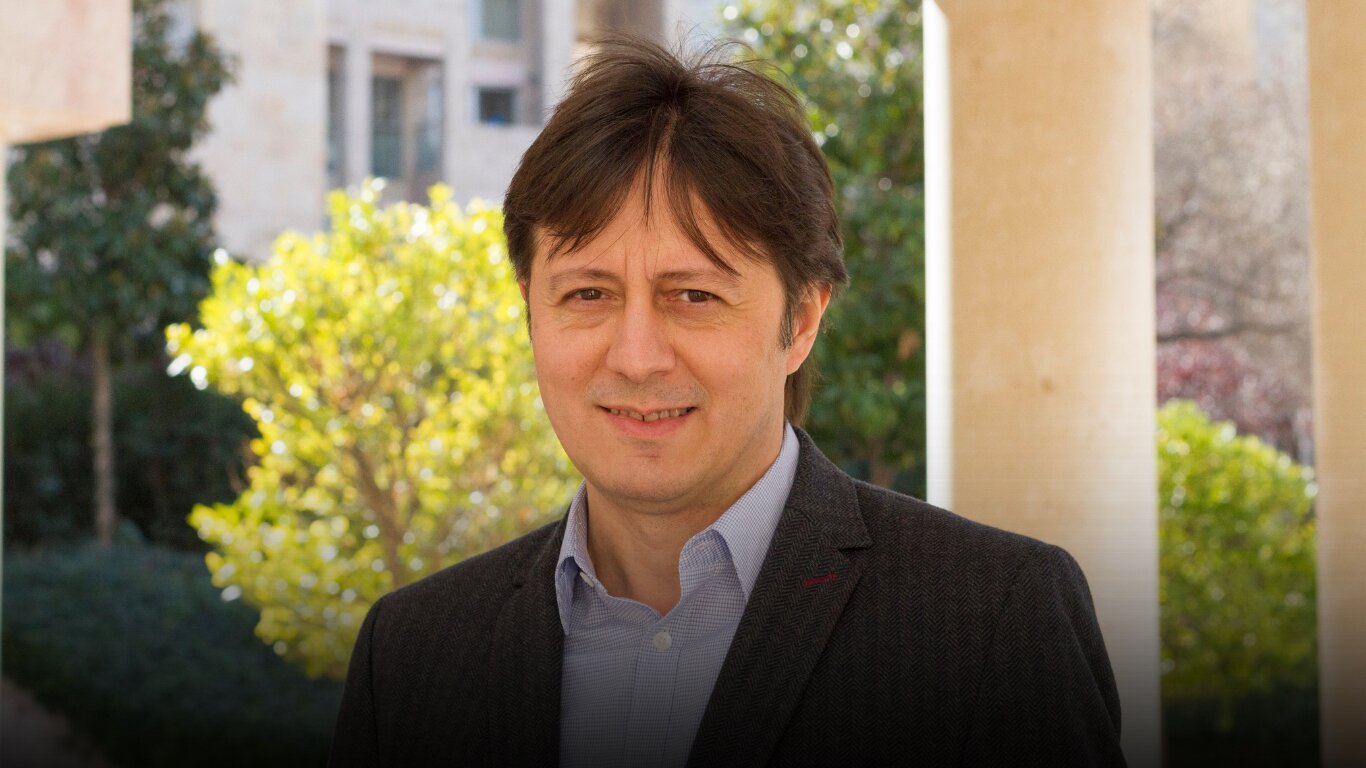
Dr Lucian Leustean is a British scholar of religion who for decades has studied how religions develop in our rapidly chanhing world, one marked by crises and upheavals.
He is the editor of an academic handbook devoted to the role of religion in Europe’s history, culture, politics, and social life, as well as a co-author of a study examining the intersection of three major themes: religion (religious institutions and ideas), geopolitics, and forced displacement in the post-Soviet space.
This is Dr Leustean’s first interview with for LF. And although the list of questions for him could be extensive, this time we focus on an issue that concerns people today: the instrumentalization of religion.
— Dr. Lucian, you are a researcher of religion and Orthodoxy. There is an opinion that Europe has become liberal and has abandoned its Christian roots. Does this coincide with your observations?
— First of all, many thanks for your kind invitation. The European Union has a long history and has gradually developed into a political system formally established by the 1993 Maastricht Treaty. It is important to remember – and this is an aspect still largely overlooked in the policy world – that the founding fathers of the European Union emphasised the concept of “community.” During the 1950s and 1960s, the first transnational organisations (the European Coal and Steel Community, the European Atomic Energy Community, and the European Economic Community) all included the word “community” in their titles.
The emphasis on “community” rather than “union” was meant to transcend the divisions between Eastern and Western Europe and to bring together cultures and populations across the continent. If we look at the long list of politicians who played key roles in establishing European institutions – starting with Robert Schuman, Alcide De Gasperi, Max Kohnstamm, President Jean Rey, and President Jacques Delors – we find that they all highlighted the idea of “community” as fundamental to building a prosperous and peaceful Europe.
— Perhaps this opinion is imposed by Russia, which speaks of itself as the sole guardian of Christian values?
— In the post–Cold War period, Eastern Europe has been characterised by uneven patterns of religious revival. For example, highly religious countries such as Poland and Romania stand in contrast to Estonia and Bulgaria, which display much lower levels of religiosity. In Western Europe, similar contrasts can be observed between highly religious Ireland and Italy, and the Netherlands and Great Britain. The Russian population fits within the wider European dimension of religiosity, situated somewhere in the middle. In this regard, I recommend numerous national censuses and studies, particularly regular surveys conducted by the Pew Research Center.
From a political perspective, however, the post–Cold War period saw the emergence in Russia of a new narrative, namely that Eastern Orthodox Christianity was fundamentally incompatible with the West. In the long term, the politicisation of Orthodoxy served to advance the geopolitical interests of the Russian state and was comparable to the nineteenth‑century strategy of the Russian Empire, which justified intervention by claiming to protect the rights of Christian populations in Southeastern Europe. This narrative bears little resemblance to the ways in which the founding fathers of the European Union understood and engaged with religion, whether in its institutional expressions or in lived religious experience.
— Is religion returning to the public European discourse?
— Religion has two dimensions: institutional structures and lived experience. In the European Union, religious affairs remain the exclusive responsibility of national legislation, and there is no pan‑European policy imposing a uniform model of religion-state relations. The arrival of displaced populations from the Middle East, North Africa, and, more recently, Ukraine has shown that new religious communities are opening places of worship and becoming more visible in countries where secularisation has historically been stronger.
This does not mean that Western European societies are suddenly becoming highly religious; rather, the religious landscape is gradually diversifying. Religious communities have also been among the most active actors in supporting displaced populations, providing essential assistance and helping to welcome people in need.
— Are there politicians who broadcast their religiosity?
— The separation between religion and political institutions means that referring to someone’s religious affiliation or beliefs in public life typically has little impact on policy. A politician working on a specific policy issue does not derive their expertise from religious convictions or personal religiosity. In Britain, for example, if we look at recent former Prime Ministers, Theresa May (daughter of a Church of England clergyman) and Rishi Sunak (a practising Hindu) showed that neither drew on their religious background as a source of governmental expertise, nor did they impose their personal religious values on state policies.
— The world suffers greatly from crises and very often from the unworthy behaviour of elites. Is religion able to change the quality of elites? Do you believe in a religious renaissance of European society.
— Religion plays an important role in identity formation at both private and public levels. It is part of our narrative that shapes who we are as human beings and transcends cultures and societies. There will always be politicians whose behaviour in office is imperfect. Religion, in its institutional form, is not a mechanism for holding political officials to account for their actions or policies. Rather, it serves as a reminder that they belong to a community and that their work is ultimately carried out on behalf of that community and for the public good.
In this sense, a religious renaissance in European society can help revive this ideal of community, namely that political leaders recognise the significant role that religious communities play in supporting populations in need and in advancing social cohesion.
— You once held a very interesting seminar in Kyiv dedicated to how Orthodoxy is changing in the modern world. The recent years of Russia’s invasion of Ukraine and the role of the Russian Orthodox Church and the Moscow Patriarchate in Ukraine have shown the negative consequences of the instrumentalization of religion. Do Western researchers understand the dangers of such instrumentalization?
— Indeed, in March 2022, more than 1,000 scholars signed “A Declaration on the ‘Russian World’ (Russkii mir) Teaching”, condemning the political instrumentalization of Orthodoxy.
— How do you think this can be combated?
— The Declaration clearly indicated that maintaining a separation between religion and the state can help prevent political instrumentalization. In addition to the points raised in the Declaration, I would like to emphasise two further factors.
First, there is a scholarly need for deeper study of the concept of ethno‑phyletism in the Eastern Orthodox world, which promotes close links between religious independence (autocephaly) and processes of nation‑state building. From this perspective, Ukraine is not different from other predominantly Orthodox countries in the region.
Second, a better understanding of the humanitarian role played by religious communities – not only Eastern Orthodox, but all religious traditions – in supporting populations in need could help ensure that religious institutions remain less susceptible to political control. Religious communities that actively care for those in need and that participate in humanitarian networks embedded in international aid programmes are better equipped to resist state pressure. Inter‑faith humanitarian work reaches a wider spectrum of vulnerable populations and helps transcend political constraints.
— Do you think that if we introduce full financial transparency, for example, of the church leadership of the Russian Orthodox Church in European countries, would this help the clergy of the Russian Orthodox Church behave in an evangelical manner?
— There are several ways to ensure that religious communities comply with national legislation in European countries, and financial transparency is one important mechanism among them. However, financial transparency must be coupled with sustained interfaith dialogue and active involvement in social and humanitarian programmes aimed at supporting people in need, regardless of their religious affiliation.
— Do you follow all the spy scandals that erupt in Europe through the Russian Orthodox Church? Have you formed your own attitude towards this?
— The recent headlines concerning the political instrumentalization of the Russian Orthodox Church recall the religious tensions of the Cold War period. It was well known that Russian clergy were vetted by security services before travelling abroad or engaging with their Western counterparts. Maintaining dialogue remained important, not only for fostering understanding across ideological blocs but also as a means of offering support to populations living behind the Iron Curtain.
— Should scientists rethink the phenomenon of the faithful of the Russian Orthodox Church being deceived and made part of the spy infrastructure?
— As I mentioned earlier, the lessons of the Cold War period remain highly relevant today.
— How do you see the future of the conflict between the satellites of the Russian Orthodox Church and those in the orbit of the Ecumenical Patriarchate?
— The Eastern Orthodox world will continue to remain divided between two centres of gravity, with churches maintaining close ties either to the Russian Orthodox Church or to the Ecumenical Patriarchate. Unfortunately, the March 2024 statement of the World Russian People’s Council declaring Russia’s invasion of Ukraine to be a “holy war” not only represented a major division between Russia and the West but also revealed the limited willingness of other Orthodox churches to issue clear public condemnation. Orthodox churches continue to operate largely as “national” institutions, and their engagement with international counterparts frequently reflects national interests rather than a pan‑Orthodox or ecumenical perspective.
A thorough re‑evaluation of the relationship between Orthodoxy, nationalism, and ethno‑phyletism – beginning with academic scholarship and extending into ecclesial discourse – could help explain why contemporary Orthodox churches are structured as they are and not otherwise.
— And finally. Not so long ago, there was a conference in Cambridge dedicated to ecumenism. We see very correct steps by the Ecumenical Patriarchate towards the Pope. Do you think that such a cultural and spiritual exchange would be useful for world Christianity? Orthodoxy?
— The ecumenical movement reached its peak with the establishment of international organisations in the years after the Second World War. Unfortunately, many churches have followed national narratives rather than sustaining the ecumenical ideals of cooperation and unity; in several Orthodox churches, conservative networks even regard ecumenism as a heresy.
It is my hope that the end of Russia’s invasion of Ukraine will prompt a renewed evaluation not only of the social and humanitarian role played by Orthodox churches and other religious confessions, but more widely of the ecumenical movement.
Inter‑faith dialogue and participation in ecumenical networks have been crucial both in providing support to populations in need and in helping religious communities resist political pressure and state control.
Bio:
Dr Lucian Leustean is a Reader in Politics and International Relations at Aston University, Birmingham, United Kingdom. His recent publications include, as editor with Grace Davie, The Oxford Handbook of Religion and Europe (Oxford University Press, 2022), and as author of Religious Failure, Geopolitics and Forced Displacement in Russia, Eastern Europe, and the South Caucasus (Central European University Press, forthcoming 2026).
Anna Yansone, LF