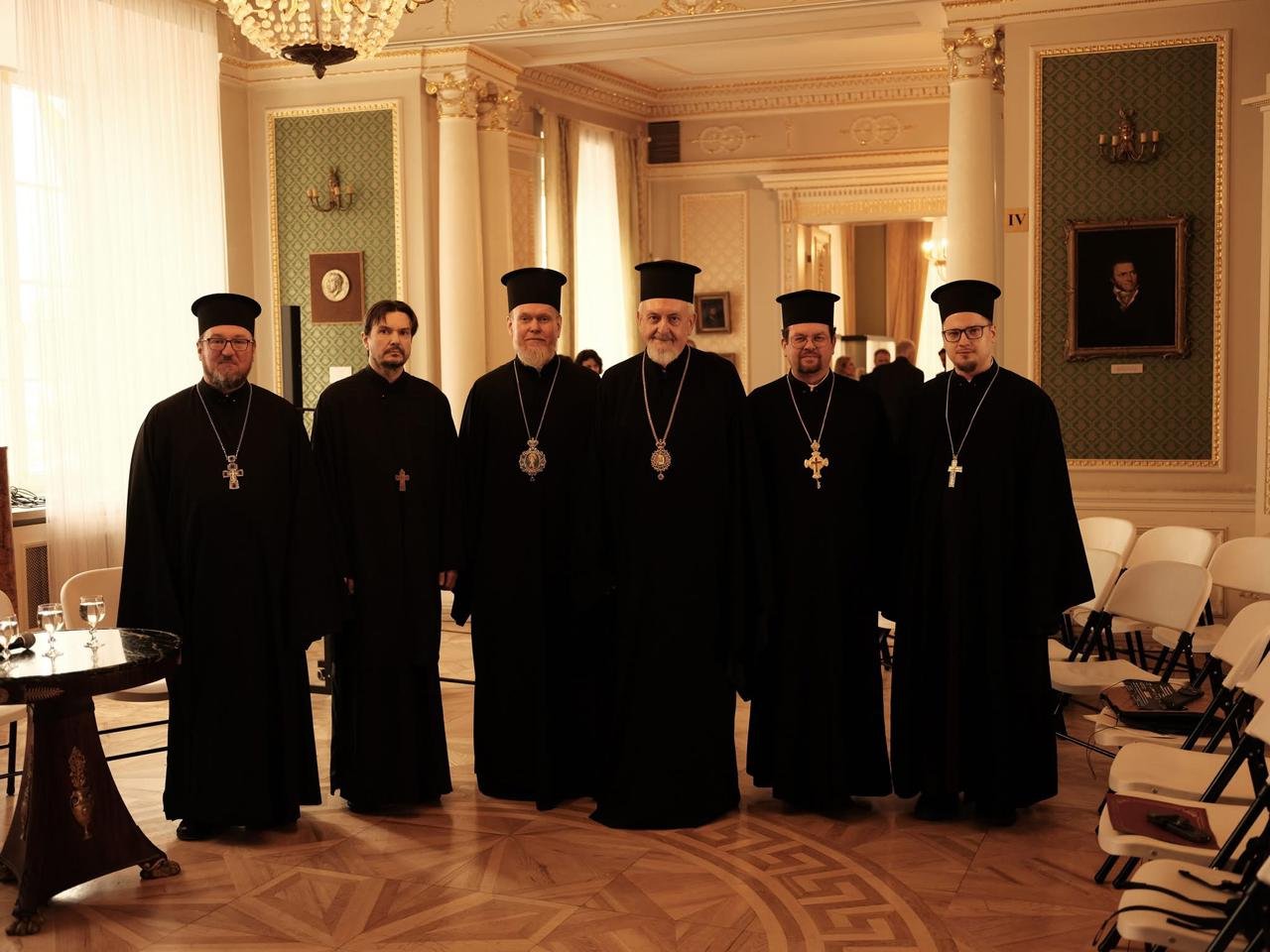
- In Vilnius, to mark the anniversary of Russia’s war against Ukraine, a two day conference titled “Constantinople and Moscow: The Transformation of Church Affiliation and the Influence of Imperial Policy” is being held at the Chodkiewicz Palace.
The conference brought together scholars, religious leaders, and politicians from the Baltic states and Ukraine. It became a profound and necessary reflection on the history of the Church, its relationship to political power, and its interaction with society and the state.
We have prepared a brief overview of the opening speeches for you.
“AN CHURCH FILLED WITH PHOBIAS HAS NOTHING TO OFFER THE WORLD”
The address of the conference’s first speaker, a representative of the Ecumenical Patriarchate, Metropolitan Emmanuel of Chalcedon, touched on very deep themes, including the Eucharist, the role of the Church, the difficulty of daily decisions in matters of religious freedom, pastoral honesty, and the integrity of political elites.
“We will not descend to a discussion built solely on legal terminology, but will speak from the heart. As Orthodox Christians, we value the democratic freedoms we possess and must assume a certain responsibility, humanitarian, existential, the responsibility to fight injustice, to seek dialogue, to prevent aggression, and to build bridges. And, of course, changes of jurisdiction could help with this.
Very often there is a lack of resolve, there is no desire for confrontation, no desire to express one’s opinion, sometimes to defend the truth, or one simply cannot manage it. Yet we still must bear this responsibility. All this is also relevant for secular states that seek to neutralize geopolitical challenges, and in this case our interests coincide.
Many historic events have taken place in Vilnius, and external temptations have altered the course of history. But when we look at contemporary Vilnius, we return to the question of how the Church lives in this context. Each time we speak about church jurisdiction, the question arises of how much it helps people achieve their goals. For example, in Ukraine this jurisdiction is now functioning well, with its crises, pains, and human tragedies, and this is a terrible realization for the entire Orthodox world. We must look this horror boldly in the eye if we want our Church to have a future in the twenty first century. We must not be afraid. A Church full of phobias, closed in on itself, has nothing to offer a suffering world. We must begin precisely with this. We must rise above our human weakness and manifest a Church capable of helping even in such terrible times.
We must look at this situation critically and answer these questions honestly for ourselves. Not ideologically, not bureaucratically, not embellishing anything, but, I would say, simply, lightly, aphoristically.
It is through such a lens that we can look at a change of jurisdiction because, as I have already said about the meaning of the word jurisdiction, through the word we can understand throughout the whole of human history, over these centuries, what its meaning has been for us and how we strive toward God.
Indeed, when the meaning of the word jurisdiction changes, as in the title of this conference, it seems to sound merely legal. But the core meaning is defined by something entirely different. We understand that historically there was a certain moment when very important changes took place, and this also concerns the Ukrainian Church. The Ukrainian example shows us the authenticity of church life, how they truly celebrate the Holy Liturgy, how they ask questions and answer them, rejecting all ecclesial hypotheses. These people truly strive for God and to be with God. But we are now in Vilnius, a dynamic historical city that knows what identity means, what historical rebirth means after oppression and occupation. It is truly a living city. It is not merely a romantic nostalgia for a golden age that may never even have existed.
When we ultimately look at church faith, what do we expect? What is our churchly hope? What is our church history? This touches us very deeply and touches our wounds. And, of course, we strive for their complete healing. We seek that transcendence and that geographical jurisdiction that will help us achieve this.
Vilnius shows us these historical changes and demonstrates that this is possible, that the Church truly bears the truth, transforms processes, and can give believers what they seek. This is the central axis of our jurisdiction and of the very meaning of the Church. And this meaning arose from the historical presence of Jesus Christ, who is with us yesterday, today, and forever.”
“SUBORDINATION OF A LOCAL ORTHODOX CHURCH TO THE MOSCOW RELIGIOUS CENTER MEANS NOT MERELY A SPIRITUAL TIE, IT MEANS SUBORDINATION TO THE APPARATUS OF THE RUSSIAN STATE”
A guest from Ukraine, a speaker of the Ukrainian Autocephalous Church, Metropolitan Evstratii, shared what, in his view, makes the Moscow presence on the religious map dangerous.
“The subordination of a local Orthodox Church to the Moscow religious center means not merely a spiritual tie, it unquestionably means subordination to the apparatus of the Russian state. The question lies only in the forms and the degree of this subordination. The decisions of the Ecumenical Patriarchate in 2018 and 2019 to grant autocephaly are significant not only for Ukraine. They concern the entire historical territory of the Kyiv Metropolis, including present day Belarus and Lithuania. Any claims by the Moscow Patriarchate to the role of Mother Church in this space are invalid and contradict canonical order. As the First Throne and as the Mother Church, it is precisely the Ecumenical Patriarchate that possesses the canonical and moral right to assist in resolving the complex issues of Orthodox existence in the space from the Baltic to the Black Sea.
At the same time, the crisis of the Russian Orthodox Church is systemic in nature and is connected with its support for the ideology of a sacred war. We are speaking not merely about freeing individual church structures from the control of the Kremlin. We are speaking about preserving the whole of Universal Orthodoxy from being absorbed by the false doctrine of the Russian world.”
“TO PREVENT FAITH FROM BECOMING AN INSTRUMENT OF POLITICAL POWER”
Father Chancellor Vitalij Motskus, head of the Lithuanian Exarchate and a representative of the Institute of Orthodox Christian Education and Research, emphasized that it is very important to call phenomena, events, and processes by their proper names, thereby serving honesty and an understanding of history.
“Lithuania’s historical experience allows us to understand with particular sensitivity how political structures influence religious communities, how faith becomes part of identity, and how at times a community finds itself caught between evangelical truth and imperial interests.
The main theme of this conference and the subjects of the presentations are not merely historical episodes about what once happened. Although the historical period under discussion is vast, everything comes down to one thing, what fruits do the events and experiences of those times bear for us? What historical lessons must we draw now and what path should we choose today? For this reason, special attention is paid to the contemporary context, what is happening today against the background of the war in Ukraine, canonical disputes, and the dramas of believers.
This is a very important discussion, to reveal old and often still unresolved problems, to seek solutions, and to educate people. It is very important to call phenomena, events, and processes by their proper names, thereby serving honesty and an understanding of history. Only in this way will society come to understanding and only in this way can truth be distinguished from falsehood. This requires courage, intellectual honesty, and determination in the search for truth and dialogue.
I hope that this conference will become another step toward further discussions and will help us better understand not only the past but also our responsibility for the present and the future, the responsibility to speak the truth, to defend human dignity, and to prevent faith from becoming an instrument of political power. This is also the mission of the Institute of Orthodox Christian Education and Research, established by the Exarchate of the Constantinople Patriarchate in Lithuania, one of the organizers of the conference.”
In the next article, we will continue our review of the speeches.