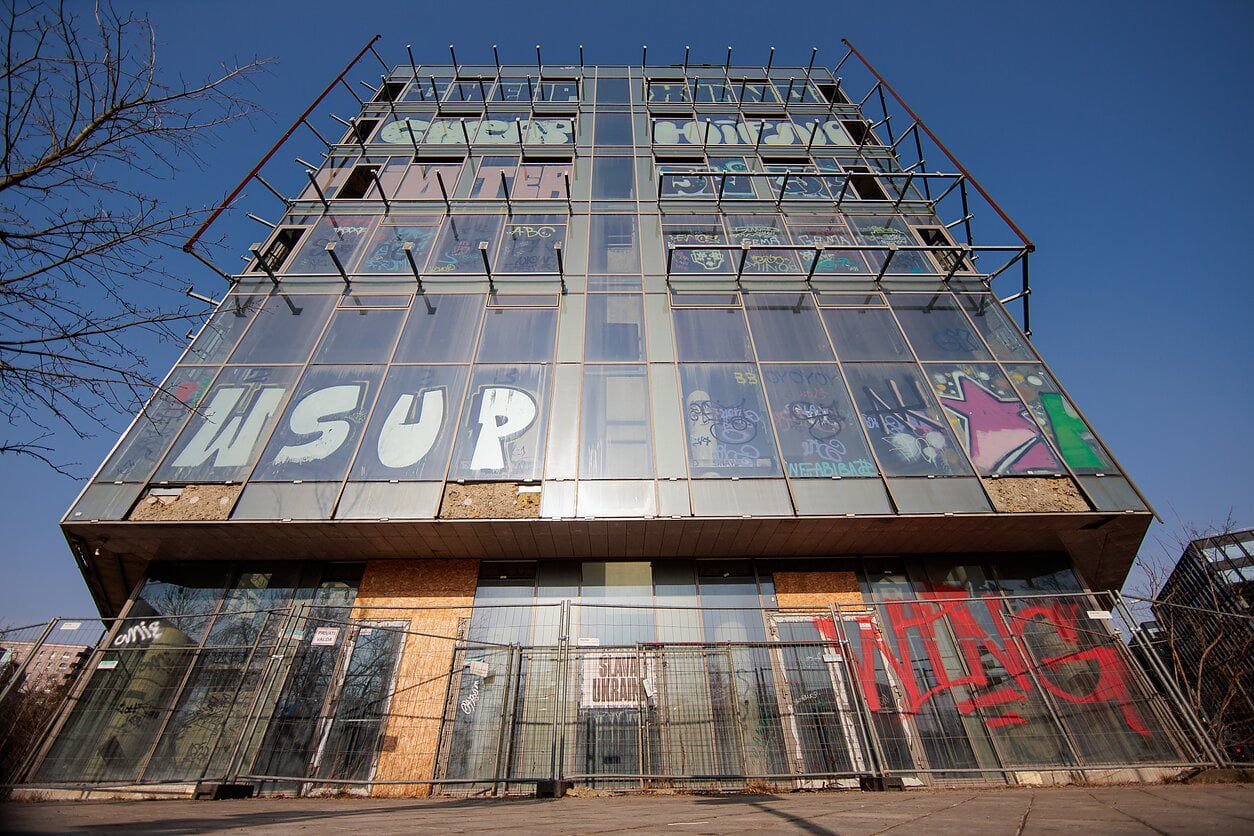
The authorities of Vilnius intend to demolish the unfinished House of Moscow. In the future, a church for the separated Orthodox community, that is, the Lithuanian Exarchate of the Ecumenical Patriarchate, may be built on this site.
This is reported in an article by LRT.
This is not the first attempt to get rid of the building, whose use under the current geopolitical conditions appears impossible. This time, Vilnius Mayor Valdas Benkunskas stated that he would seek ways to overcome bureaucratic obstacles and suggested that construction companies could join the demolition using their own resources and expertise.
To carry out the plan, changes in the law are required, which the mayor intends to initiate by discussing the issue with members of the Seimas.
The Lithuanian Exarchate of the Ecumenical Patriarchate, established after the start of Russia’s full scale war in Ukraine, also hopes for a swift conclusion to the long running demolition saga of the House of Moscow.
Several years ago, an Orthodox community that separated from the Moscow Patriarchate asked to be granted a plot of land in Vilnius for the construction of a church.
“After a long search, it was decided that this location suited them. They would like to build both a prayer house and a community center here. Together with the government and the Ministry of Foreign Affairs, we gave an informal promise. The fact that this has dragged on for years also frustrates them, because on their side a charitable foundation has already been set up and donations are being collected for the future construction, yet the building is still standing,” Benkunskas said in frustration.
Representatives of the Lithuanian Exarchate of the Ecumenical Patriarchate say that there were discussions about transferring this specific plot of land for the needs of the community.
“This would be a very important symbol: on the site of the House of Moscow, that is, a building that was intended as yet another point for spreading narratives of the Kremlin hostile to our country, to build a church independent of the Kremlin and its ideology,” explained priest Vladimir Seliavko, who is also the director of the charitable foundation Lithuanian Koinonia Foundation, which is raising funds for the future church.
However, the priest stressed that so far there have been no promises or obligations from the mayor’s office, and all discussions have taken place only verbally.
At the same time, according to him, although the Russian Orthodox Church in Lithuania consistently distances itself from its connection with Moscow, it possesses both churches and commercial real estate here that generate considerable monthly income.
According to a representative of the Exarchate, the church on the site of the House of Moscow is not expected to be large, unlike other Orthodox churches in Lithuania.
“It will not be like the churches of the Russian Orthodox Church in Lithuania, built with imperial scale, apparently to show who is in charge here,” Vladimir Seliavko assured.
At present, services of the Ecumenical Patriarchate are held in various locations. If the church is built, this will help concentrate the main activities there.
Earlier, we wrote that the Lithuanian Minister of Foreign Affairs stated that the authorities should limit the activities and influence of Russian special services within the structures of the Orthodox Church of Lithuania.
As LF reported, a threat assessment prepared by the State Security Department and the Second Investigation Department under the Ministry of National Defence states that the Orthodox Church of the Moscow Patriarchate plays a significant role in shaping and maintaining “ideological narratives” promoted by the Russian regime.
Earlier, an international conference “Constantinople and Moscow: Transformation of Church Affiliation and the Influence of Imperial Policy” was held in Vilnius. It discussed mechanisms of the instrumentalisation of religion, the role of the Russian Orthodox Church in advancing Moscow’s geopolitical interests, and ways to counter Russian hybrid influence while respecting religious rights and freedoms.
We previously published an interview with Vitalijus Mockus, Chancellor of the Lithuanian Exarchate of the Ecumenical Patriarchate.
An interview with one of the most prominent religious figures of the Ecumenical Patriarchate, Emmanuel Adamakis, can be read via the link.