Estonia’s Internal Security Service (KaPo), in its latest annual report, named clergy and individuals associated with the Russian Orthodox Church whose activities were deemed a threat to national security.
Due to their support for Russia’s aggression against Ukraine and their promotion of the Kremlin’s foreign policy, these individuals have been barred from entering Estonia and the Schengen area, ERR reports.
Last year, Estonia refused to extend the residence permit of a cleric of the Narva Diocese of the Estonian Orthodox Christian Church, which is under the jurisdiction of the Moscow Patriarchate. The individual, a Russian citizen Mikhail Sorokaty, known as the monk-priest Ilya, had been engaged, together with the Russian embassy, in activities aimed at dividing society and promoting historical propaganda. Sorokaty has left Estonia.
Long-term residence permits were also revoked for nuns from the Narva Cathedral, which belongs to the Estonian Orthodox Christian Church. Thus, in 2025, the abbess of the Exaltation of the Cross Jerusalem Stavropegial Convent, Ekaterina Chainikova, and the treasurer of the same convent, Elvira Koroleva, known as the nun Juvenalia, were active in the Estonian Orthodox Christian Church.
The Exaltation of the Cross Jerusalem Stavropegial Convent is directly linked to support for Russian aggression, as it collects aid for military operations and delivers it to the front. However, this is not all. In cooperation with the “People’s Front of Russia,” which is overseen by Sergei Kiriyenko, Deputy Head of the Presidential Administration of Russia, military equipment is also supplied to occupied territories, KaPo noted.
As abbess of the convent, Chainikova, following the example and calls of Patriarch Kirill, supports Russia’s aggression in Ukraine, the Internal Security Service added.
In February 2026, Dmitry Burov, also known as the monk-priest Daniil, who is linked to the Estonian Orthodox Christian Church, left Estonia. He did not conceal that he was unwilling to answer questions from the Estonian state regarding Russian intelligence services and the army. He also refused to assess Russia’s aggression against Ukraine.
Burov had reasons to remain silent. In 2012–2013, he served as head of the department for cooperation with the armed forces and law enforcement agencies of the Amur Diocese of the Russian Orthodox Church.
While in Estonia, Burov was involved in an incident in which, together with his companion Vasily Dyachenko, an archimandrite of the Vladimir Diocese of the Yaransk Diocese of the Russian Orthodox Church, he filmed the territory of a military unit near the entrance and outer perimeter of the barracks of the Taara Kupeljanov Battalion in Võru.
Last year, six clerics of the Estonian Orthodox Christian Church were banned from entering the Schengen area or Estonia on security grounds. This year, one more, Burov, was added.
As reported by LF, Estonia’s Supreme Court, in a public hearing on February 3, considered a petition by President Alar Karis to declare amendments to the Churches and Congregations Act unconstitutional. The Church of the Moscow Patriarchate believes the document is directed against it, while parliament cites national security considerations.
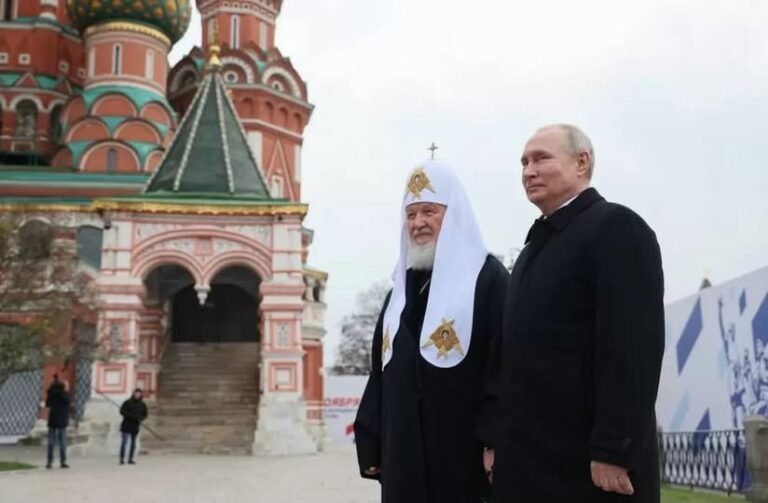
Earlier, Patriarch of the Russian Orthodox Church Kirill Gundyayev stated that in a number of countries, including Estonia, there is allegedly an ongoing campaign against the Russian Orthodox Church.
Although the Russian Orthodox Church considers Estonia part of its canonical territory in its documents, this is not the case from the point of view of Orthodox canon law. This is stated by church historian Priit Rohtmets and specialist in Orthodox canon law David Hutt-Stade.