Catholic bishops have expressed regret over praying with Trump at the White House, saying the meeting was used for political purposes.
This was reported by CRUX.
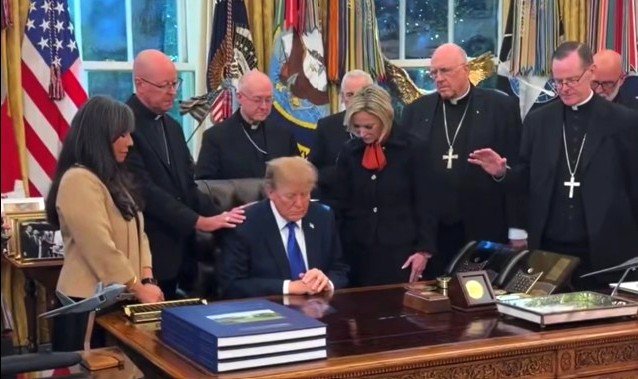
According to the report, two Catholic bishops expressed regret over agreeing to attend a meeting at the White House, during which a photograph was taken showing them praying with President Donald Trump. The photograph was subsequently made public.
Milwaukee Archbishop Jeffrey Grob said in a statement titled “Public Apology” that the White House had promptly released photographs and video footage of the meeting without the participants’ consent, less than two weeks before the midterm elections.
“I feel profound sorrow, not only for the pain I have caused, but also because something so sacred to religious leaders, prayer to our Heavenly Father, was used in this way,” Grob said.
Bishop William Joensen of Des Moines, Iowa, also issued a statement indicating that he believed the White House had exploited the bishops for its own purposes. “I regret that I did not exercise greater discernment and was overly naive, unlike those who used our meeting for partisan political purposes. I pray that I may be more prudent and wise in the future, while remaining steadfast in my commitment to dialogue and prayer for political leaders at all levels,” he wrote.
Asked whether the bishop had consented to the publication of the photographs and video footage, the White House press office declined to answer. Instead, White House spokesperson Taylor Rogers said, “American Catholics have never had a better president than Donald Trump, and his impressive record proves it.”
Members of the U.S. Conference of Catholic Bishops hold differing views on Donald Trump and his administration’s policies. For example, Bishop Robert Barron of Minnesota agreed to serve on the president’s Religious Liberty Commission, which was composed almost exclusively of conservative Christians. Other bishops, by contrast, have strongly condemned certain aspects of Trump’s hard-line immigration policies, arguing that they conflict with Catholic teaching.