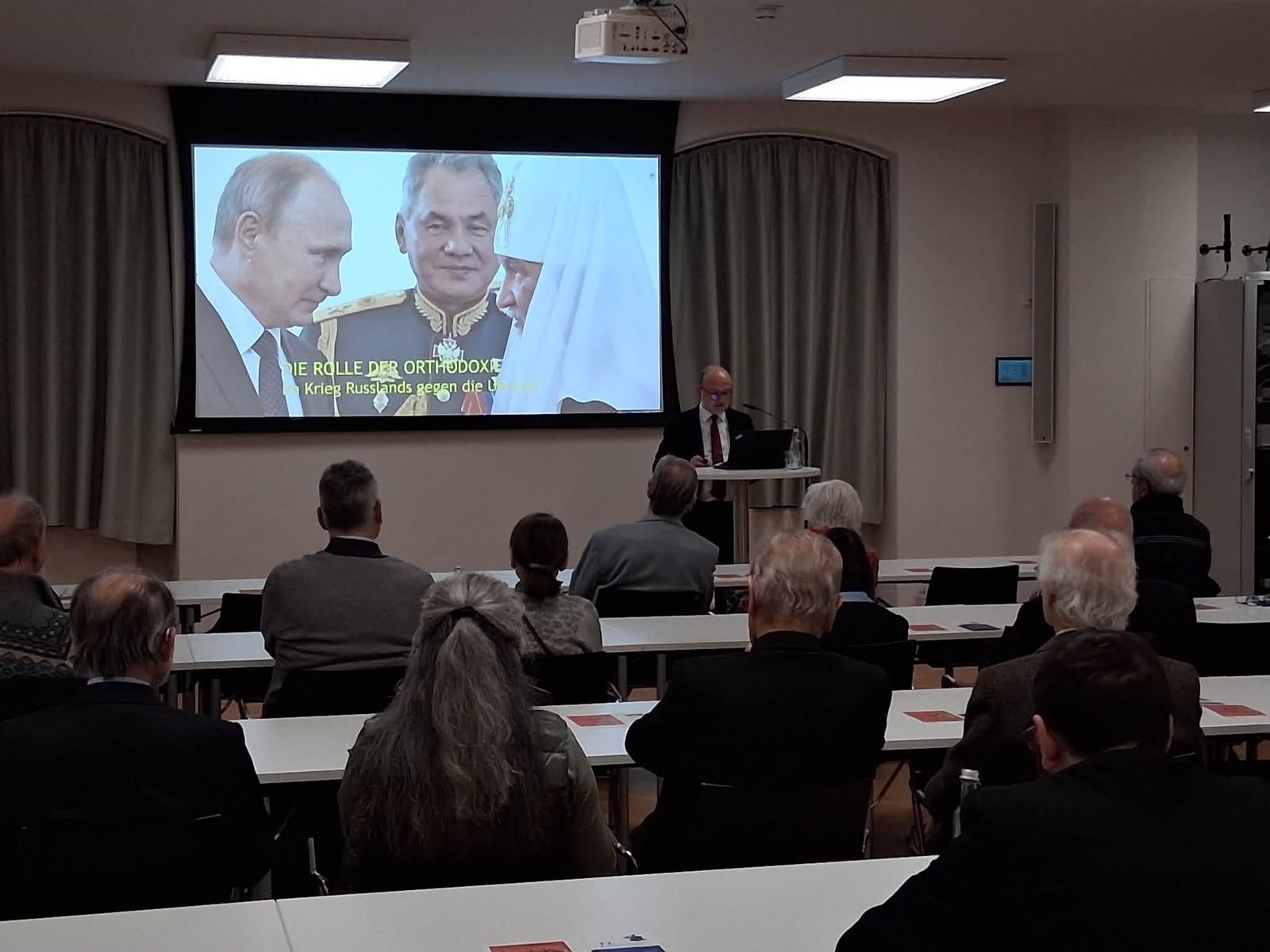
At the invitation of the Albertus Magnus Academic Forum of the Roman Catholic Diocese of Regensburg, theologian Georgios Vlantis, Archon Hieromnemon of the Great Church of Christ, delivered a lecture entitled “Churches in Times of War: The Role of Orthodoxy in Russia’s War Against Ukraine.”
Taking as his starting point Vladimir Putin’s recent interview with Serbian filmmaker Emir Kusturica, the speaker outlined the principal features of the Russian regime’s understanding of its relationship with religion and offered a detailed analysis of the ideology of the “Russian World.”
He then examined Moscow Patriarch Kirill’s position on the war, highlighting his attempts to provide a purportedly metaphysical justification for the war and the distortion of the Gospel message inherent in such a justification. Mr Vlantis drew attention to the newly emerging doctrine of soteriological automatism promoted by Kirill, who claims that Russian servicemen killed in Ukraine go directly to heaven.
The speaker subsequently outlined the network of dependencies and propaganda established by the Russian Church with the aim of systematically undermining the standing of the Ecumenical Patriarchate and Ukraine’s independence, while imposing Russian claims. He spoke of a Russian “ecclesiology of bribery and blackmail,” criticising the Churches of Jerusalem and Serbia, as well as other Orthodox Churches that openly side with Moscow.
Referring to the scandalous liturgical concelebration marking the 80th birthday of Moscow Patriarch Kirill, Mr Vlantis posed the following questions: “How can one preach peace while glorifying a dictator accused of war crimes? What message are the numerous Orthodox Primates sending when they not only fail to utter a single word of criticism of the Moscow Patriarch’s views but also hail him as a model of Orthodoxy? What exactly are they teaching their faithful?”
A substantial part of the lecture was devoted to examining the complex ecclesiastical situation in Ukraine, where Orthodoxy remains far from restoring its unity. The speaker praised the courageous peacebuilding stance of the Ecumenical Patriarchate and Patriarch Bartholomew’s solidarity with the Ukrainian people, as well as the initiatives undertaken by Orthodox theologians to condemn the doctrine of the “Russian World” and restore peace.
He also criticised the Roman Catholic Church and the wider ecumenical community for mistakes made in their relations with Moscow, emphasising the need for a paradigm shift in ecumenical dialogue, with the emphasis moving from an excessive reliance on diplomacy to prophetic witness.
In concluding his lecture, Mr Vlantis remarked, among other things:
“I am ashamed of many Orthodox Primates, yet neither the Church nor the message of the Christian East can be reduced to their words and deeds. I am grateful for those voices among the clergy, theologians and the faithful at large who, over the past several years, have chosen the path of criticism and prophetic witness, reminding us that the Church exists to serve the Prince of Peace, not the Lords of the Darkness of War. The age in which we live is an age of responsibility, both for Orthodox Christians and for our brothers from other Churches.”
The text of the lecture will be published shortly.