A Symbolic Gesture Turned Political Statement
The Russian Orthodox Church (ROC) found itself at the center of public debate after one of its top officials publicly honored a journalist who had reported a young street musician to the authorities — an act that directly contributed to the singer’s arrest for performing opposition songs. While the Church remained silent about the arrest itself, the gesture carried a clear political message: institutional approval of informant culture and state-led pressure on dissent.
Arrested for Street Music
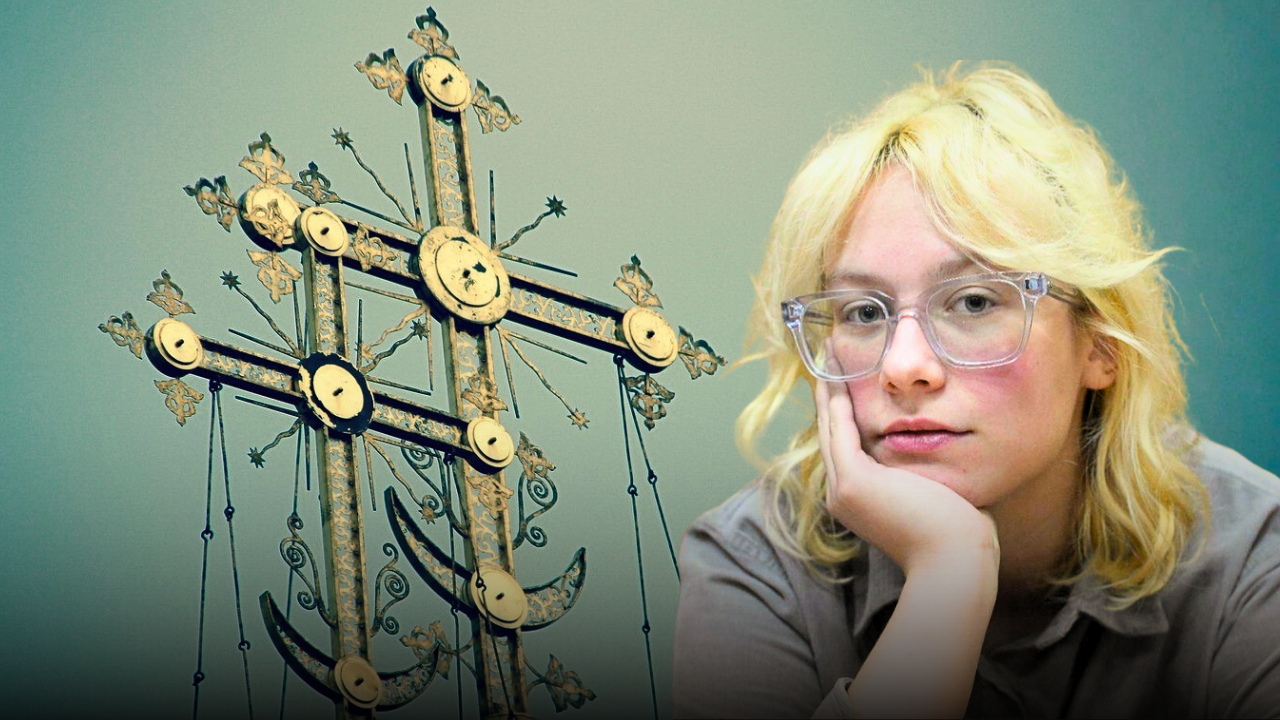
Eighteen-year-old Diana Loginova, known by her stage name Naoko, was detained in St. Petersburg on October 15. The young musician was known for her acoustic performances in city streets, where she sang songs by contemporary Russian artists critical of the Kremlin — many of whom have been labeled as “foreign agents.”
The immediate pretext for her arrest was her performance of “The Cooperative Swan Lake” by Noize MC — a song banned by Russian courts for its criticism of President Vladimir Putin’s regime. Loginova was sentenced to 13 days of administrative arrest for organizing an “unauthorized public event.” Authorities also opened a separate case under Russia’s law against “discrediting the Armed Forces,” which carries potential criminal penalties.
A Denunciation Rewarded
Prior to Loginova’s arrest, journalist Marina Akhmedova — a member of the Presidential Human Rights Council and editor-in-chief of the pro-Kremlin outlet Regnum — repeatedly attacked the young performer online. In at least four Telegram posts, Akhmedova accused Naoko of staging a “political protest disguised as art” and of spreading “dangerous ideas.”
Her posts gained traction in pro-government circles and reportedly drew the attention of law enforcement. Just one day after Loginova’s arrest, on October 17, Akhmedova received an official award from the Russian Orthodox Church. The award was presented by Vladimir Legoyda, head of the Church’s Department for Society and Media Relations, during the ROC’s media forum “Faith and the Word.”
Although the award was formally described as recognition for journalistic excellence, the timing and context left little doubt: the Church’s gesture appeared as a public endorsement of Akhmedova’s stance — and, by extension, of the state’s punitive actions against dissent.
Propaganda and the Manipulation of Perception
The conservative Orthodox television channel Tsargrad added another layer of propaganda to the story. The outlet compared Naoko’s street performances to the 2012 Pussy Riot protest in Moscow’s Cathedral of Christ the Saviour — despite the fact that Naoko had never performed in a religious space or made statements about faith.
More disturbingly, Tsargrad drew visual parallels between Loginova and Darya Trepova, the woman accused of carrying out the fatal explosion that killed pro-war blogger Vladlen Tatarsky. By conflating peaceful street art with violent crime, such media narratives reinforce a dangerous logic in today’s Russia: any form of public expression that deviates from the state’s line is equated with extremism.
Performative Loyalty
The Church’s decision to honor the author of multiple denunciations was more than coincidence — it was a calculated display of loyalty to the state. The ROC’s gesture served as a signal that it not only accepts but actively legitimizes the mechanisms of repression when they align with the regime’s interests. The Church thus positions itself not as a moral or spiritual counterweight to power, but as an auxiliary pillar of the state’s ideological order.
The Fusion of Faith and Authoritarianism
The case of Naoko underscores a deeper transformation within Russia’s religious landscape. Increasingly, the Russian Orthodox Church functions less as a moral institution and more as a participant in the political and repressive machinery of the state. By rewarding an informant instead of calling for compassion or fairness, the ROC reinforces a culture of fear and conformity — the very foundations of authoritarian control.
This episode serves as a stark example of the growing symbiosis between spiritual authority and political power in Russia: a Church that once claimed to be the guardian of moral values now acts as an active agent of the regime’s totalitarian agenda.