When construction began on the Russian Orthodox Church of Our Lady of Kazan in the Swedish city of Västerås, few people outside the local Russian-speaking community paid any attention. Today, however, the church has attracted the scrutiny of Sweden’s security services and has become an example of how religious institutions can be used for political and intelligence purposes.
An Unusual Church
The Russian Orthodox Church in Sweden began showing interest in building a temple in the area in 2012. Despite the fact that Västerås, with a population of 160,000, has only about a hundred members of the Moscow Patriarchate, the land for the construction was nonetheless granted.
At first glance, the church looks no different from other Russian Orthodox temples abroad. However, Sweden’s Security Service (Säpo) noted several peculiarities. The church grounds are surrounded by a high metal fence; several surveillance cameras are mounted on the roof; and the entrance bears a sign reading, “No entry for unauthorized persons.” For a religious building – traditionally open to worshippers – such measures appear unusual.
Questions also arose over the origin of the funds used for construction. According to an investigation by Nordic Defence Review, the key sponsor of the project was the Russian state corporation Rosatom – a strategic enterprise responsible for nuclear energy and closely tied to Russia’s military-industrial complex. Analysts note that this is not an isolated case: through Rosatom and Gazprom, Russia supports a number of religious sites across Europe, reinforcing its cultural and political influence.
A Dangerous Proximity
What worries Swedish authorities most is the church’s location. The building stands less than one kilometre from the runway of Stockholm–Västerås Airport, which is used by NATO forces.
Already at the project’s approval stage, Säpo sent a warning to the Västerås municipality:
“The church is situated too close to a strategic facility. Its tower could be used for observation or the placement of electronic equipment.”
Despite these concerns, local authorities granted construction permission, citing the principles of freedom of religion.
Today, experts identify three potential risks:
- Visual surveillance. The church tower, roughly 22 metres tall, allows observation of air traffic, even though zoning regulations limit structures in the area to a maximum height of 10 metres due to the nearby strategic infrastructure.
- Electronic intelligence. The building’s structure could theoretically accommodate equipment for intercepting airport communications.
- Legal immunity. Swedish law restricts counter-surveillance measures around religious sites, creating a “blind zone” for national counterintelligence.
The Priest in Focus
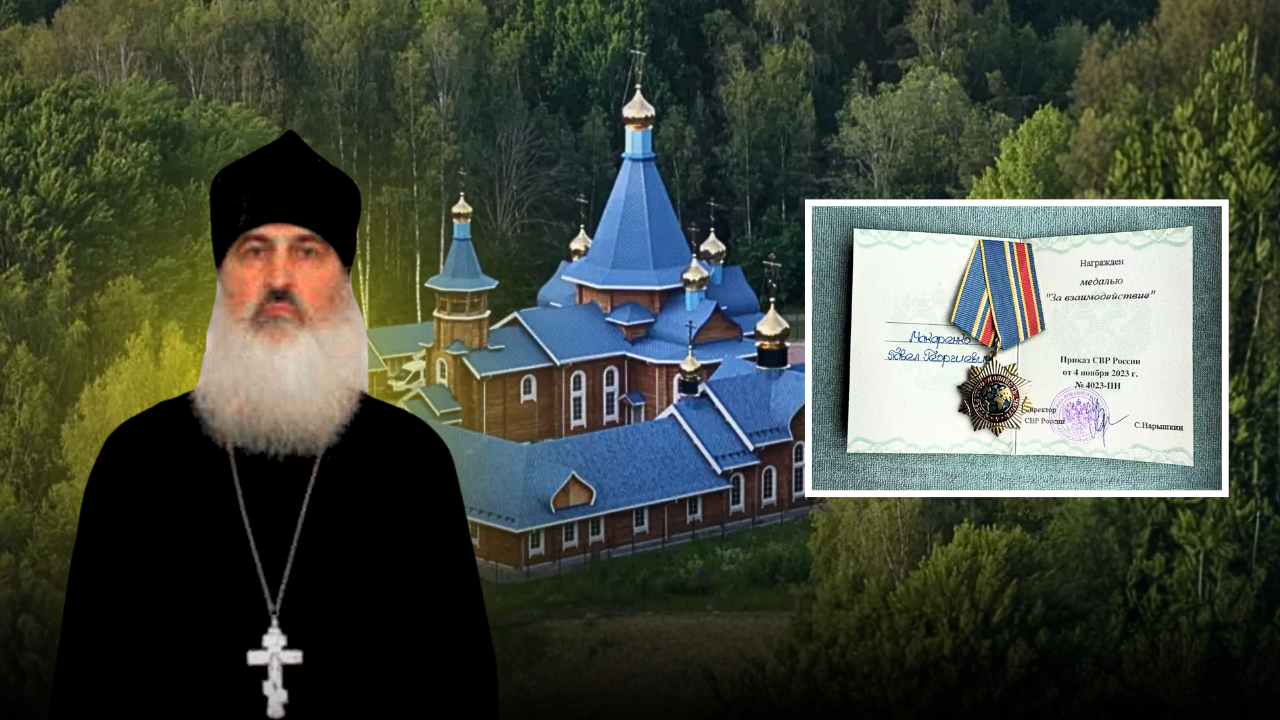
Further attention has been drawn to the biography of the church’s rector, Father Pavel Makarenko, who became embroiled in scandal in 2021. For several years, alongside his priestly duties, Makarenko served as general director of the Russian trading company NC Nordic Control AB. His tenure ended in 2021, when the Stockholm District Court found him guilty of aggravated accounting fraud involving payments for fake invoices issued to firms in Russia and Belarus.
One of the most revealing details in Makarenko’s biography is that in 2023, while still an ordained priest of the Russian Orthodox Church, he was awarded a medal “For Exemplary Service” by Russia’s Foreign Intelligence Service (SVR). This fact has only reinforced suspicions among Swedish authorities that the Västerås church could be serving intelligence functions on behalf of the Kremlin.
In June 2024, the Västerås municipal council unanimously supported an initiative to revoke the land grant for the church and referred the case to the national government for legal review. It was the first instance in Sweden where a religious building was officially recognised as a potential national security risk.
The Church as an Instrument of Influence
A 2024 report by the European Centre of Excellence for Countering Hybrid Threats (Hybrid CoE) stated that Moscow “actively employs the instrumentalisation of diasporas and Russia-linked institutions” as part of its hybrid strategy. The report noted that “through funds and organisations affiliated with the Russian Orthodox Church, Russia seeks to influence political processes and public opinion across Europe.”
Similar cases have been documented elsewhere. In Bulgaria, three Russian Orthodox priests were expelled in 2023 on espionage charges. The Bulgarian State Security Agency (DANS) stated that they had been “conducting activities aimed at advancing Russian interests and influencing the country’s internal politics.” That same year, the FBI in the United States also issued warnings to Orthodox organisations about possible attempts by Russian agents to use churches for recruitment and intelligence operations.
A Broader Context
Since the start of Russia’s full-scale invasion of Ukraine, the governments of Northern Europe have reassessed Moscow’s use of “soft power.” What was once seen as cultural or spiritual diplomacy is now viewed as part of hybrid warfare – a blend of propaganda, business, and religious influence serving the Kremlin’s strategic goals.
The story of the church in Västerås illustrates how the Russian Orthodox Church, in its current form, is increasingly functioning not only as a religious institution but also as a component of the Kremlin’s foreign policy apparatus. Through its network of parishes, humanitarian initiatives, and diaspora connections, the Church has become part of a system advancing Russia’s intelligence and ideological interests in Europe.