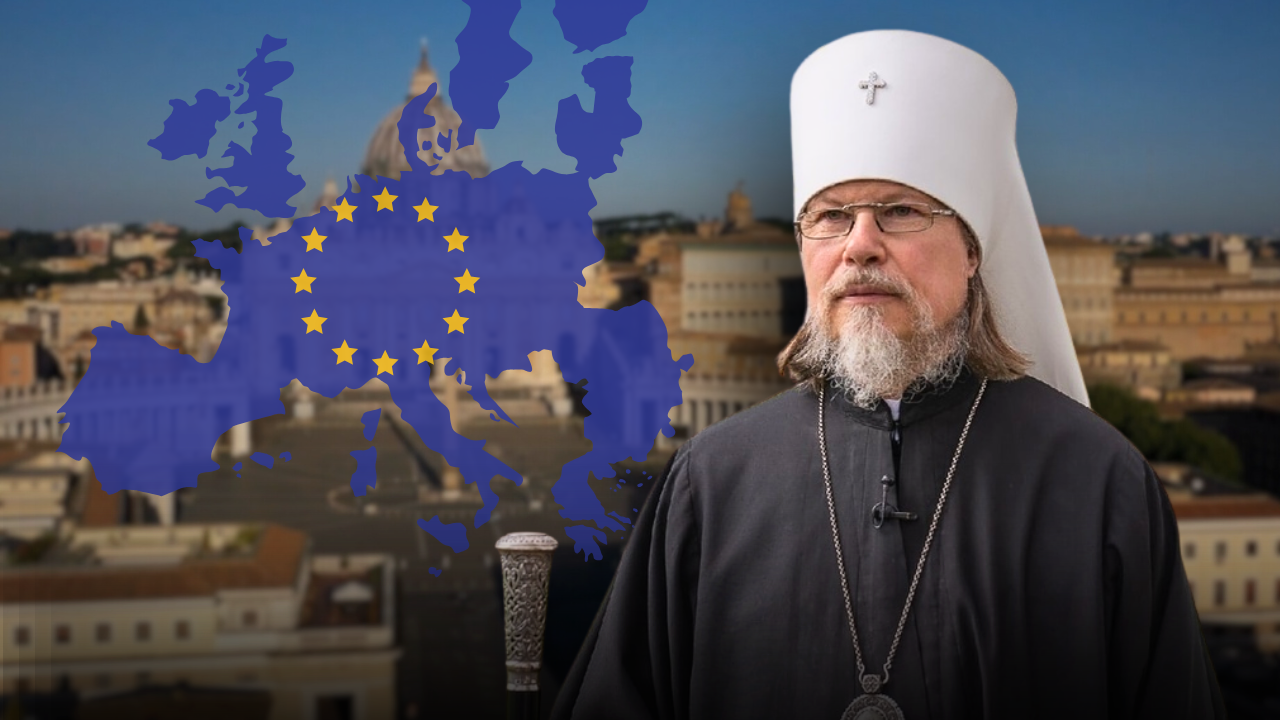
Patriarch Kirill of Moscow (Vladimir Gundyaev) has transferred the administration of the Patriarchal Exarchate of the Russian Orthodox Church in Western Europe to Metropolitan Mark of Ryazan and Mikhaylov (secular name: Sergey Golovkov), who is known for his public statements supporting Russia’s war against Ukraine. The decision has become the most significant personnel change within the ROC in Europe over the past year.
The Appointment and Its Context
In early November, Patriarch Kirill removed Metropolitan Nestor of Korsun and Western Europe (secular name: Sergey Sirotkin) from the leadership of the Patriarchal Exarchate of Western Europe, as well as from the administration of the Korsun, Spanish-Portuguese dioceses and the parishes of the Moscow Patriarchate in Italy. Metropolitan Mark, who had headed the Ryazan and Mikhaylov Metropolia of the ROC since 2015, was appointed acting administrator of all these structures. He assumed his duties in the new post on 12 November.
The appointment drew increased attention, as several previous statements by Mark Golovkov — including his comments on the role of Christians in wartime — had already been the subject of debate among theologians and analysts.
Public Statements by Metropolitan Mark on the War Against Ukraine
The newly appointed administrator of the ROC’s Western European structures, Metropolitan Mark, has been known for several years to regularly promote the justification of Russia’s military aggression against Ukraine.
In February 2023, he stated that under wartime conditions a Christian may violate the commandment “Thou shalt not kill”. In an interview with Russian regional media, Mark emphasised that within the religious tradition “there is a long-standing practice of blessing participation in wars”, and that this “cannot be ignored”.
These words came against the background of a statement by Patriarch Kirill, who had previously claimed that “sacrifice on the battlefield washes away sins”. Commenting on this position, Mark noted: “If a soldier sincerely protects his loved ones and acts out of Christian motivation, then there is an opportunity to ‘cleanse’ certain sins.”
Experts in Christian theology point out, however, that the forgiveness of sins in church tradition is linked to repentance rather than participation in acts of violence. They stress that violence — even in conflict — has no independent “purifying” meaning, which, in their view, places Metropolitan Mark’s statements at odds with Orthodox doctrine.
Public Endorsement of War Crimes
In October 2024, Mark Golovkov endorsed the position of President Vladimir Putin, stating that the decision not to halt the war in Ukraine corresponded to “eliminating the root causes of the conflict”. He described these words as “truly golden”.
“We hear from the country’s leadership that peace is possible only when the root causes of the conflict are eliminated. These are correct words, truly golden words.”
In various public appearances, the hierarch repeatedly emphasised the need for “steadfastness” and “loyalty to the Fatherland”.
Acting as a “Political Officer” for Mobilised Soldiers and the Military
Metropolitan Mark has also taken part in ceremonies connected with the military training of special units of the Russian Armed Forces for further aggression against Ukraine. In 2022, he visited the Airborne Forces training centre in the Ryazan region and participated in a ceremonial gathering marking the formation of a regiment made up of mobilised residents, where he delivered a blessing.
Later, addressing graduates of the Suvorov Military Institute of the Airborne Forces in Ryazan, Mark said: “Turn to God, He is our general; victory comes from Him” and “Where God is, there is victory.”
Attitude Towards Russians Who Left the Country
In January 2025, at the Christmas Readings held in the Ryazan Regional Duma, Metropolitan Mark sharply criticised those Russians who left the country after the start of the war or who do not support the Kremlin’s policies.
“We see, alongside the heroes, a huge number of people, including young people, who live by values different from those of the majority of our people. In 2022, we suddenly discovered that part of the population, and not a small one, left the borders of our Fatherland at the hour of trial, while another part, living here, is in fact alien to the interests of our people.”
The Beginning of Metropolitan Mark’s Career in Europe
Within a week of his appointment as head of the ROC’s Western European Exarchate, Metropolitan Mark took part in several public events in EU countries.
On 20 November, the Russian hierarch, together with Russia’s ambassador to France, Aleksey Meshkov, unveiled a monument to the Russian poet Alexander Pushkin in Paris. The next day, in the town of Altea (Spain), Metropolitan Mark presided over a liturgy and then met with Russia’s ambassador to Spain, Yuri Klimenko. According to the embassy, they discussed the life of Russian-speaking Orthodox communities as well as the “prospects for joint cultural and social projects”. Another topic was the strengthening of ties between the ROC and the Russian diaspora in Western Europe.
Possible Consequences for Europe
Transferring the administration of the ROC’s Western European structures to Metropolitan Mark means that oversight of the Orthodox communities and engagement with the Russian diaspora in key EU states will now be led by a figure who openly supports Russia’s military aggression as morally justified and “defensive”.
For European countries, the presence of Russian religious organisations has already become a subject of scrutiny: in 2024–2025, several states considered potential risks that Russian religious structures could be used as instruments of Russia’s foreign influence. Against this backdrop, the appointment of the new Western European exarch only heightens concerns about risks associated with the ROC’s activities in Europe.