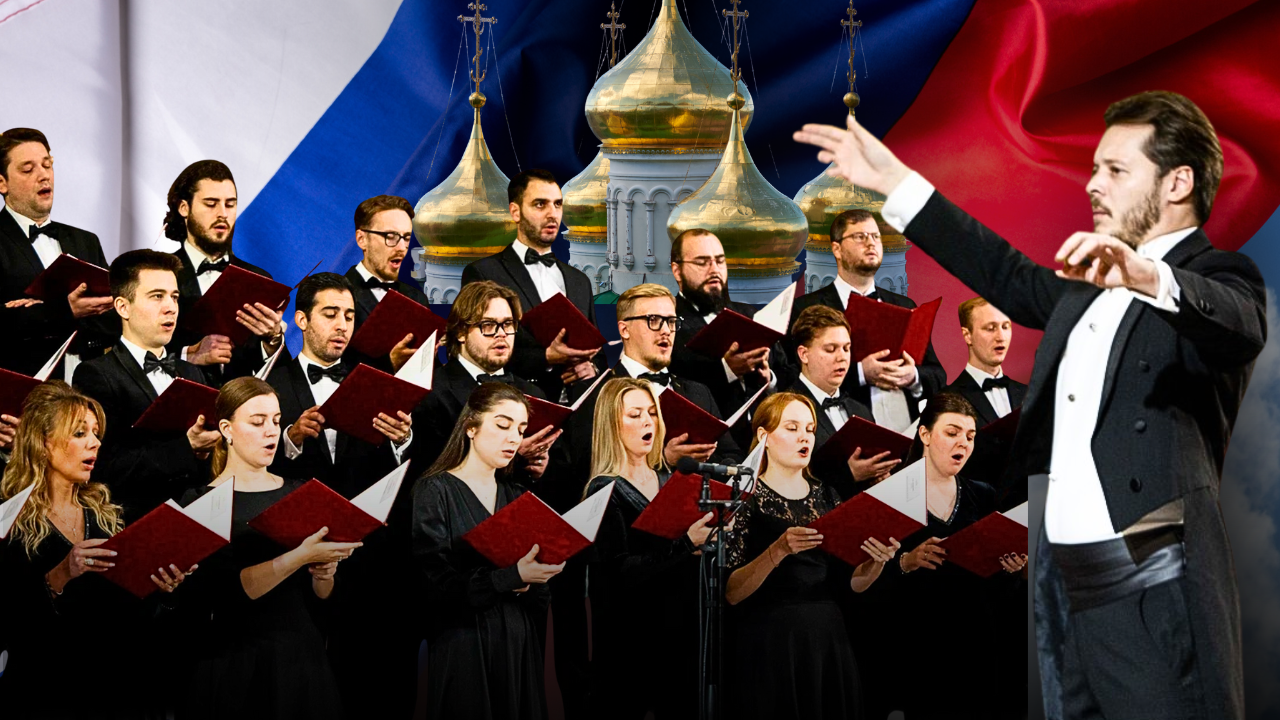
On 12 November 2025, the Moscow Synodal Choir of the Russian Orthodox Church performed in Rome at the Church of St Ignatius of Loyola. The event was presented as part of an international sacred music festival organised by the Fondazione Pro Musica e Arte Sacra.
Russian propaganda media portrayed the Rome performance as a “concert in the Vatican”. On the main Russian state television channel Rossiya-1, the event was even described as a “triumph”.
However, the Church of St Ignatius of Loyola is not a Vatican basilica but a Jesuit church with no direct institutional link to the Vatican. An examination of available sources shows that the only official announcement of the concert appeared on the organiser’s Facebook page, which has around 2,000 followers.
Despite this, Russian state media — including Rossiyskaya Gazeta — framed the performance as a “victory for the Russian world”, “a bridge for dialogue”, and “a symbol of cultural understanding”.
The Moscow Synodal Choir is one of Russia’s key ecclesiastical musical ensembles, closely linked to the Russian Orthodox Church and to Russian state institutions. Its international tours are regularly organised with the involvement of the Russian Ministry of Culture, affiliated concert organisations, and the external relations structures of the Church. As a result, the choir functions not only as an artistic ensemble but also as an instrument of Russia’s cultural diplomacy.
The choir regularly appears at events supporting Russia’s military actions against Ukraine and performs at state and “patriotic” ceremonies.
In 2024, the Moscow Synodal Choir became the focus of public controversy. During the Russian church-public forum “Christmas Readings”, presided over by Patriarch Kirill, the choir performed a piece titled “333”. The lyrics contained direct references to artillery strikes and the killing of Ukrainians:
“…behind the wheel is a ‘ukrop’
rolling across the field in a coffin on wheels,
and beyond that field a former hooligan
precisely adjusts the ‘Smerch’ and ‘Uragan’.”
In this way, the Moscow Synodal Choir — as part of the structures of the Russian Orthodox Church — has taken on a role within Russia’s propaganda apparatus, promoting and justifying the country’s war against Ukraine.
European audiences often perceive such performances merely as elements of routine cultural exchange. However, for the Russian state and for church institutions aligned with it, concerts like the Moscow Synodal Choir’s appearance in Rome serve much more pragmatic purposes: projecting influence, advancing state-aligned narratives, demonstrating a semblance of international support, and using culture as a channel for “soft” penetration into European space as part of Russia’s broader hybrid activity.