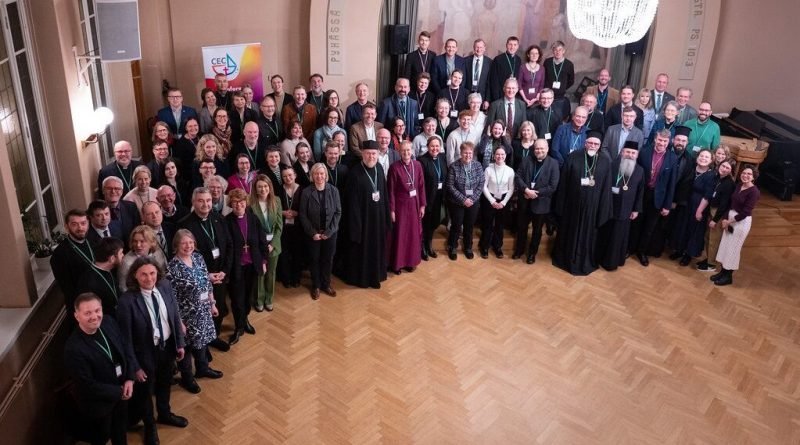
An ecumenical conference entitled “Resisting Empire, Promoting Peace: Churches Confront the Ideology of the ‘Russian World’” was held in Helsinki under the auspices of the Conference of European Churches, which unites Orthodox, Protestant, Catholic and other churches.
The event took place on 1–3 December and focused on contemporary issues related to the spread of the aggressive ideology of the “Russian World” and the threats it poses to EU countries and the entire Christian world.
At the end of the meeting, participants adopted an official statement. In this document, European church leaders for the first time so explicitly described the ideology of the “Russian World” as a threat to the Christian faith and emphasized that it has become the spiritual justification for Russia’s war against Ukraine.
“Fueled by the ideology of the ‘Russian World,’ Russia’s war against Ukraine is simultaneously a military, political, and humanitarian assault that has caused suffering to millions and the deaths of hundreds of thousands of people. At stake are not only the lives of those directly affected but also the common future of Europe, as the war undermines the democratic foundations on which our societies are built,” the statement reads.
According to the participants, the “Russian World” is not a cultural idea but an imperial doctrine that took shape by the 2020s, substituting theology with politics. It presents Russia as a “special civilization” waging a “metaphysical battle” against the West and justifies violence as a defense of “traditional values.” The document emphasizes:
“The ideology of the ‘Russian World’ denies the national identity of Ukrainians and neighboring peoples, as well as their right to self-determination. Relying on a dualistic worldview, it portrays the West — with its emphasis on human rights, democracy, liberalism, gender equality, and individual autonomy — as an evil that Russia must resist in a so-called ‘metaphysical battle’ for the ‘traditional values’ that Russia allegedly protects. The Russian Orthodox Church continues to provide quasi-theological and institutional support for the invasion, thereby suppressing dissent among its own clergy and other members.”
A particularly sharp assessment was given to the theological theses associated with this ideology. Participants called heretical the claims of the top leadership of the Russian Orthodox Church that the death of a Russian soldier “washes away sins,” and that the attack on Ukraine may be considered a “holy war.”
“The ideology of the ‘Russian World’ is a distortion of the Gospel at its very foundation. Every person bears within themselves the image of God — an imprint that cannot be erased, absorbed, or reinterpreted by anyone else. This is the basis of the Christian understanding of the human person: a human being stands before God with an inherent dignity that surpasses nationality, culture, or civilization. No ideology can subordinate this reality to its own purposes. However, the ideology of the ‘Russian World’ preaches hatred and war instead of the love and peace of Christ. For Christians, there can never be a ‘holy war.’ War is incompatible with the teaching and example of our Lord Jesus Christ,” the statement says.
According to the participants, the “Russian World” uses Christian rhetoric to legitimize imperial goals. The Russian Orthodox Church, the document notes, provides the invasion with pseudo-theological justification and suppresses internal dissent.
European churches declared the need for determined resistance to this ideology: to expose the sacralization of power, strengthen theological literacy, call evil by its name, and protect those affected by the consequences of the war.
In the final document, the participants outlined specific commitments and directions that Christian communities in Europe intend to follow in the future to counter the “Russian World”:
Resisting Empire
Confronting ideology, misuse of faith, and propaganda
- Strengthen Ukrainian resistance to the ‘Russian World’ ideology and its devastating consequences.
- Challenge the misuse of faith by the Orthodox and other Churches in Russia, for example, when they declare a ‘holy war.’
- Offer clear and responsible theological reflection on the ‘Russian World’, for example, by demasking the sacralisation of political power.
- Cultivate theological literacy that can recognise and challenge the misuse of religious language, for example, by resisting the temptation to confuse the Reign of God with any given political entity or form of rule.
- Prioritise democratic education and broad community engagement so that people are equipped to resist manipulation such as propaganda and misinformation.
- Name sin as sin, for example, when war crimes are being committed in the Russian war against Ukraine.
Addressing internal church responsibilities
- Reflect critically on one’s own imperial heritage, for example, by addressing distorted readings of the Bible and tradition.
- Strengthen dissident Russian voices, including those resisting religious nationalism and exceptionalism.
Practicing moral accountability and public witness
- Encourage the collection and preservation of testimonies of survivors and of the fallen. The Church has always been a keeper of memory.
- Labour under the constant demands of love in our response to Russia’s invasion of Ukraine, for example, by avoiding dehumanising language.
Promoting Peace
Offering direct support for victims and those affected by war
- Offer hospitality to refugees and support to those displaced by the war in Ukraine.
- Encourage our churches to intercede for the victims of crimes against humanity, for example, for Ukrainian children illegally deported to Russia.
Building spiritual practices oriented toward peace
- Include regular prayers for our brothers and sisters in Ukraine and all places suffering because of war, in our personal lives and in the worship services of churches.
- Pray for those complicit in Russia’s aggression against Ukraine, that God’s grace may lead them to the ways of the Gospel, inspire repentance, and open the path to just peace and reconciliation.
Building a just and reconciled future
- Build up truth-and-reconciliation dialogue between local churches in Eastern and Westen Europe and churches in Russia resisting all forms of religious nationalism, exceptionalism and imperialist concepts.
- Encourage, promote and support non-violent conflict prevention, conflicttransformation and the patient work of reconciliation, for example working on trauma healing.
- Safeguard democracy, for example, by affirming human dignity and human rights.
- Uphold international law, for example, by advocating for the inviolability of international borders.