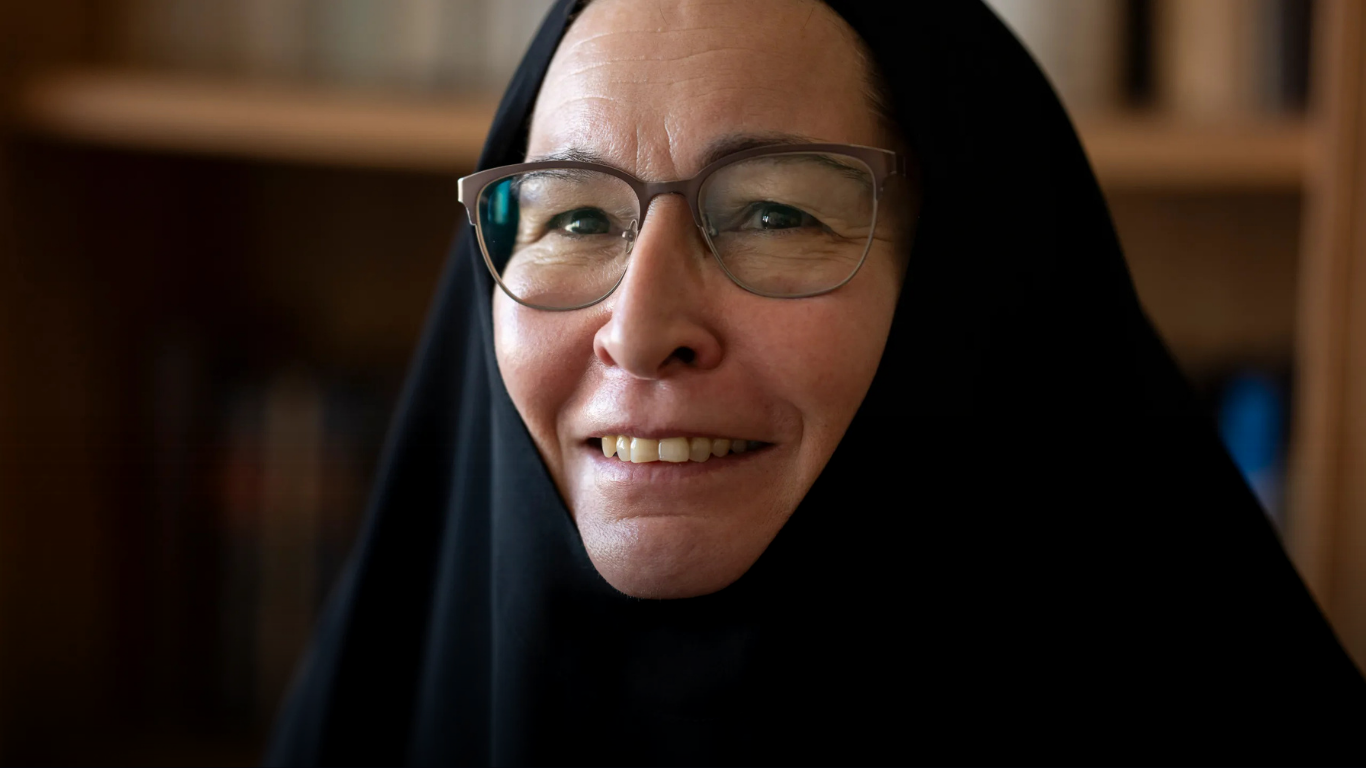
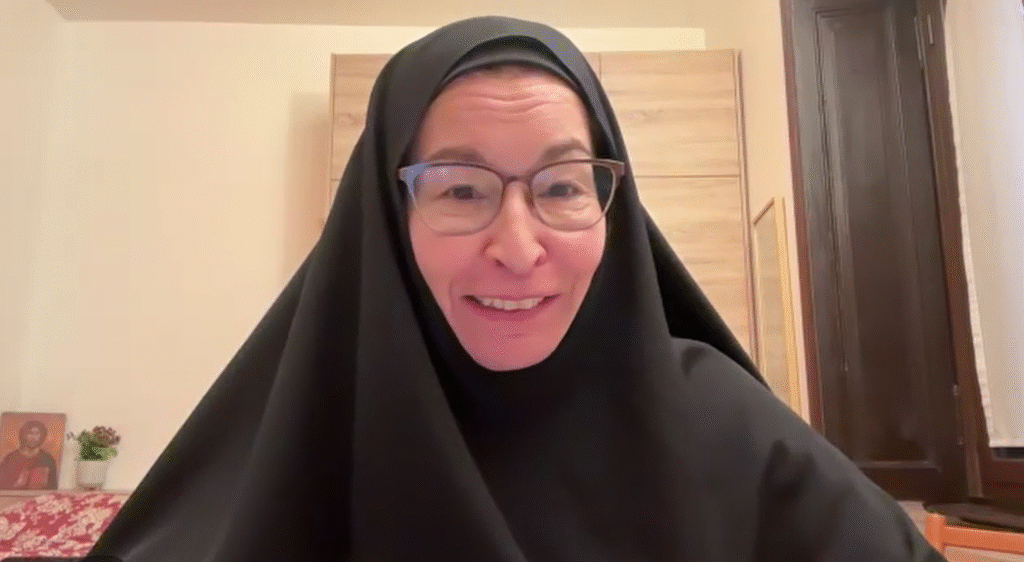
This was the most high-profile departure from the church sphere last year. When Sister Vassa Larin — a nun, scholar, liturgist, and the most recognizable face of women’s Orthodoxy — disregarding all the warnings of the Russian Orthodox Church, embarked on the path of criticizing the heresy of the “Russian World” and Patriarch Kirill Gundyaev. In response, she was banned from ministry.
In our conversation, we speak about her journey, her inner rupture, and the possibility of transformation for the Russian Orthodox Church.
I WAS NOT DEPRIVED OF ANYTHING I NEEDED
— Sister Vassa, when you took the path of criticizing Patriarch Kirill, you lost access to immense benefits. We know how generously and seductively Moscow rewards those who remain its supporters. Against the backdrop of the silence of priests and of certain local churches, this stands out sharply. How does Patriarch Kirill’s position affect the fate of Christianity?
— There is no need to worry about the fate of Christianity. No patriarch can silence the word of God, stop its action, or extinguish His love for us. As for benefits… I was not deprived of anything I needed. And I am deeply grateful to God for everything. These are not empty words. What is unbearably painful for me is that sacred figures, including Patriarch Kirill and part of the so-called clergy, support what cannot be supported, call both war and other things “sacred” — things that in no way can be connected to divine revelation.
That those who clothe themselves in sacred vestments also clothe demonic and anti-human actions and intentions in sacred words.
We must not deceive ourselves: even when it seems that they are winning or triumphing, constructing an image of prosperity and strength through lies, this is not strength. What could be more powerless than such an organization — or even an entire state — that attacks women, children, and civilians?
Much that is associated with Orthodoxy is discredited precisely because of these people. People hear the word “Orthodoxy,” especially those outside the Church, but not only them, and think it is some kind of ideology.
A CHRISTIAN DOES NOT LIVE BY CLOSING FAITH IN A BOX AND OPENING IT ONLY IN CHURCH
— The Russian Orthodox Church strongly preaches obedience and the absence of social activity. Previously, this was considered an ascetic preaching of humility. Now it seems rather a means of cultivating total submission to the authorities.
— There is a way of forcing church people into silence by claiming that the Church is “outside politics.” This is not true; it never has been. An Orthodox Christian — or any Christian — does not live by closing life into some little box that one brings to church and opens only there, then hides or closes one’s faith back into that box. We illumine our thoughts, our intellectual capacity, our emotional life, and our physical being. All our human faculties we strive to transform in the light of our faith.
Every day we must choose a path according to our conscience. This is not always easy. They like to reason as follows: “All authority is from God; your task is to obey.” And the patriarch tells Russian soldiers about some kind of duty and obligation, saying that if they simply obey and fulfill their duty, all their sins will be washed away. A very simple scheme, you understand? “Go, die, kill. I bless you. Now all your sins are removed.” Do whatever you want, because His Holiness has blessed it. Each of us can do something from our own corner to discern where good is and where evil is.
— Is repentance and transformation of the Russian Church possible if it has never undergone a council of purification, serious repentance? It did not repent when Old Believers were killed with its participation; nor in 1917, when it cooperated with Soviet power; nor now, when it blessed the killing of Ukrainians.
— The answer is always: “Yes.” Because repentance is always possible for each of us. We must not be afraid to repent. I do not think that I myself have nothing to repent of. To some extent, I feel responsibility for the “Russian World,” because I did not see and did not fully realize what was happening there. I, too, can say that I was obedient to those who led me. I passed through stages of my monastic life actively participating in the process of the so-called reunification of the Russian Orthodox Church Outside Russia with the Russian Orthodox Church. Behind closed doors, I took part in commissions and meetings with Moscow church officials while all this was being prepared.
I do not want to exaggerate my significance in this process, but I did play some role. My vision, however, was very limited. I was not engaged in politics, as church figures like to say. And yet I feel responsibility for all this “Russian World” disgrace.
I cannot speak of this calmly, because I am both American and Russian. I feel the pain of this situation almost on a physical level. Some of the people I grew up with, who visited my family home, no longer communicate with me and are fully immersed in a Putinist vision of the world. Nevertheless, I am not despondent.
— How do you assess the experience of the reunification of the Russian Orthodox Church Outside Russia and the Russian Orthodox Church?
— Let us clarify: the Russian Orthodox Church Outside Russia is the Russian Orthodox Church Abroad.
This was an experience of canonical unification that took place in 2007. By helping it, representatives of the Church Abroad wanted the experience of the Russian Orthodox Church Outside Russia to flow into the Russian Orthodox Church of the Moscow Patriarchate. I remind you that the Church Abroad had previously criticized very clearly and loudly the cooperation with a godless authority.
Now this experience seems to be forgotten, and we do not hear a clear word — a useful, productive critique of cooperation with the authorities in Russia. We hear that the Church Abroad often criticizes, even engages in lobbying in Washington regarding criticism of the Ukrainian state. But it does not criticize the state of the Putin regime.
It has not said a single word about the torture and persecution of priests in the occupied territories, about churches of other jurisdictions being seized, or Protestant, Catholic, Greek Catholic churches being closed, and so on.
Not a word is heard about the fact that in the Russian Federation people are imprisoned for any criticism of the Putin regime and the war he launched. Gradually, the Church Abroad is becoming Moscow’s church.
I experienced a new attitude from bishops when I took the path of criticizing the war.
— Was it a difficult rupture?
— Yes. At first, I received several emails from the first hierarch concerning my public statements. He criticized minute by minute what I had said in an interview with the Freedom television channel. This was a full year before my final ban. Another hierarch ordered me, before Great Lent, to enter a monastery — without specifying which monastery, where, or how. It was as if someone told you that you must get married but did not specify to whom, how, or why. There were no prerequisites for this. For twenty-seven years I have not lived in a monastery. I have spent half my life in monasticism, and it was precisely a bishop who took me from the monastery to work in the diocese — he sent me to study, blessed my trip to Rome to write a doctoral dissertation. For almost eight years I taught at the University of Vienna. Now I am at the Kyiv Theological Academy. There were no problems with what I was doing when, for years, I was part of the Inter-Council Presence of the Russian Orthodox Church. I did not invent life in the world for myself; due to these various callings, my path was with the blessing of my hierarchs.
This arose precisely because of the topic of Patriarch Kirill’s heresies. When I spoke with Pope Francis, I said that the patriarch’s statements were blasphemy against the Holy Spirit. I said this to the Pope, and later, when a photograph of this appeared, I wrote what I had said. Then a bishop of the Russian Orthodox Church summoned me for a conversation; we spoke in English. We talked for almost three hours. He said that Putin “is a great political leader,” that he is a great political leader — “Führer,” as it is called in German. He said that I misunderstood Patriarch Kirill and misunderstood his words. But unlike that bishop, I speak Russian. I understand what Patriarch Kirill said, because I saw both the text and the video of his address. At that moment, it was about the statement that all sins would be washed away from those who fulfill their “duty,” their oath — meaning the war in Ukraine.
This is an extremely important issue: they manipulate the concepts of obedience, duty, and oath. These are crucial themes. And when a person vested with ecclesiastical spiritual authority manipulates this very powerful place in Holy Scripture, it is like violating a person’s conscience. If a person begins to think that they must act this way because God commands it, this is a terrible manipulation. Especially when it comes from the Church.
But our vocation is to speak when everyone else is afraid to speak, because the dimension of earthly life is not everything. We look forward to the life of the age to come.
It is terrifying when a person is promised that all sins will be washed away and that they need not fear their eternal destiny. When the state and people outside the Church have lost their conscience, or no longer have an inner core, the ability to distinguish good from evil; when the Church itself is no longer the Church but — I cannot find another word right now — a church-like structure, let us call it that, ceases to be the voice of conscience — then where does one go?
But returning to your very first question: yes, they cannot silence the Church. The Church can live, and faith lives. Because each of us is called to be a temple of the Holy Spirit. Thus, the Church is not always embodied in splendid large cathedrals.
Neither the Russian Orthodox Church Outside Russia nor the Russian Orthodox Church guarantees the existence of the Church. The Church is far greater than all of us. It is something founded by Christ Himself.
— Is the Church capable of making politics better — not in Russia specifically, but in any country?
— Of course. We have become accustomed to understanding the word “Church” as meaning “bishop.” This is already incorrect, and we must — however difficult it may be — unlearn this. When we say “the Church does not speak,” “the Church is silent,” or “the Church cooperates,” we mean bishops. That is not the whole Church. So let us be the Church. Let us be the Church. We are not obliged to solve all the problems of the world and of church structures, because that is beyond our power, but let us be the Church.
Do not be despondent. Believe, because Christ is near, especially in such dark times.
Anna Jansone, LF