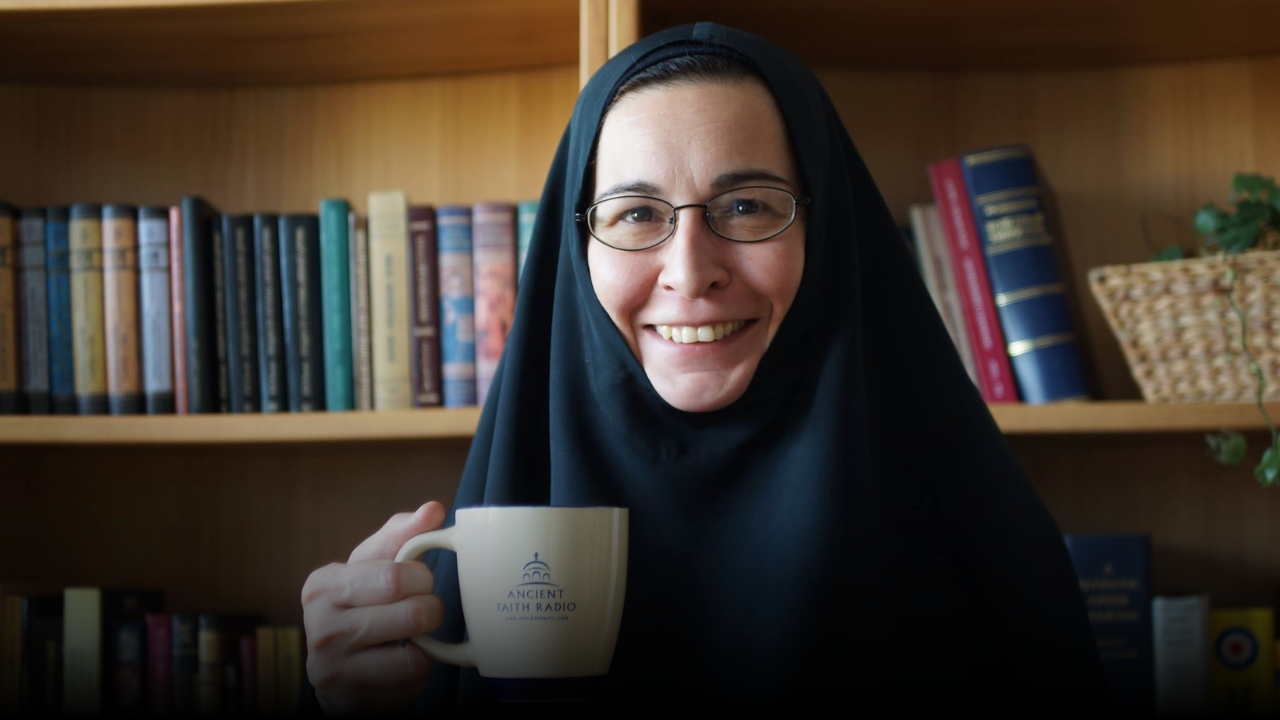
Sister Vassa Larin, a well-known Orthodox blogger and an influential figure in the English-speaking Orthodox community, has been stripped of her monastic status after publicly condemning Russia’s war against Ukraine. The decision was made by the Synod of the Russian Orthodox Church Outside of Russia (ROCOR), which operates under the jurisdiction of the Moscow Patriarchate.
Conflict Between Conscience and Obedience
Nun Vassa Larin, a U.S. native, has taught liturgical theology at the University of Vienna for more than a decade and hosted popular educational programs on Orthodoxy on her YouTube channel. After Russia’s full-scale invasion of Ukraine in 2022, she openly spoke out against the Russian military aggression, saying she considered the Church leadership’s stance “spiritually disastrous.”
“Some people like to say, ‘It’s all politics — we just need to pray and not pay attention; it’s not our concern, nothing depends on us.’ But when the war began, I had to speak out against those voices in the Church that supported the aggression.”
According to Larin, it was precisely her anti-war stance that led to the decision to revoke her monastic status, officially described as an “act of disobedience.” Her bishop, Luke Murianka, vicar of the Eastern American Diocese of the Russian Orthodox Church Outside of Russia, demanded that she cease all public activity and completely withdraw from social media — in effect, to remain silent. When the nun refused, she was expelled from her community. The ROCOR Synod later confirmed this decision.
Criticism of the Moscow Patriarchate
Sister Vassa has repeatedly spoken out against the rhetoric of Patriarch Kirill, head of the Russian Orthodox Church, who in 2022 called the war a “sacred mission.” In her writings, she argued that such statements “distort Christian teaching” and turn faith into an instrument of ideology:
“There now exists an unnatural union of Putinism and Orthodoxy — this is a distortion of faith, a heresy. Through a poisonous ideology, we are taught a concept of obedience that turns people into slaves who must submit to any authority.”
Larin also wrote that the concept of the “Russian World,” actively promoted by some clergy, contradicts Gospel principles. According to her, Patriarch Kirill “publicly preaches heresy that kills, because it is an inhuman doctrine — it distorts the notions of good and evil,” and that “this must have consequences under canon law.”
A Symptom of a Broader Trend
The defrocking of Sister Vassa marks part of a wider trend: an increasing number of Orthodox clergy in Russia and abroad have faced sanctions for criticizing the war.
A study by the Center for Orthodox Christian Studies at Fordham University reports that over the past two years, more than 70 priests in Russia have faced disciplinary measures or suspension from ministry for anti-war statements.
However, according to Larin, “this is the first known case in which a Russian church structure extends its punitive practices to Orthodox figures in the United States.”
The story of Sister Vassa Larin stands as both an example of personal integrity and a reflection of broader processes in which religious institutions influenced by Moscow are increasingly becoming mouthpieces of its aggressive ideology. The incident also highlights the growing authoritarian tendencies within the Russian Orthodox Church and its leadership’s readiness to use repressive measures against voices of conscience who refuse to align with the Kremlin’s aggressive policies.