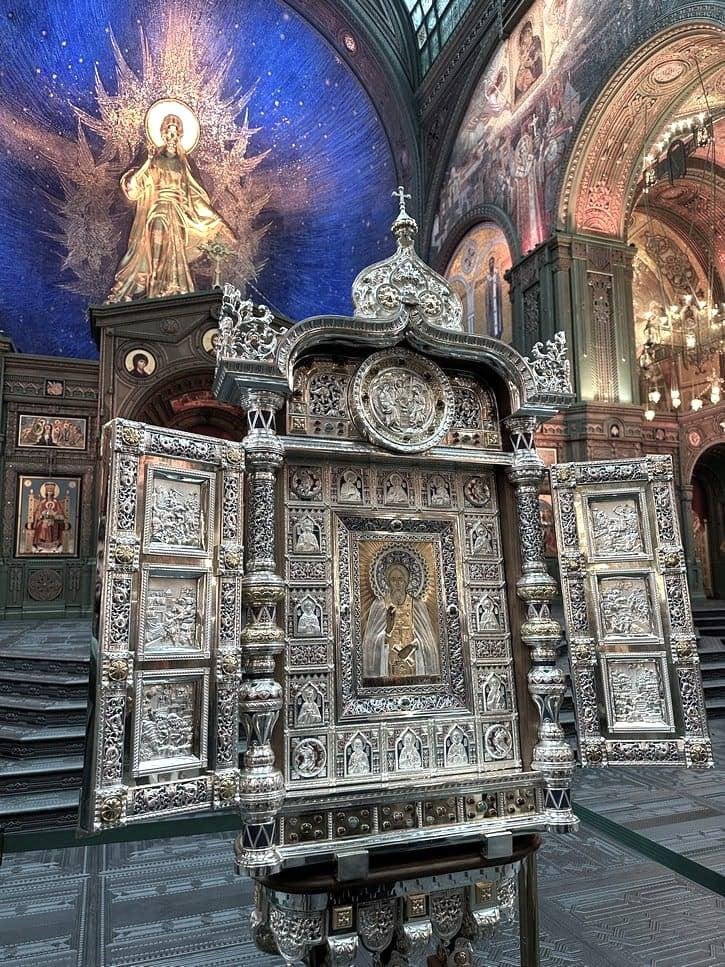
The Secretary of Russia’s Security Council and former Russian Defense Minister Sergei Shoigu presented to Russia’s main cathedral of the armed forces a “unique” portable iconostasis 2.5 meters high, produced to his personal order.
This was reported by Golos Kryma.
At the center of the composition is the image of the “hegumen of the Russian land,” Sergius of Radonezh, who blessed Prince Dmitry Donskoy, also canonized by the Russian Church, for the Battle of Kulikovo.
The composition also marks six battles and events from different periods that are commemorative for Putin’s Russia: the Battle on the Ice (1242), the Battle of Poltava (1709), the French invasion of Russia of 1812, World War II, referred to in Russia as the “Great Patriotic War,” the Annexation of Crimea by the Russian Federation in 2014, and the full scale war against Ukraine launched in 2022.
“This is our offering to the cathedral. In fact, it is our family icon. We worked on it for a year,” Shoigu said. He was the author of the idea to create the iconostasis.
As is known, the main cathedral of the Russian armed forces, another well known name is the Patriarchal Cathedral in the name of the Resurrection of Christ, is a temple of the Russian Orthodox Church located in the Odintsovsky Urban Okrug of Moscow Oblast on the territory of Patriot Park. It is dedicated to the 75th anniversary of the victory over Nazism in World War II and also to the “combat feats of the Russian people in all wars.” Construction was completed on May 9, 2020, and the consecration took place on June 14 of the same year.
Earlier, LF wrote about how Russia used religion to prepare the invasion of Ukraine.
As LF previously reported, images of participants in the “special military operation,” meaning the invasion of Ukraine, appeared in one of the churches of the Russian Orthodox Church.
Earlier we also wrote about how the Russian Orthodox Church provides church premises for training by military youth clubs.
As LF reported, the annual XXXIV Christmas Readings were held in Moscow at the House of the Russian Army, and the audience consisted of military priests of the Russian Orthodox Church. Russian journalists who follow the Christmas Readings have called them church staff exercises and write about the constant militarization of this forum of the Russian Orthodox Church.