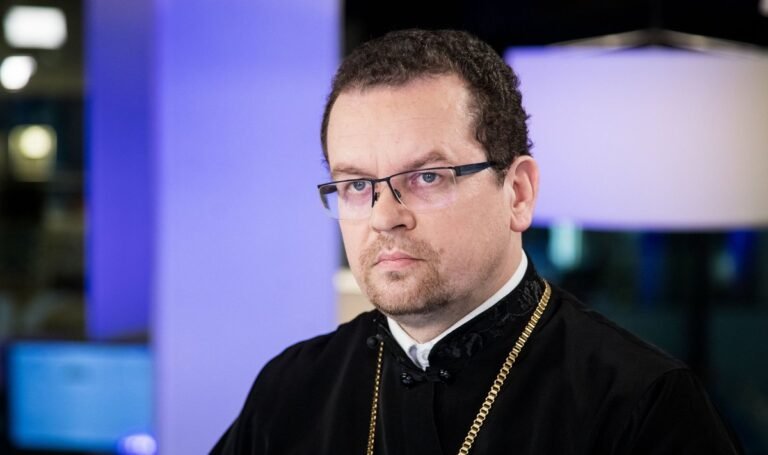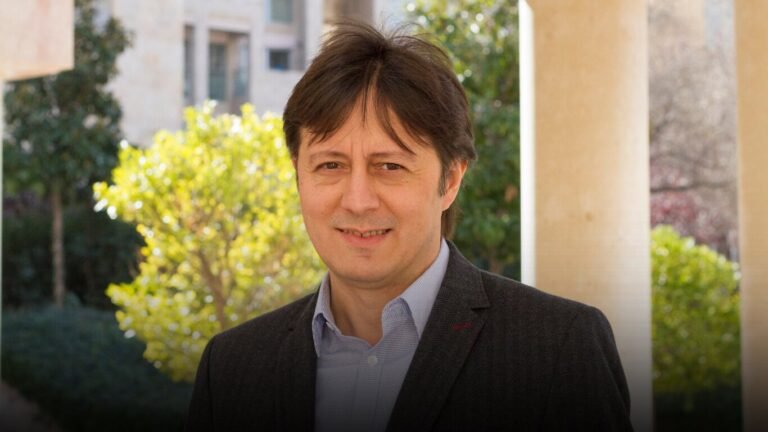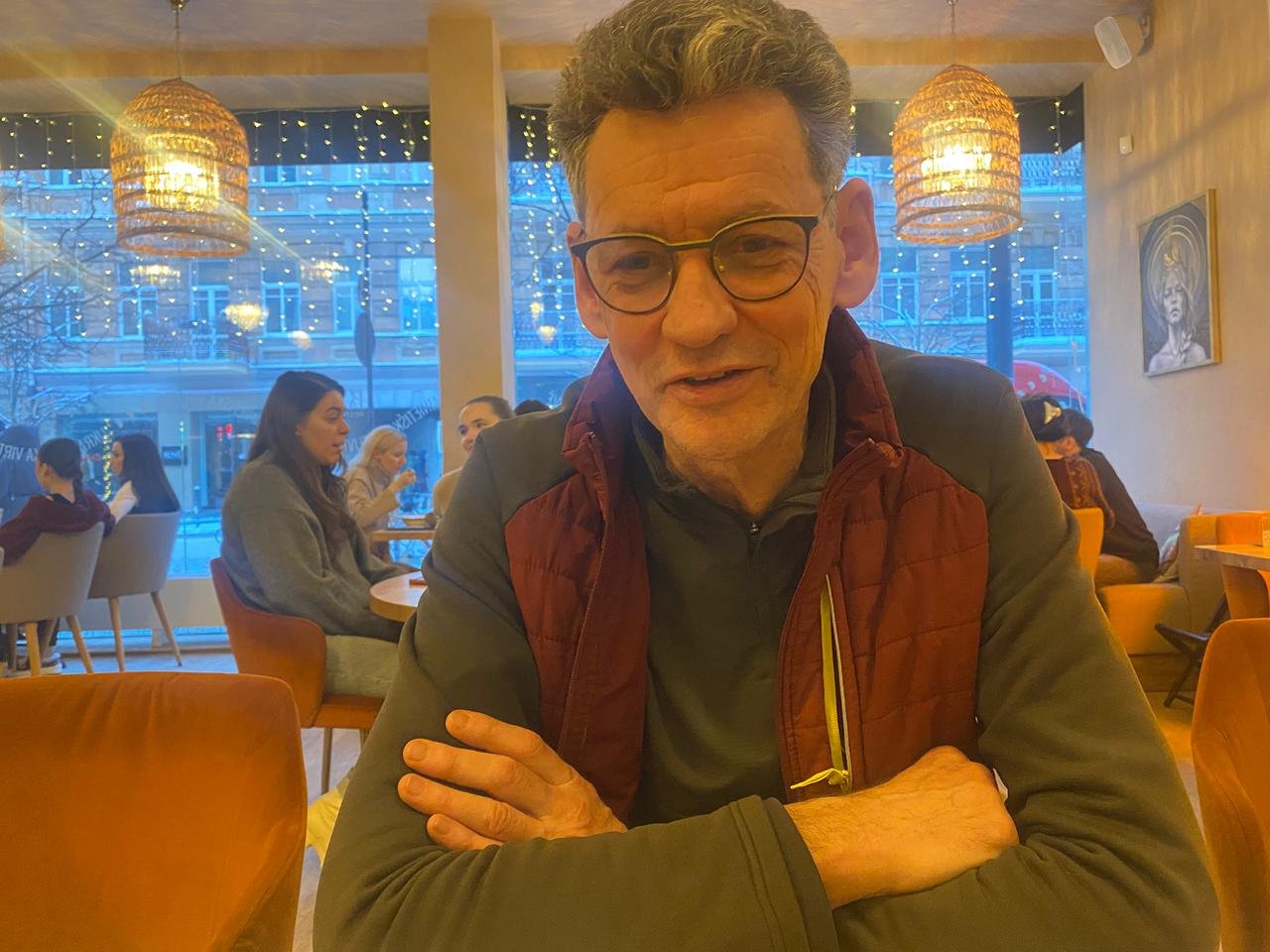
The popular Lithuanian outlet Delfi published a conversation with a signatory of the Act of the Re-Establishment of the State of Lithuania, former Member of the European Parliament Arunas Degutis, who is a deep expert on the religious issues of his country. With the author’s permission, we republish the text.
Arunas Degutis remains an active participant in public life today, including as a member of the Lithuanian Riflemen’s Union. Against the backdrop of intensifying debates around the Orthodox Church, we spoke with Arunas Degutis, a man who knows both the Orthodox and the Catholic traditions well.
Arunas Degutis is one of the founding fathers of independent Lithuania, the term used for Lithuanian deputies who in 1990 signed the Act of the Re-Establishment of the State of Lithuania, and a former Member of the European Parliament. He is now an active member of the Lithuanian Riflemen’s Union. Incidentally, all members of the signatories’ club, even though most are elderly, have completed basic military training required in the event of a possible invasion by the eastern neighbor. As the church issue is becoming increasingly resonant, we decided to ask Mr. Arunas several questions, especially since he knows both Orthodoxy, he even sang in the church choir of an Orthodox church in Vilnius, and Catholicism.
— Mr. Arunas, first of all, tell us how you ended up in an Orthodox church choir?
— I came to the Orthodox Church as part of my spiritual search. Since 2006 I have been to Mount Athos three times. I visited various monasteries, including the Panteleimon Monastery.
— But this monastery is considered pro-Russian on the Holy Mountain.
— Back then I only saw the early signs of the “Russian world,” which later blossomed. It was there, incidentally, that I bought the anonymous book series “Project Russia.” Read it. It speaks about the inevitability of a global crisis and salvation in “Russian Orthodoxy.” My friends and I even argued about why Russians have such an identity crisis. Perhaps the problem is that “Russian” is not a noun but an adjective. They lack a substantive identity and are in an endless search for authenticity, so at one time they are Bolshevik Russians, at another Orthodox Russians. The empire collapsed, the Soviet Union collapsed too, and they did not understand what to do or who they were becoming. Then Putin latched onto Orthodoxy to give Russians at least some identity, “a Russian is a Christian, a fighter for traditional values,” to give them something to hold onto in their search for identity and then use it exclusively for his personal interests. For him, Orthodoxy is a way to manipulate people. I drew this conclusion after reading that book and listening to popular Russian political strategists.
They believed that the “Project Russia” series had been written on commission from the Leningrad KGB. The authors’ names were omitted so the discussion would not turn into criticism of the writers themselves. When I was in the European Parliament, I spoke with Father Antony, who represented the Russian Orthodox Church in EU institutions. When we became friends, he said not everyone understands the power of the Russian Orthodox Church in spreading the “Russian world.” But, as far as I know, he later left it. Now it is easy to imagine, seeing what they are doing in Ukraine, or in Africa, where they have moved in and simply buy priests. There is no such thing as a church called the Russian Orthodox Church. In my view, it is a ministry of cults for spreading ideology in order to continue expansionist policy.
But returning to myself, although I am not Orthodox, I liked the Eastern liturgy. I sang the liturgy in Lithuanian. Services in the Church of St Paraskeva were conducted in Lithuanian. I was not the only one, he laughs. If you know, one of the Gediminids, Grand Duke Algirdas of the Grand Duchy of Lithuania, was married to a Russian princess. He is known to have built Orthodox churches. One of them, St Paraskeva, was built by his wife. That is where I sang. I enjoyed singing in the church choir. I liked Orthodoxy and its chants in general.
When we proclaimed independence, we returned all their property. Even today we pay money from the Lithuanian budget to support traditional religious communities. Despite all the pain and suffering that the Russian people brought to Lithuania during the last occupation, the independent Lithuanian authorities showed an example of tolerance and friendliness, respecting the right of Russian-speaking citizens to preserve their traditions and practice their religion. All property confiscated in communist Russia from Orthodox believers was returned. It became a source of pride. We became a truly democratic country for everyone. However, real trials revealed complex moral dilemmas. In 2022, when Russia again invaded Ukraine, five Orthodox priests openly sided with Ukrainians and condemned the aggressor. Metropolitan Innokentii initially supported their position but soon abruptly changed his mind and, apparently under pressure from the Moscow patriarch, not only suspended the priests but also defrocked them.
All these priests lost their livelihoods and were forced to work low-paid jobs, including driving taxis. All this for daring to say no to a fratricidal war, and I consider them martyrs for the faith. The claim that the Lithuanian branch of the Russian Orthodox Church is not under Moscow’s influence is clearly false. The worst thing is that everything is done under the cover of Christianity, spirituality, and love for God. Defrocking and persecuting those who oppose aggression is not merely a mistake but a deeply sinful choice by the church leadership. It is a situation where faith is used to justify killing brothers and sisters of the same religion.
One of the greatest advantages of Catholicism is the ability to question any statement, including the words of the highest clergy. After death, one cannot justify oneself before God by saying, “I blindly obeyed the priest.” Everyone answers for their own decisions. God gave a person both heart and mind, and it is by their choice that judgment will be rendered. He is not a prosecutor at a Nuremberg trial, and it is impossible to hide behind arbitrarily interpreted rules.
God judges intentions and the call of the heart, not words of justification. When a representative structure of the Ecumenical Patriarchate of Constantinople appeared in Lithuania, we rejoiced, hoping that Russian-speaking Orthodox believers could choose for themselves whom to commemorate in prayer, Kirill, Gundiaev, who justifies aggression, or someone who condemns fratricidal war. Unfortunately, most chose the side of the aggressor despite Lithuanian citizenship, access to all democratic achievements, and privileges unavailable to citizens of Russia.
How can this behavior be justified? It is not my place to moralize, but to put it mildly, it is improper, dishonest, and deeply regrettable. True faith is shown not in words but in actions, even if it requires the courage to go against pressure and risk. Estonia raised this issue long ago and expelled the head of the Russian Orthodox Church. Here, when the local head of the Moscow Patriarchate’s residence and work permit expired, our authorities extended it. Estonia refused to extend the residence permit of Metropolitan Evgenii Reshetnikov because his public actions and statements were incompatible with national security interests. My friends and I from the signatories’ club ask why the Lithuanian metropolitan’s permit was extended.
Only because he is more cautious in his statements? Metropolitan Innokentii worked in France and other Western countries and has skills, as he says, in multilateral church diplomacy, yet at the start of the war he declared his position on Ukraine. But it went no further than words. By decree he defrocked former clerics of his diocese who demanded a complete break with Moscow.
There are rumors about his friendship with our minister of justice. Russia exploits the rhetoric of “traditional values” while waging a war of conquest. And the only pro-Russian organization in Lithuania is the Russian Orthodox Church. There are no others left. They enjoy the benefits of democracy, have rallied around the church, and receive support from the budget.
— Why do people, clergy and believers, remain in the Russian Orthodox Church? Are they afraid of change? Do they not understand that they are part of a church totalitarian machine?
— They live in self-deception in order to do nothing. The ability to change requires work. The clergy, even if they are not full carriers of the “Russian world,” psychologically cannot break away from the Moscow Patriarchate because it is tradition, environment, and likely various forms of Moscow support. This passivity and unwillingness to change leads them to justify Russia, to resort to neutral formulas such as “we are for peace, we feel sorry for everyone.” It is a form of soft conformity, not out of bloodthirst but simply out of fear. Just admit that because of Russia, Orthodox believers in Ukraine are killing other Orthodox believers. When I sang in the choir, I invited an old friend and he even converted to Orthodoxy. After the war, after 2014, he told the rector during confession, “I cannot listen to Kirill being commemorated during the liturgy.” He left the church. And this is not an isolated case. I see that Moscow is working. They are trying to create the appearance of a fictitious majority in Lithuania in order to draw others in, to present themselves as a force, so that people with an uncertain church identity will join the majority. It is manipulation aimed at increasing the number of Orthodox believers at the expense of Ukrainian refugees. They want all Russian speakers living in Lithuania to become part of the Moscow Patriarchate. Russia invests a lot of money in this. I understand how and at what levels informational support for the church in Lithuania operates. Our country is only beginning to understand these mechanisms. But we are not just failing to dominate. We are not even taking countermeasures or initiative in working with the Orthodox, on our own field. And I, as a member of the signatories’ club, try to prove that if we lose the information war, we will lose everything. Neither tanks nor armored vehicles will help if the church steals the hearts of our people. Now two structures are represented in Lithuania, the pro-European Ecumenical Patriarchate and Moscow. We must expose all the heresy and crimes of the Russian Orthodox Church so that remaining in this structure becomes impossible for a baptized person. But those loyal to the Moscow Patriarchate are easily deceived. For many years religion has been woven into ideology so subtly that ordinary people cannot distinguish one from the other. Yet we are a free country, a member of the EU, providing information and every opportunity to develop critical thinking. One must distinguish true spirituality from “spirituality” into which chauvinism and the idea of great-power domination have been woven. They have become so simplified that they say one thing, do another, and understand a third. Moscow Orthodoxy, with its preaching of submission and the absolutization of obedience, is especially convenient for manipulating people. But one must think. Even on Mount Athos there is a prayer. When a monk begins to pray and temptations approach, he asks God for mercy to show him whom he is dealing with. They fear a subtle form of pride and pray, “God, let us know whom we are dealing with.”
Millions of Russians cannot understand whom they are dealing with when they go to kill Orthodox Ukrainians or support those who kill Orthodox believers. At the same time, we must find legal and democratic ways to fight them. We must defend freedom and democracy, but not at the cost of democracy itself. I do not consider loyal to our state those who use the benefits of our democracy and for the fourth year remain in the Moscow Patriarchate. If they are not loyal to Lithuania, then they are loyal to someone else. And this “someone else” hides behind the so-called canonical space of the Russian Orthodox Church. During a church conflict a believer cannot choose a third side. It simply does not exist. One must choose between two. Let us pray.