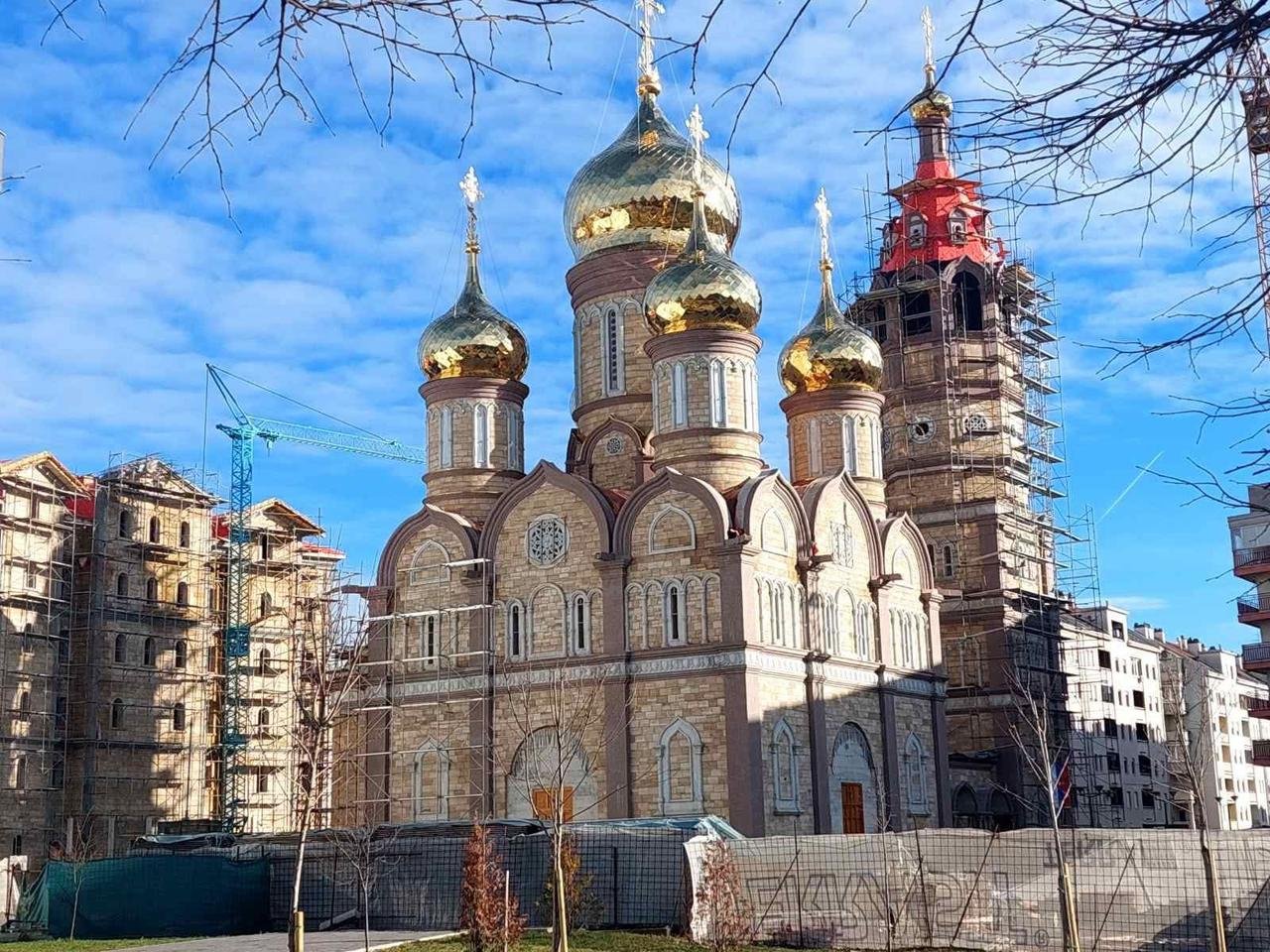
Construction of an Orthodox “Russian-Serbian” church in the capital of Banja Luka, Republika Srpska, has been ongoing for eight years. The Bosnian Serb authorities promote the project as “historic for bilateral relations”. Among the initiators is the Imperial Orthodox Palestine Society, headed by former chief of the Federal Security Service Sergey Stepashin.
This is reported in a feature by Radio Svoboda.
The work is being carried out by the Diocese of Banja Luka with financial support from the government of Republika Srpska. Construction of the cathedral began in 2018. The church is designed as a copy of the Chudov Monastery in the Moscow Kremlin, which was demolished after the Bolshevik Revolution. During the project presentation it was announced that the cathedral would be dedicated to the Romanov dynasty and to the last Russian emperor, Nicholas II of Russia, as a sign of gratitude to Russia for supporting the Serbian people during the First World War. The building is being constructed according to a design by the Moscow Architectural Institute, with both Russian and local craftsmen carrying out the work.
At the beginning of 2019 the cathedral was included among budget priorities, and it was then announced that the work would be completed within 18 months. That deadline has already been postponed twice, ahead of the parliamentary elections in 2022 and 2024.
The church and an accompanying cultural center are being built in central Banja Luka, near the government building of Republika Srpska, on a plot of about 6,500 square meters. The cultural center is intended for the study of the Russian language and for organizing programs related to Russian culture. The initiators of the project were the Diocese of Banja Luka and representatives of the humanitarian organization Imperial Orthodox Palestine Society, headed by Sergey Stepashin, a former prime minister of Russia and former head of the Federal Security Service.
The cathedral remains one of the budget priorities of Republika Srpska, while other infrastructure projects in Banja Luka are still awaiting funding.
Several years ago, at the initiative of the Imperial Orthodox Palestine Society, a bust of Nicholas II was installed in central Banja Luka. Another bust of the last Russian tsar stands near Doboj, a town in the north of the republic. It was unveiled in 2017 at the initiative of the Association of Serbian-Russian Friendship and Unity of Orthodox Peoples and with the support of the Embassy of Russia in Bosnia and Herzegovina.
Russia provides active support to Milorad Dodik, until recently the president of Republika Srpska, who does not hide his separatist views. Since the start of Russia’s full scale invasion of Ukraine, Dodik has met nine times with Russian President Vladimir Putin.