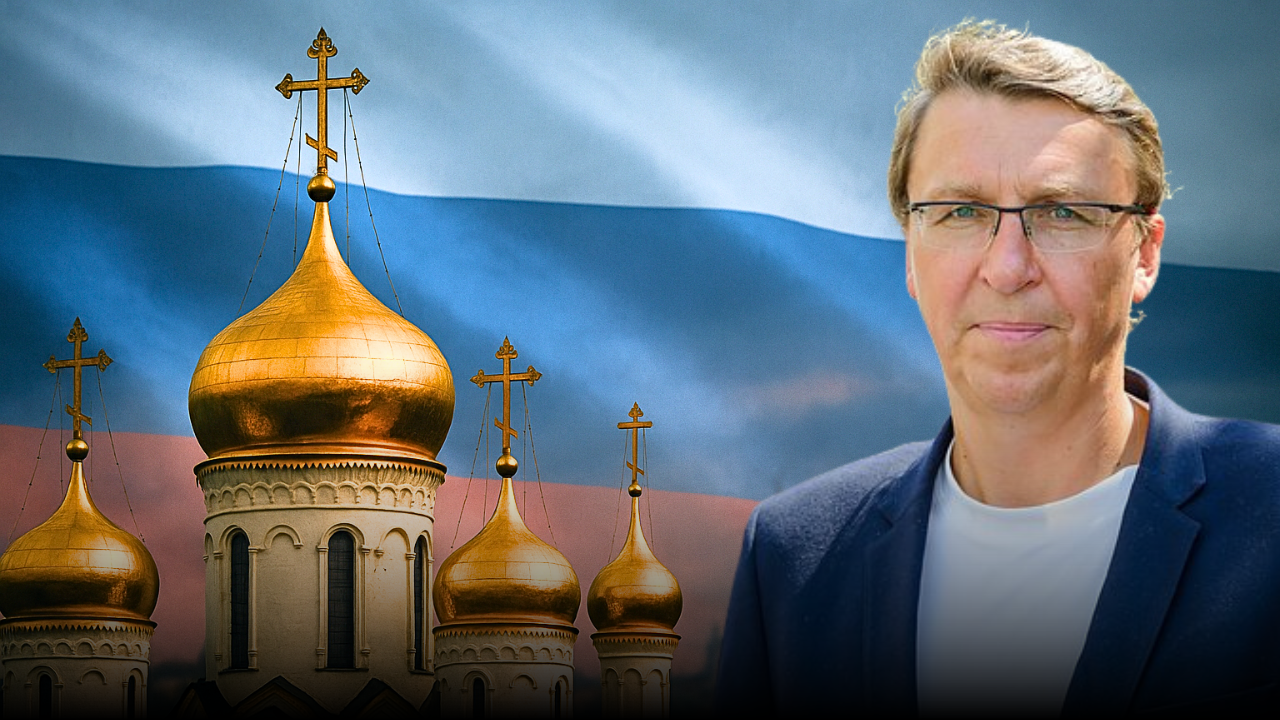
In an exclusive interview for Libertas Fidei, Lithuanian journalist and political observer Vytautas Bruveris explains how the Russian Orthodox Church has turned into an instrument of power and is used by the Kremlin to destabilise other countries.
The Church as Part of the Regime
— Mr. Bruveris, how do you assess the role of the Russian Orthodox Church in Russia’s contemporary political system?
— Today’s Russia is a dictatorship, and over the last decade the Russian Orthodox Church has in effect become its branch — a lever and a resource of the regime. The Church is used to subjugate society at home and to project influence abroad. It is no longer an independent spiritual institution but an element of an authoritarian system performing political functions.
De facto, the boundary between a secular state and the Church has been erased: ecclesiastical structures are embedded in the system of power, serve as its ideological support, sustain official narratives, and justify repressive practices and external aggression. This is not merely about preaching — it is an instrument of internal control and the legitimisation of power.
When Faith Turns into Politics
— Can one say that religion has become part of Russian political propaganda?
— Absolutely. When priests, representatives of denominations and even parishioners begin to use their faith as an instrument of political pressure, that is no longer religion but politics. Faith becomes a way to pursue specific political goals, influence and control. And it is precisely here that the fact that Church and state in Russia have effectively merged into one becomes manifest.
The Kremlin’s Religious “Soft Power”
— How far does this influence extend, and where is it most visible?
— Russian propaganda understands perfectly well the power of the religious factor. When an internal conflict, split or moral contradiction arises in a society, Russia immediately intervenes. Moreover, it acts on both sides, setting people against each other. Its aim is simple: chaos, destruction, the undermining of stability. It is a proven method — to shake a society and then use its internal contradictions to one’s own advantage.
This is not only about the post-Soviet space. The Moscow Patriarchate is present in many European countries, and everywhere it exists it is, in one way or another, drawn into geopolitical processes. This is a form of Russia’s “soft power”. The Kremlin deliberately looks for weak points in other states — old traumas, unresolved disputes, internal conflicts — and amplifies them.
When a society fails to resolve its problems for a long time, they only worsen, and then it becomes ever easier for Russia to exploit them. Thus religious structures turn into an instrument of influence rather than a spiritual space.
When religion becomes a political weapon, it loses its essence. The Church in Russia today is not the voice of faith but the voice of power. And that voice carries far beyond the country’s borders.