7.3 million euros for coups, multimillion budgets for disinformation, nearly one hundred Russian political strategists in 30 countries.
Investigative journalists from the website Forbidden Stories published unique materials on how Russia is seeking to expand its influence in Africa and the countries of the Global South. The methods include military coups, costly disinformation campaigns, and sabotage.
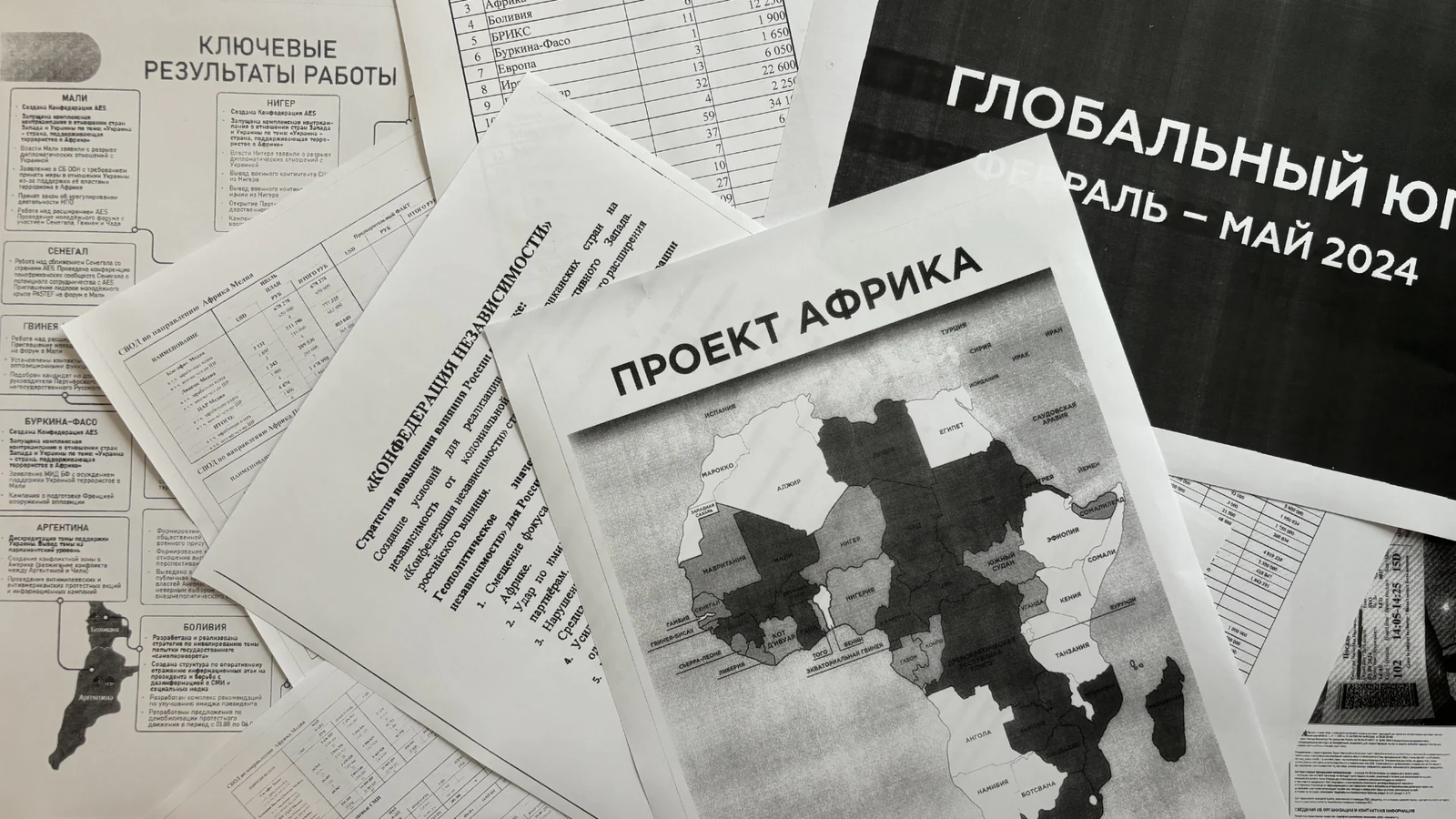
The editorial team of the pan African media outlet The Continent received 76 internal documents totaling 1,431 pages in Russian. Among them are strategic plans, staff biographies, accounting reports, and reviews of disinformation campaigns from January to November 2024. A consortium of Western and independent Russian language journalists conducted thorough fact checking of this major leak and confirmed its authenticity.
“COMPANY” THE STRATEGIST AND EXECUTOR OF RUSSIAN OPERATIONS
The main operations hub turned out to be the so called “Company”, a network of experts organizing disinformation and political influence worldwide in Moscow’s interests. Under the control of Russia’s Foreign Intelligence Service, its activities span more than 30 countries, from Mali to Bolivia, including South Africa.
The network employs nearly 90 political technologists, spin doctors, and PR and social media experts who constantly move across Africa and Latin America while maintaining contact with offices in St Petersburg.
Operations include political influence, disinformation, and links with security structures, going far beyond ordinary lobbying.
The primary objective is to push the United States and France out of Africa and strengthen Russia’s positions in strategic directions.
HOW RUSSIA HELPED CARRY OUT MILITARY COUPS IN THREE COUNTRIES AND THE PLAN FOR AN ANTI WESTERN COALITION IN AFRICA
This strategy found practical expression in the creation of the Alliance of Sahel States, which united Mali, Burkina Faso, and Niger in September 2023.
In all three countries, two years earlier, the sitting authorities were overthrown in military coups accompanied by harsh anti Western rhetoric. Internal documents indicate a far deeper level of Russian involvement in this partnership than previously assumed.
The blocking of European media, the banning of NGO activities, and the termination of military technical cooperation agreements form a fairly unambiguous list of achievements already reached. Moscow’s agents claim to have played a decisive role in shaping the Alliance of Sahel States.
The current plan envisages expanding the alliance to other African countries in order to create the largest anti Western coalition in Africa starting from early 2024.
Journalists assert that the documents outline action scenarios for nearly every country.
In Chad, the objective is to remove the country from the sphere of influence of France and the United States by limiting the ability of French forces to use their military base to violate the airspace of neighboring states.
Another document states as a goal for Libya the creation of chaos in the military political situation in western Libya. A significant part of this roadmap has already been implemented, as evidenced by two documents titled Work Plan and Key Results dated September 2024.
RUSSIA’S BELTS OF INFLUENCE LIBERATION FROM THE “COLONIAL LEGACY OF THE COLLECTIVE WEST”
Understanding Russia’s strategy of external influence requires returning to 2023, the date of one of the earliest files in the leak. This document reveals the existence of a project called Confederation of Independence, which had until now remained classified.
Presented as the center of future expansion of Russian influence, this confederation is intended to dismantle what the authors of the report describe as a belt of instability created by the West. They accuse France of shaping this belt with the help of fundamentalist Islamist groups since the 1990s and propose creating conditions to respond to African countries’ demand for liberation from the colonial policy of the collective West.
Moscow has developed a clear approach to mobilizing a significant part of the African continent to its side by exploiting dissatisfaction with former colonial powers and their allies, primarily France. Already on the first pages of the roadmap, the objectives are formulated with utmost clarity. They involve undermining the image of Western countries as reliable political and military partners, turning the neocolonialism of France, the United Kingdom, and the United States into an object of international disputes, and disrupting the military logistics of AFRICOM, the United States Africa Command.
The ultimate goal is stated plainly. At present the “Company” is working on a plan to reformat the African space by creating a belt of regimes friendly to the Russian Federation.
INTELLIGENCE, PROPAGANDA, DESTABILIZATION
The material, using specific projects as examples, reveals the scale of a global initiative called the Global South implemented over four months from February to May 2024.
The methodology is refined and repeated for each target country. After a preparatory phase involving assessment of the situation, mapping of actors, establishing contacts with high level politicians, and gradual penetration to opinion leaders, destabilization operations are launched and then amplified through local media.
In Senegal, for example, an August 2023 document envisaged a state coup. Its objective was to initiate rapprochement with Russia, under which the Foreign Intelligence Service was to support local armed forces with official Russian units in the event of a successful putsch, with a final directive to suppress or encourage civil protests depending on the chosen scenario.
Political interference was accompanied by economic offensives. Documents examined by Forbidden Stories and its partners show the central role of Russian operators in shaping Moscow’s geostrategic objectives.
Thus, in a February 2024 document, the “Company” claims credit for drafting a new mining code for Mali proposed by the junta a year earlier. Its aim was to discredit foreign players and revise existing contracts in favor of Russian companies and investors.
In Angola, the priority target of a disinformation campaign is named as the Lobito Corridor project, a key railway artery for exporting minerals managed by American and European operators.
The “Company” also claims to have conducted a similar operation in Niger against the French company Orano. According to internal documents, coordinated media pressure contributed to the decision of Nigerien authorities to revoke Orano’s licenses for uranium extraction at the Imouraren mine. Each of these campaigns demonstrates how the “Company” combines lobbying, influence, and disinformation to reshape the economy of strategic resources.
In all target regions, Russian plans often include an anti Ukrainian component. In a number of African countries, for example, an information campaign is being conducted under the leitmotif Ukraine is a country that supports terrorists in Africa. It illustrates how Moscow seeks to impose a global narrative to shape public opinion and legitimize the invasion of a neighboring country.
LF Comment:
The methods described above are far from the full toolkit used by the Kremlin for expansion in Africa and South America. In December 2021, the Russian Orthodox Church created the so called Patriarchal Exarchate of Africa, thereby grossly violating the canonical territory of the Patriarchate of Alexandria, whose ecclesiastical jurisdiction has since ancient times extended over the African continent. In essence, the Exarchate of Africa is an unlawful colonial body of the Russian Orthodox Church and one of the instruments of Russian influence on the African continent. This church annexation is considered unacceptable from the standpoint of church canons because, in secular terms, the Russian Orthodox Church invaded the sovereign territory of one of the most ancient patriarchates, founded by the Apostle and Evangelist Mark, the Patriarchate of Alexandria.
In addition to the geopolitical and economic interests of the Russian Federation in the African region, the reason for the invasion was the revenge of Moscow Patriarch Kirill against the Patriarchate of Alexandria, which refused to submit to the authority of the Russian Orthodox Church and remained an ally of Ecumenical Patriarch Bartholomew of Constantinople.
Patriarch Kirill Gundyaev simply seeks to assist in this reformatting of Africa, first through the Wagner private military company and now through new structures that have replaced it under the wing of the Foreign Intelligence Service. It is no coincidence that the first sermons of Russian Orthodox clergy began with persuading Africans that Russia is not associated with colonialism, racism, or the slave trade, sensitive issues for Africa.
The institutional presence of the Russian Orthodox Church is another form of soft power. It entails the formation of a permanent organizational structure, the consolidation of long term presence, and the development of networks of contacts. A religious structure creates channels of communication, builds trust based relationships, and works with local communities.
By opening parishes, training clergy, participating in humanitarian projects, and developing educational initiatives, the Russian Orthodox Church strengthens the political influence of the state associated with the church and contributes to what official Russia is doing, reformatting Africa and the Global South and making it hostile to the West.