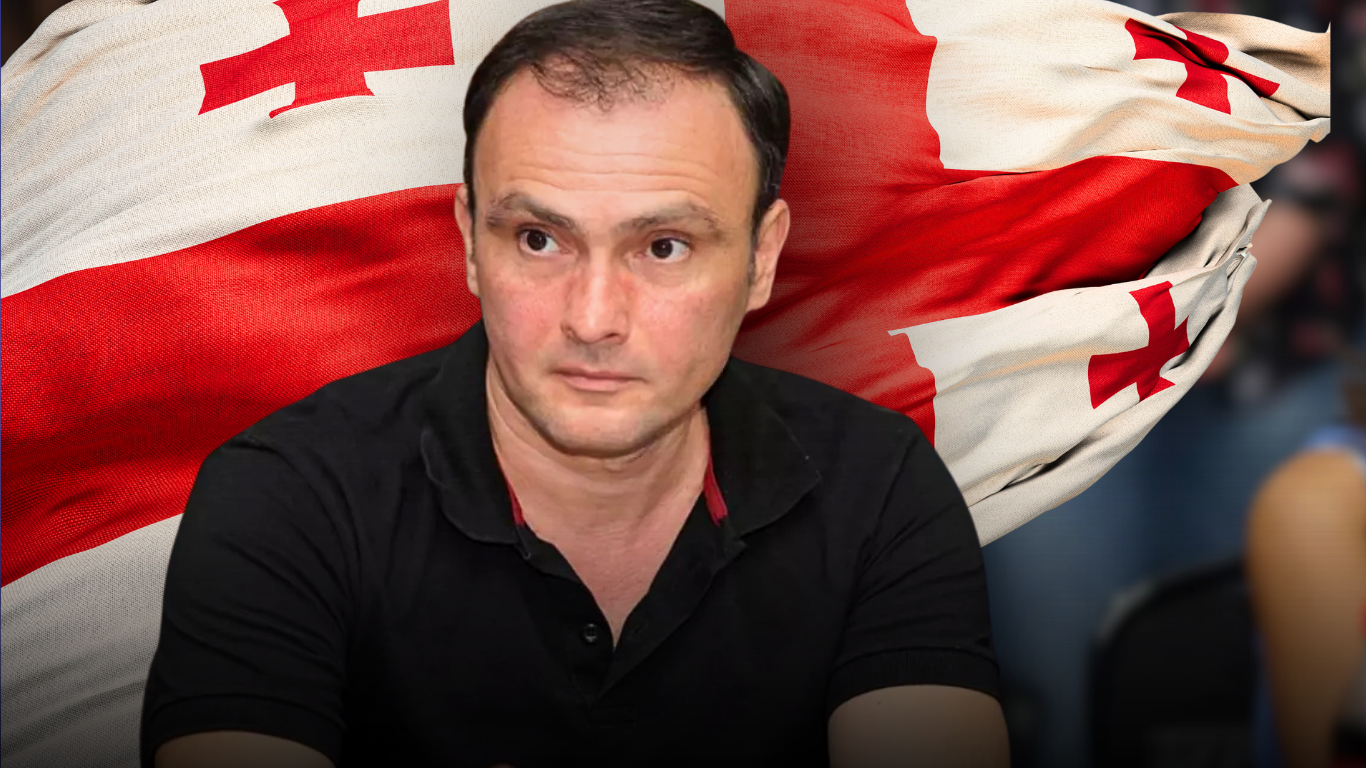
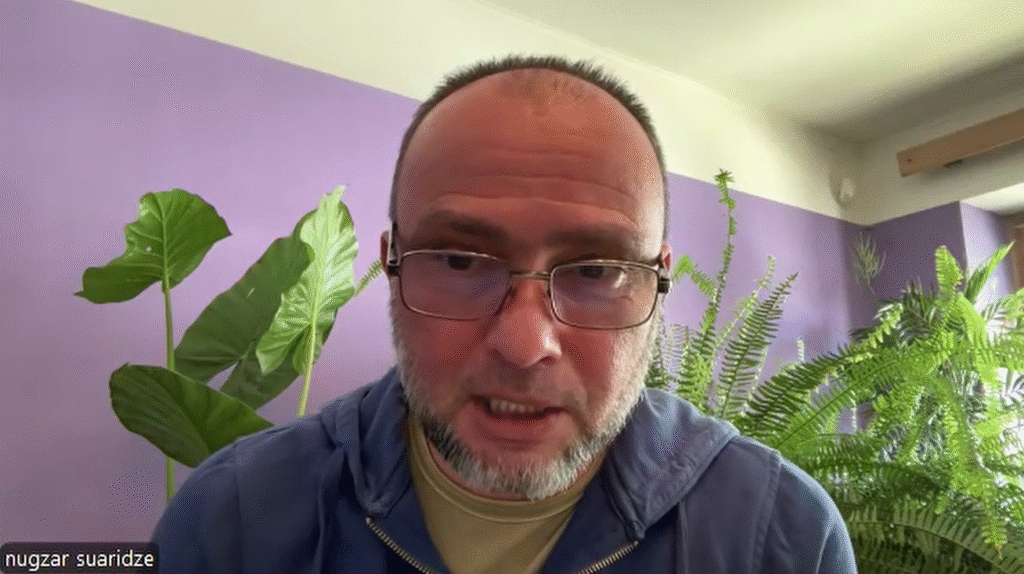
Nugzar Suaridze is a Georgian independent investigative journalist, a participant in protests for Georgia’s European future, and the author of a documentary film about Ukraine’s autocephaly, which has already been released in four languages.
Nugzar Suaridze always emphasizes that he is not a theologian and speaks about church-related issues solely as an investigator and a citizen of Georgia. Nevertheless, in recent years he has become a well-known public voice precisely on church matters.
Nugzar is also known for having addressed the Georgian Church via his social media at the height of the protests concerning Georgia’s European future, asking why the Church was not with its people and why it did not support the protesters. Coincidentally or not, after this appeal the Georgian Patriarchate issued a cautious and toothless “peacekeeping” statement.
We contacted Nugzar via Zoom to discuss the influence of Russia on the Georgian clergy and whether the Georgian Church is capable of — or willing to — overcome it.
WE HAVE NOT EMERGED FROM THE HISTORICAL INFLUENCE OF THE RUSSIAN FEDERATION, WHEN OUR SPIRITUAL LEADERS WERE APPOINTED BY THE NKVD/KGB/FSB
— Nugzar, tell us about the situation in your Church. Can it be considered a church that is one hundred percent in Russia’s orbit?
— I cannot speak of a one hundred percent Russian orbit, because more and more priests are constantly emerging who come to the protests and support the active part of Georgian society.
They say that the Church must be with its people.
At the same time, when speaking about the scale of the protests, one must bear in mind that there are only four million of us Georgians. Therefore, twenty people, two hundred, two thousand, or two hundred thousand with clear demands is already a lot. And I am glad that we now have spiritual leaders. Archimandrite Dorote Kurashvili and his brethren constantly come to the protests to pray. The Georgian Church has banned them from clerical activity, but they remain with the people. Unfortunately, the Patriarchate immediately punishes such figures.
— What do you attribute the strength of Russian influence to?
— Partly to the fact that we never broke free from the historical influence of the Soviet Union, when church figures and clergy, if not directly appointed, were at least “approved” or “strongly recommended” first by the NKVD, then by the KGB, and later by the FSB. This explains the ambiguity and slipperiness of statements made by the Georgian clergy. And I do not believe this is right. There is only one truth, and the Church must stand on the side of truth. Instead, we hear explanations from part of the clergy that if we side with the people, the Abkhazian Church will be taken away from us, since Abkhazian territories have already been torn away. We are told that our Patriarch currently bears the title “of Abkhazia and All Georgia.” Russia actively exploits this. Although our spiritual leaders cannot freely travel or serve in Georgian in Abkhazia. So de facto it is not our Church.
— Of course, the Abkhazian Church is de facto part of one of the dioceses of the Russian Orthodox Church. Does the Georgian clergy understand this?
— No. They repeat the words that although de facto it is not our Church, de jure it is ours. And Russia exploits this ambiguity. Perhaps the time will come when the Georgian Church will honestly acknowledge that all that remains of the Abkhazian Church for us is a fragment of the Patriarch’s title — and that this changes nothing.
RUSSIA IMPOSES THE VIEW THAT IN THE EVENT OF A NEW WAR, ONLY THE GEORGIAN PATRIARCHATE WOULD BE ABLE TO PLAY A PEACEKEEPING ROLE
— Since we have touched upon 2008, to continue the topic: when Russia attacked Georgia, Patriarch Ilia merely called for peace. Did Georgian society, which was highly emotional at the time, accept this cautious position?
— After 2008, when the Patriarch met with Putin, he clearly said that this could not continue and that something had to be resolved between Russia and Georgia. That was the first and last, so to speak, critical approach taken by our Patriarch.
Unfortunately, in recent years he has not been physically capable of undertaking anything. But even then, this same doublethink was present. Yes, during the war Russia allowed the Patriarchate to enter and retrieve the wounded and the bodies of the dead, they negotiated this, and only they had the right to enter the conflict zone. At that moment it played a role: people said that our Patriarchate was behaving cautiously, but that it was doing a good deed.
And Russia continues to impose this narrative: that if something happens in Georgia, only the Patriarchate will be in contact with Russia and will play its peacekeeping role. Russia uses such instruments very effectively.
— Regarding Putin and the Patriarch of Georgia. Recently Tina Kandelaki, a popular Russian TV host, said that during a trip to Georgia the Patriarch Ilia told her that he was praying for Putin. The last time she was in Georgia was five years ago, by then Abkhazia had already been occupied and Crimea had already been annexed. Could the Patriarch really have prayed for a tyrant? Could Tina have invented these words, or did the Patriarch indeed say them?
Both possibilities cannot be ruled out. It could have been Tina Kandelaki’s fabrication, or such words might indeed have been spoken. If it did happen, it might have looked like this: Tina asked the Patriarch what she should convey to Putin. (laughs) She probably provoked him. And what could the Patriarch have replied? To convey that he is praying. Tina Kandelaki is not very popular in Georgia. Everyone may have personal attachments to one country or another, but when part of Georgia’s territory is occupied and Russia creates such problems, and one of the Georgians relates to Russia in this way, it does not contribute to a positive attitude toward her in Georgia.
— You have explained the Church’s pro-Russian stance by historical tradition and attachment. But in many countries where the Moscow Patriarchate has strong positions, investigative journalists seek and find that pro-Russian hierarchs are financed by the Russian Orthodox Church and the Kremlin. Have Georgian journalists attempted to examine the financial underpinnings of such interactions?
Has the question been raised in Georgian media that a small Church might be financed by Russian money?
— It is very difficult to prove. Russia does not use credit cards for transfers, they can probably deliver money in suitcases. There is a great deal of information in the media that church leaders are engaged in business and that their businesses are, in one way or another, connected with the Russian Federation, and that they broadcast Russian narratives.
Behind this business there may be markets and tax privileges, but it is hard to prove. However, as our experts say, the position of the Georgian Church and Russian influence is not only a matter of Russian money, it is a matter of consciousness and intellect.
— Of an intellectual inability to understand the price of genuine independence?
— Many of them are, so to speak, intellectually lame.
— In Ukraine, monasteries of the Moscow Patriarchate are usually bastions of pro-Russian sentiment. You have more than one hundred and fifty monasteries. What can you say about the mood in your monastic communities?
— It is hard to say. In Ukraine everything became obvious when the war began.
We did not have such a peak when it would be clearly evident who was on which side.
There are church leaders who say that we have no right to judge, that God will manage everything and repay everyone according to their deeds. But we also have neutral and pro-Georgian spiritual leaders.
— If there are pro-Georgian ones, then the Church has a chance to cleanse itself of imperial influence…
— Yes, I think so too. Every month I see new priests who speak out openly and whom the Church leadership puts “on pause,” temporarily banning them from ministry.
— And how do priests who can oppose their superiors make a living? In a poor country, does a ban not deprive them of their livelihood?
— No, there is no direct dependence. Such church figures have their own flock, with whom they meet and pray. Conscious and free parishioners do not abandon their spiritual fathers because they have been banned. In such situations they follow them. Every evening Dorote Kurashvili and his brethren pray at the protests.
— We know well how the Moscow Patriarchate acted in Ukraine during the Euromaidan. After the liturgy they would allow people to kiss the cross while saying that there is no salvation in Europe. They repeated that the Maidan was a demonic gathering, that Europe would bring hordes of homosexuals who would adopt all the children. They heavily exploited anti-European and homophobic rhetoric. How does this manifest itself in Georgia?
— Exactly the same, but with Georgian specifics. Where was Europe and the EU when, already in the twelfth century, we had the beginnings of a parliamentary state? Our tradition is richer and our history better. What can they tell us? Russian narratives are present in our space and they are very strong. This includes the promotion of so-called neutrality: we do not want either Russia or Europe. To speak of Georgian neutrality can only be done by someone who is either uneducated or corrupt. How can a country in a globalized world be neutral and be friends with everyone?
THE GEORGIAN CHURCH SHOULD HAVE BEEN AMONG THE FIRST TO RECOGNIZE UKRAINE’S AUTOCEPHALY
— In your documentary film “Spiritual Struggle,” devoted to Ukraine’s attainment of autocephaly, your experts say that instead of siding with the autocephalous Ukrainian Church, Georgia has effectively sided with the Russian Church. Why did they not recognize the autocephaly of the Church of Ukraine?
— A great deal of time has passed. In 2019 they promised to read the Tomos, discuss it, and make a decision. They have been doing so for seven years. Yet recognition of Ukrainian autocephaly by Georgia would have been historically justified. If we look at the photo chronicle of relations between the Russian and Georgian Churches, the Georgian Patriarch has always stood to the right of the Moscow Patriarch. If the right side makes the correct choice, it would be a powerful blow to both Russian politics and the Russian Orthodox Church. The Georgian Church understands this… And I can repeat once again: the Church must not speak ambiguously. It must stand on the side of truth. And if the truth is that Ukraine received the Tomos, then the Georgian Church should have been among the first to recognize it—had it chosen the right decision. Why did it not recognize it? Out of fear. But the Church must not fear the truth.
At the same time, strange things are happening in Georgia. Our former Prosecutor General moved to the Russian Federation, obtained Russian citizenship, and took the surname “Romanov.”
He built a church in Georgia and became its ktitor (an officially recognized donor acknowledged by the rector and parish, exerting influence on the parish — ed.). Thus, Georgians also finance the Church — wealthy and pro-Russian ones.
— One can imagine what kind of attitudes he transmits there and how he shapes the clergy.
— I can imagine. He is not just a ktitor, he is a former chief prosecutor who brought charges and had access to a wide range of documents. What documents from the security services might he have transported to Russia? It is a tense situation.
— Yes. When the clergy are kept on the hook by compromising material, terrible things can happen.
— Yes.
— Is the Church losing authority?
— I think so. From what I can judge, even deeply devout believers are beginning to question whether it is right to trust the clergy so unconditionally.
— We see how painfully Georgia is trying to reclaim its European future. If your Church were with the people, would it change public sentiment? Would it influence Georgia’s future? Could it change the situation?
— Unquestionably — yes. It would change it. If the Church were with the people, the country would move in the right direction. Unfortunately, the Church depends on the state, is financed by the state, and follows governmental narratives step by step. If the Church were on the side of the people and professed the same principles, everything would be better and problems would be resolved more quickly.
Anna Jansone, LF.