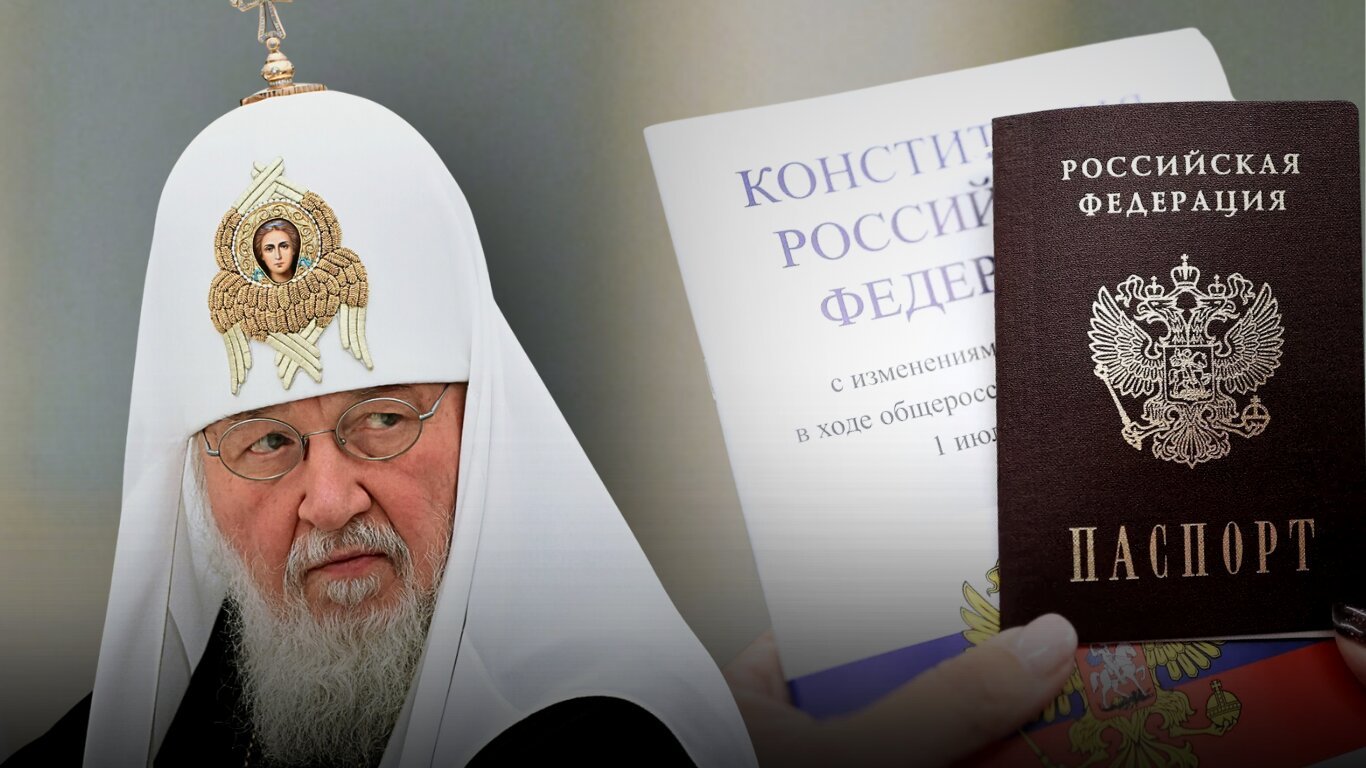
Moscow Patriarch Kirill (Gundyaev) said that Russia’s mission is “to preserve Christian moral values in a world afflicted by evil.”
He made the statement during his address at the “Christmas Parliamentary Meeting” in the building of the Federation Council in Moscow on January 29.
According to him, “the future of Russia and the world depends on the Russian Federation’s ability to defend moral values.”
“As lofty as it may sound, the future of Russia and the world directly depends on our ability, firmly and together, to uphold the religious identity of the state-forming Russian people and to defend Christian moral values,” he said.
The Primate of the Russian Orthodox Church believes that many foreign citizens, including from Western Europe, wish to move to Russia.
“In their countries, adherence to God-commanded moral principles can cost a person their job or even land them in prison. Russia is perceived in the world as a defender of traditional values and an ark of salvation. And this is not my invention, not an image that arose in my mind while I was working on this text. All of this came to me through communication with people, including our brothers and sisters who today live in Western European countries,” Gundyaev said.
He thanked Putin “for supporting foreigners who share Russian values.”
“Thank God, on August 19, 2024, President of Russia Vladimir Vladimirovich Putin signed a decree on supporting foreigners who share Russian values and disagree with the imposed neoliberal ideology. Now these people can obtain temporary residence permits under a simplified procedure, and we know that temporary residence for many becomes permanent,” Gundyaev said.
He also noted that Russian soldiers in Ukraine are “heroically defending fundamental values of truth, goodness, and justice.”
LF commentary:
Overall, this is not the first time Russia has invited foreigners who share its declared values to settle permanently. However, expatriates who moved here, often captivated by literary and ideological images, after some time left, unable to withstand the gap between reality and the appearance being created. These departures left far from the most enthusiastic testimonies in history.
The French aristocrat Astolphe de Custine came out of curiosity about an alternative to the Western political model and left convinced that public life here rests on coercion. A major figure of European culture arrived with sympathy for the Soviet project but departed the country with a sense of suffocation and lack of freedom.
Panait Istrati, a Romanian-French writer, arrived as a romantic of the socialist revolution and left with a feeling of shattered dreams. Similar impressions were described by Bertrand Russell and Luke Harding.
After Russia’s invasion of Ukraine, even those who had lived in the country for decades left, having passed a point of no return. Propagandistic substitution of reality ceased to work. The question remains open as to whether the call of the Russian Orthodox Church will lead to the emergence of new compatriots.