The Russian Orthodox Church has once again declared “pressure from the authorities of Ukraine, Moldova, Estonia, Latvia, and Lithuania on canonical church structures.”
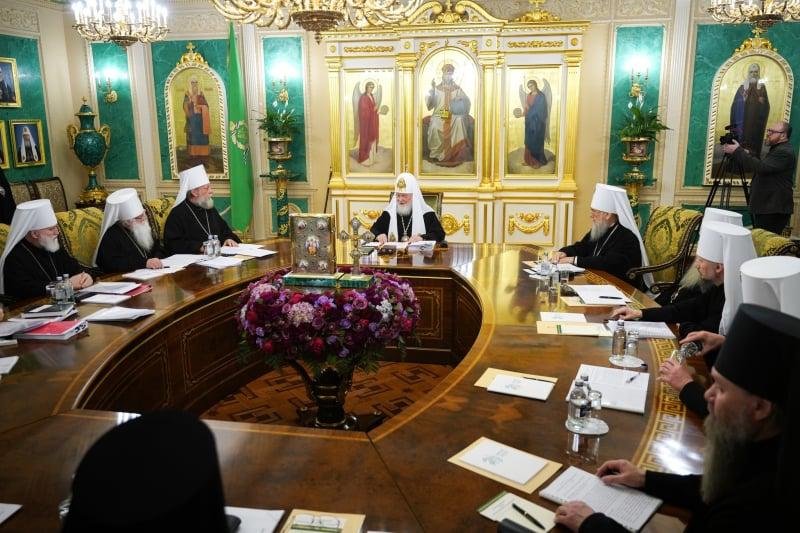
This was reported by the outlet RIA Novosti with reference to documents of the Synod of the Russian Orthodox Church, which took place on 12 March 2026 in Moscow. Speaking about “canonical structures,” the Synod means the representations of the Moscow Patriarchate in these countries.
The Synod, in particular, approved the final document of the so called Rozhdestvenskiye Chteniya of the Russian Orthodox Church, which were held at the end of January 2026 under the chairmanship of Moscow Patriarch Kirill.
The authors of the document called to “pray for the strengthening of spirit and steadfastness of Orthodox believers in Ukraine, in Moldova, and in the Baltic region in connection with the pressure exerted by the authorities of these countries on the Orthodox Church.”
“The participants of the readings express deep concern about the situation of the Ukrainian Orthodox Church, as well as pressure from the Estonian authorities, the leadership of Moldova, Latvia, and Lithuania on canonical church structures,” the document states.
The participants of the readings also called on the international community to “draw attention to the most serious violations of the religious rights and freedoms of Orthodox believers” in these countries.
The document approved by the Synod of the Russian Orthodox Church also addresses the war against Ukraine. The Moscow Patriarchate interprets it as “defending the borders of Russia” and “preserving the spiritual and cultural unity of Holy Rus.”
As LF previously reported, from 25 to 30 January 2026 the International Rozhdestvenskiye Chteniya took place, where the Russian Orthodox Church spoke about the protection of the “Russian world,” which supposedly will ensure the transformation of Russia, about the spiritual meanings of the “special military operation” in Ukraine, and about the particular features of its ministry within the armed forces and law enforcement bodies of the Russian Federation.
According to LF, Russian journalists who follow the Rozhdestvenskiye Chteniya described them as church staff exercises.
Earlier we reported that the Minister of Foreign Affairs of Lithuania said on Monday that the authorities must limit the activity and influence of Russian special services within the structures of the Orthodox Church of Lithuania.
As LF reported, a threat assessment prepared by the State Security Department and the Second Department of Operational Services under the Ministry of National Defence states that the Orthodox Church plays a significant role in shaping and sustaining “ideological narratives” promoted by the Russian regime. According to the intelligence assessment, by using its dioceses Russia spreads its ideological influence within the Lithuanian Orthodox community.
Earlier an international conference titled “Constantinople and Moscow. Transformation of Church Affiliation and the Influence of Imperial Policy” took place in Vilnius. It discussed the mechanisms of the instrumentalisation of religion, the role of the Russian Orthodox Church in implementing Moscow’s geopolitical interests, and the possibilities of countering Russian hybrid influence while respecting religious rights and freedoms.
LF Afterword
One of the leading religious journalists, Aleksandr Soldatov, once remarked, “the Russian church empire is falling apart.” Observing how in Russia the Russian Orthodox Church has turned into a detachment of the authorities, Orthodox believers from Ukraine, the Baltic states, Moldova, and even Kazakhstan are leaving its jurisdiction. And where the Russian Orthodox Church cannot follow behind a Russian tank, it arrives with statements about persecution. This is a change of tactics because the strategy of the Russian Orthodox Church remains the same, to help its state legitimise war, expand influence, and reduce the amount of freedom, democracy, and joyful healthy Christianity.