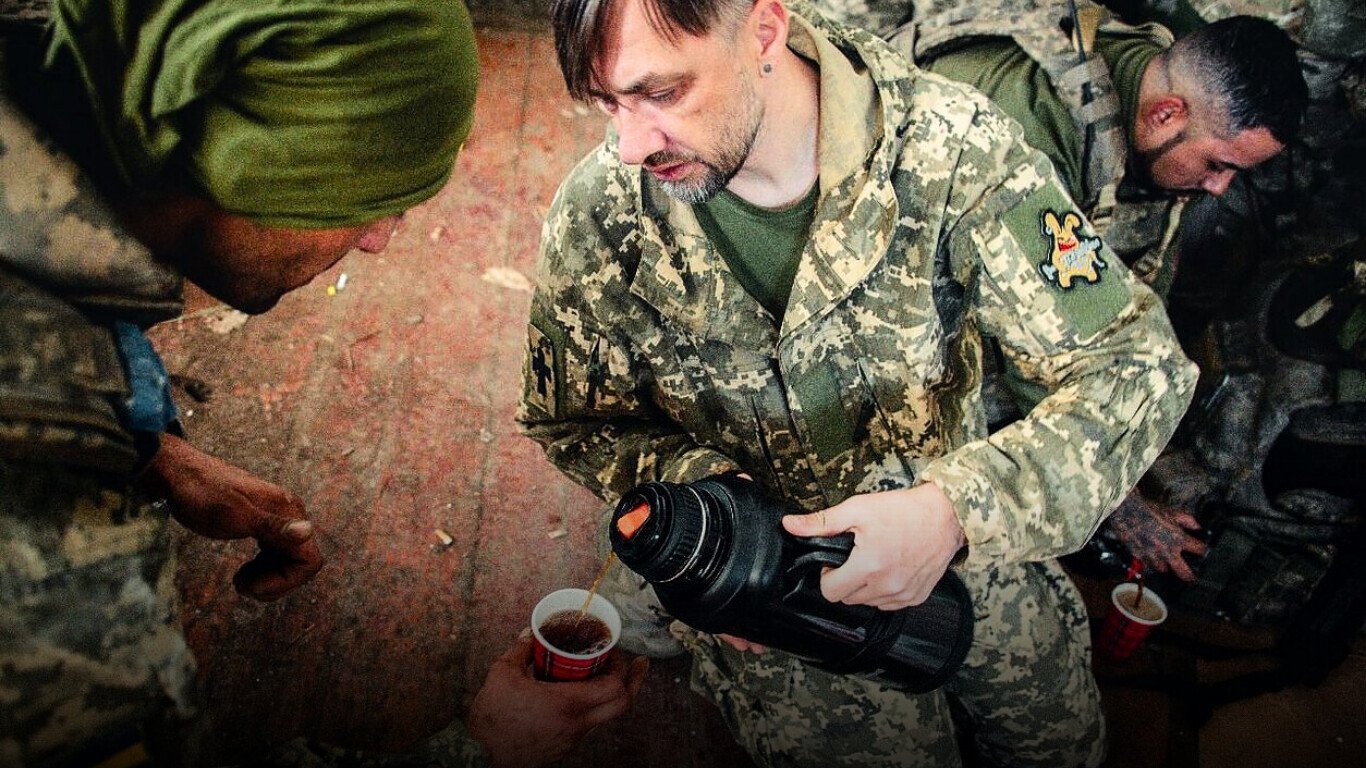
Russian military aggression against Ukraine has given impetus to the development and popularisation of such an institution as military chaplaincy. The topic of military clergy has moved out of Ukrainian trenches and is now widely discussed across all EU countries. We decided to republish a conversation with one of the most well known Ukrainian chaplains, Serhii Dmytriiev, which he gave to the Lithuanian outlet LRT.lt.
The fighting part of Ukrainian society will continue to resist no matter what and to the very end, whatever that end may be. Because it realises that it simply has no other choice in this decisive historical struggle, on which it depends whether Ukraine will remain an independent state or not. This was stated in an interview with LRT.lt by one of the most well known and authoritative Ukrainian military chaplains, Serhii Dmytriiev Padre.
Padre was born and raised in Russia, began his priestly career in Ukraine, and is now one of the leaders of the social service of the Orthodox Church of Ukraine. He took part in the Maidan, later served as a chaplain in the 30th Brigade of the Armed Forces of Ukraine, in the Territorial Defence and in the Ground Forces.
According to him, not only the Russian regime but also many in the West still do not understand that it was and remains the active part of Ukrainian society that is the decisive factor in this war. On the other hand, in Dmytriiev’s view, the Russian regime may be exhausted by this war no less than Ukraine, therefore it is too early to speak about the inevitable defeat of Ukraine.
The Ukrainian military chaplain also stated that the Baltic states and Europe as a whole, which increasingly speak about the threat of Russian aggression, should be particularly concerned by the fact that the enemy has long been present on their territory. This enemy, according to Padre, is the Russian Orthodox Church of the Moscow Patriarchate, which, in his words, is nothing other than part of the Kremlin regime and a weapon capable of starting to kill not only Ukrainian but also Lithuanian children.
— You have been with soldiers on the front line from the beginning of the war in 2014 until today. How do you see and feel the current atmosphere in this frontline part of society? It is said that it is increasingly exhausted spiritually and physically, increasingly disappointed in everything, in that part of society which avoids the war by all means, in the authorities shaken by corruption scandals and even theft from the army, and in the very course of the war and the so called negotiations. Moreover, it is simply becoming physically smaller and continues to shrink. What do you think about this?
— I am generally against generalisations and broad formulations. I believe that the most important thing in life is concrete human experience and what comes from the authentic lives of people. Therefore I can speak for myself and my comrades, and for us the most important thing is our own bond.
Yes, we often simply cannot physically attend funerals. On the other hand, from the reality of death, which is constantly present here, other things also arise. My wife and I swore to always keep the doors of our home open, because the person you did not manage to speak with today, thinking you would do it tomorrow, may already be dead by then. And yes, believe me, this really happens.
Therefore, for us the most important thing is the sense of belonging. The belonging of those who will be together to the end.
How do we react to corruption scandals, to pressure aimed at forcing us and our government to give in or even capitulate? Of course we get angry. Do our hands tremble? Of course not. On the contrary. This only pushes us to close ranks even more and stick together. Russians, Americans, and many others in the West simply do not understand that we are not fighting for Zelensky or against Zelensky, but for ourselves, for our friends, families, freedom and the state. And I am also fighting for my cat.
And we will fight. Because we have been fighting not for twelve but for more than a hundred years, and it has always been the case that the more we were destroyed and oppressed, the tighter we held on. And it will never again be as it was before the Maidan, no one will go back. Ukraine will either exist or it will not. And we will fight in any case.
On the other hand, it is absolutely clear that after the war ends we will have many questions for our government, not only about corruption during the war, but also about why there was no proper preparation for the full scale invasion. About many things.
The same applies to the president who, by the way, I think in any case will not remain in power, and even if he runs in elections he will lose to any competitor. The history of the whole world speaks to this. Leaders of wartime, even if they emerged as victors, usually then lost their posts.
The conflict, or more precisely the contradiction, between the part of society that tries to avoid the war and the part that is fighting, certainly exists, although in my personal life, for example, I do not feel it. I feel hostility and even danger for myself from some civilians, for example in Poland, but not in my own country. In general, I believe that this topic is extremely exploited and inflamed by Russian propaganda and special services, one of whose goals is to present Ukraine to the West as a hopeless cause.
On the other hand, those people who consciously evade military service despite being obliged to serve, and by their behaviour pose an even greater threat to the lives of those at the front, for me no longer exist as fellow citizens.
At the same time, I have seen many people who in civilian life seemed absolutely incompatible with military affairs, but after mobilisation became highly professional and heroic soldiers.
Yes, the front lacks manpower, there is a problem of desertion, mobilisation is stalling. However, it is ongoing, as are reforms in the army, and we are holding the front. Therefore, for us the most important thing is to focus as much as possible on what we have and what we can do, and that is exactly what we are doing.
Therefore, I think that after this winter, from a military point of view, we will still be in Donetsk region, the Russians will not yet take Kramatorsk and Sloviansk. Perhaps our leadership will even find additional resources and opportunities for a new counteroffensive.
And that already creates major problems for the enemy, aggravating their main problem, the exhaustion of the economy and other resources.
In general, Russia may well begin to suddenly fall apart, as has often happened in its history. I, like many people over fifty, remember how the Soviet Union collapsed literally before our eyes within a couple of years. Then America brought humanitarian food aid to Russia, and people in Moscow ate canned dog food to survive.
And I think such a scenario is quite realistic today as well. Especially if Europe, awakened by Russian terrorist actions, continues to support us, and Russia is forced to impoverish itself, because it will not only begin direct aggression against European countries, primarily former members of the Warsaw Pact, but will also be forced to invest all remaining resources into the military machine.
— It is obvious that this war would truly end in Ukraine’s victory only if the Russian regime collapsed from within. However, now it seems that the key question is whether the independent Ukrainian state will survive. Do you not think that if it turns out that Russia can no longer completely destroy it, this in itself will already be Ukraine’s victory, an opportunity for that great, final victory?
— Yes, of course. I say that we are fighting because there is simply no other path. Ukraine will exist or it will not. And it may be that this is the last and decisive battle. On the other hand, even if they manage to destroy the current state, this will not necessarily mean the end. More than once in Ukraine’s history it seemed that everything was over, but the spilled blood then turned into a new rebirth.
Was it not the same with your partisan struggle after the Second World War? It seemed that they had lost, but decades later the state for which they fought was reborn, and that rebirth was also sprinkled with their blood.
— What role does faith play in war? Does war bring more people closer to God, especially among combatants? After all, it is said that there are no atheists in war.
— No, I would not say that. War in general greatly sharpens everything, including people’s relationship with religion. Yes, many people do indeed find God in war. However, there are also those who lose Him there, because they become disappointed in Him and angry with Him. Or they decide that He simply cannot exist, because He could not have allowed what is happening here and now, that such evil and the existence of God are simply incompatible.
But the real questions and problems related to the religiosity of our society were known and visible even without this war that is happening now. You Lithuanians also know this problem, because we are in many ways similar societies simply because we emerged from one occupation system. One could say that this is a problem of all post Soviet societies as a whole, insofar as they can still be called post Soviet.
That is, I mean that we are in fact not a very religious society, although we often like to call ourselves such, to appear such and even to feel such. The religiosity of many people in reality is either an empty habit of going to church and services on holidays, or a belief in all kinds of superstitions, spells and paranormal things simply because something exists.
— Recently I saw a survey of Lithuanian society where the majority of citizens indicated that they had at least once visited fortune tellers, believe in horoscopes and similar things. What do you think about this?
— Yes, of course. Moreover, in our society there are no naturally formed historical ties with religious institutions as such, because this was impossible. In Western societies, the social importance and significance of religious communities and institutions is recognised even by those who consider themselves non religious. We are still far from that.
— What are the main differences between the Moscow and Ukrainian Orthodox churches?
— The shortest and first answer that comes to mind is that their thinking is absolutely sectarian. It is like a totalitarian sect in its most aggressive form. Completely closed, recognising a single way of contact with the outside world and people, absorbing them.
Another of the most important differences is that we are not a state church. Our doctrine is not aimed at expanding an empire. We are a people oriented church. Therefore our priest is a servant of the people and of God. Whereas a priest of the Moscow Patriarchate is a servant of the state as an empire, an official whom the people serve.
Of course, remnants of such a Russian mentality still remain in our church, I constantly see this. Above all in how some clergy still try in every possible way to be as close as possible to people holding high positions, to use this real or imagined closeness to strengthen their own status, through it to influence politicians and through power to influence society. Naturally, this exists in all confessions, but as my experience shows, in Europe it is less so. And we are closer to Europe.
I remember how once I was in the Ministry of National Defence of Lithuania, where I met the then minister Arvydas Anušauskas. And in one of the offices they showed me a statue of Our Lady of Fatima, which had been kept since the time when Lithuania was defending its restored independence, and, if I remember correctly, was a gift from one of the high ranking representatives of the Vatican clergy.
I understand that this statue is kept as a sacred symbol of Lithuania’s defence and struggle for its freedom, and not as a sign that everyone who serves goes to church every Sunday or more often and is very devout and religious. Rather, it is a sign that in decisive moments of Lithuania’s struggle for freedom, the priest was with the nation, being one of the most important fighters for that nation’s freedom.
This is also present in the memory of the nation, in its attitude to the church, and many of those who personally are not believers adhere to such an attitude.
At the same time, the dominant confession in Ukraine at least until 2014 was the Orthodox Church of the Moscow Patriarchate, and this of course still exerts a strong influence on us. And although it sought to instil in people the inseparability of church and power, it also taught them not to believe in God.
— So what does the Moscow Orthodox Church believe in?
— I do not know, it seems to me that it believes in nothing. Most likely, it believes only in itself. Also in money, power, debauchery. But that is not the main thing. The main thing is that they simply pushed people away, distanced them from faith, from Christ and His ideals.
It is obvious that there is nothing in the Moscow church of what Christ preached and of what religion in general is, not even a hint of it. On the contrary, the Moscow clergy and its leaders preach and bless things that completely contradict the teaching of Christ and all universal human values that religion upholds and defends.
— What is the current dynamic of believers transitioning from the Moscow Patriarchate to the jurisdiction of Kyiv and Constantinople? In 2019, immediately after separation from Moscow, a significant number of believers left the Russian Orthodox Church, but then the process seemed to stall. Perhaps then almost everyone who wanted to had already done so, and even the large scale Russian invasion could not influence the rest?
— The transition continues, but very slowly. Above all, we do not want to escalate the situation, we do not want internal conflict. Russia does the opposite. Through its agents it tries to shake the situation as much as possible. Moreover, it spreads its propaganda not only in Ukraine, but also on the international stage, claiming that the Ukrainian state and its authorities persecute believers and fight Christianity as a whole. And as we see, various people enthusiastically repeat this propaganda.
In addition, Russia of course uses its habitual methods of intimidation and blackmail of people, primarily the local clergy. Therefore situations occur when even those who decided to leave the Moscow Patriarchate still do not do so, because they are intimidated and pressured.
Ultimately, the Russian Orthodox Church together with its flock awaits Russia’s victory in the war. They are convinced that Ukraine will lose, will be enslaved and again put on its knees. Then they will be able to deal with everyone, especially with those who left them.
On the other hand, our Ukrainian Orthodox Church is smaller. We have fewer priests. We do not even have a sufficient number of military chaplains that the army needs. They are lacking everywhere, we are simply physically fewer.
But now I would not even want them to come to us directly from there, despite any repentance or apologies. Because these people would still bring with them Russian mentality, culture, narratives, and most importantly a distorted understanding of Christianity. More precisely, a surrogate Christianity with all its Russian attributes, from the understanding of the relationship between priest and people to excessively overloaded luxurious architecture.
— So here everything depends on how the war ends, whether Ukraine stands?
— Yes. But in our history it has always been so. The Ukrainian Orthodox Church existed even before Moscow came to power, and one of the metropolitanates was located in Vilnius.
After the proclamation of the Ukrainian state in 1918, the Ukrainian Orthodox Church retreated together with this state. Wherever Russia came, all Ukrainian priests were killed. Of course Russians were also killed, but unlike Ukrainians, far from all of them. After the Second World War, our communities that fled to Poland survived in the West, in North and Latin America. And after the 1990s, when independence was again proclaimed, our religious tradition was revived here.
However, even after that Russia through its channels of influence, primarily through pro Russian oligarchs, continued to strive to make its church here stronger and higher than the Ukrainian one. Even after 2014.
— What do you think about the situation in this regard in the Baltic states and primarily in Lithuania, where the Constantinople Exarchate was created only a few years ago and where a split of the clergy occurred that did not agree with the position of the Moscow Patriarchate, which had previously dominated here in relation to the invasion of Ukraine?
— From communication on these issues with your politicians, media representatives and clergy, I understand that since the majority of ethnic Lithuanians are Roman Catholics, they see neither a threat nor even a special topic here. I mean the presence of the Moscow Patriarchate in Lithuania. Most people either are not interested in this issue at all, or believe that it is simply a church for Russian speaking immigrants, a cultural attribute and historical heritage of the entire Russian speaking community.
People do not see a threat in this either in a historical or in a contemporary geopolitical context.
Many of those who are aware of this threat take the position that there is no need to escalate and inflame the situation, to create pretexts for Russia to shout about persecution of Russians and religion. All this is probably also reinforced by fear, knowing how such shouts from Russia usually end.
Unfortunately, it should also be said that in my view it is quite obvious that the Vatican itself still occupies a strange and incomprehensible benevolent position towards the Moscow Patriarchate and its leader Kirill Gundiaev. I really cannot explain what this is caused by, fear or a strange conviction that Moscow allegedly embodies true Orthodoxy, but this connection is obvious. I cannot imagine what could unite them, because it cannot be some common idea or ideal.
— The predecessor of the current Pope Francis often expressed great sympathy not only for Russia, but also for some of its other allies, and some of the highest hierarchs of our Lithuanian Church even expressed official solidarity with Patriarch Kirill and his subordinates in a supposedly joint struggle for religion.
— I just want to remind you that traditional Orthodoxy in Lithuania was never Moscow’s. It was the Orthodoxy of the Grand Duchy of Lithuania, of the Uniates, even of the Constantinople Patriarchate, but not Moscow and not Russian. The latter has always been the force that together with Russian imperialism destroyed Lithuanian statehood, religion and identity as a whole.
And here several questions arise for me. Why are there no Soviet monuments and symbols left in Lithuania? Because it was a criminal regime that sought to destroy independent Lithuanian identity as much as possible, to turn it into a support for the younger brother, to whom the elder brother allegedly brings true culture and civilisation. In general, because the Soviet regime was criminal, just like the Nazi one.
But why do you leave symbols of the Russian Empire, Russian imperialism, which also nourished the Soviet regime? If you enter a Moscow church in the centre of Vilnius, you will see, for example, an icon of Nicholas II. A man who destroyed Lithuania and was canonised as a saint.
In Lithuania, as you mentioned, there already exists the Lithuanian Orthodox Church, which prays in the Lithuanian language and even teaches Ukrainian refugees Lithuanian. And the traditional Moscow Orthodox Church is an accomplice of murderers and terrorists, including Lithuanian ones.
What would happen if a mosque belonging to Al Qaeda and worshipping terrorists opened in Lithuania? It would of course be closed. And how are Moscow churches different from such a mosque? In essence, it is the same Taliban, only with an Orthodox cross.
I am not saying that Moscow churches in Lithuania should be immediately closed or destroyed. But the very fact that they possess such an amount of property and assets, which are freely used by those who are under the patronage of a hostile state, seems absurd to me.
There are now about forty to fifty thousand Ukrainian refugees in Lithuania. These are very different people, but about seventy percent of them are Orthodox. They, like the majority, are ordinary believers, go to fortune tellers and so on, but will certainly come to church on Christmas and Easter.
Since Lithuanians, as I said, do not have their own Orthodox shrines, where will they go? Of course, to a Moscow church. What difference does it make to them where to light a candle or bless eggs. And there sits a Moscow priest who will begin to put corresponding things into their heads. And this is already happening.
And how many people are needed to cause, if not a revolution, then at least unrest that will shake the life and activity of the state? I will answer you as a professional revolutionary, one percent of the entire population. And here we see how niche or formally a minority affair the Moscow Patriarchate can be.
By the way, I myself saw and remember how this happened in Donbas, in Kherson and other places, and how no one believed in the danger.
I see the same thing across Europe, wherever the Moscow Patriarchate is present, only on a larger scale. There this entity is perceived as one of many confessions, belonging at the same time to minorities and to the great Russian culture and tradition. When it comes to the danger and aggression of the Russian regime, it is not seen that this regime is already here, inside, in its branches, which are precisely the Moscow churches.
In these churches, re education of abducted Ukrainian children takes place, Russian priests participate in interrogations and torture of Ukrainian prisoners of war, bless and encourage killings and violence, and those who follow them do so.
The daughter of a priest of a Moscow church in Pokrovsk hung a video camera on the bell tower, which broadcast live everything that was happening in the city centre and transmitted it to the Russian military. And so in Vilnius a local Moscow priest can from the bell tower transmit coordinates to Russian drone operators and guide them to your children’s schools, and then serve memorial services for these children and declare that they were killed by Lithuanian fascists.
Strictly speaking, all this bears the signs of a totalitarian military organisation. Only it encompasses an entire huge state, for which expansion and aggression have become the sole meaning and driving force of its existence.
And wherever the churches of this state stand, especially in countries that Russia occupied, they spread the message that this state is located precisely here, that everything around belongs to it, and that everything else is merely a historical misunderstanding that must be destroyed.