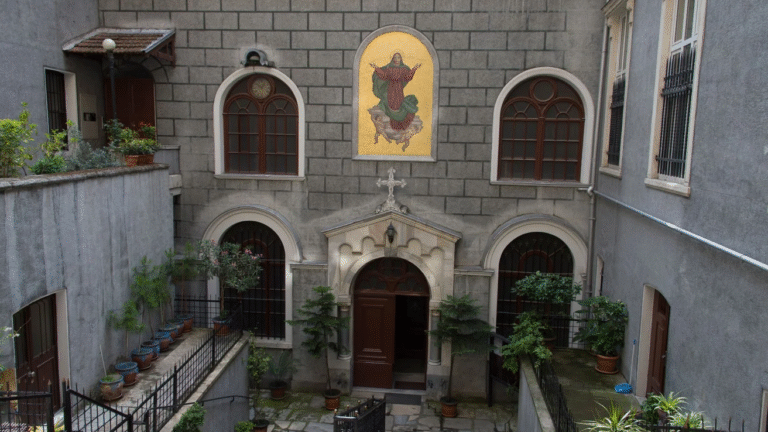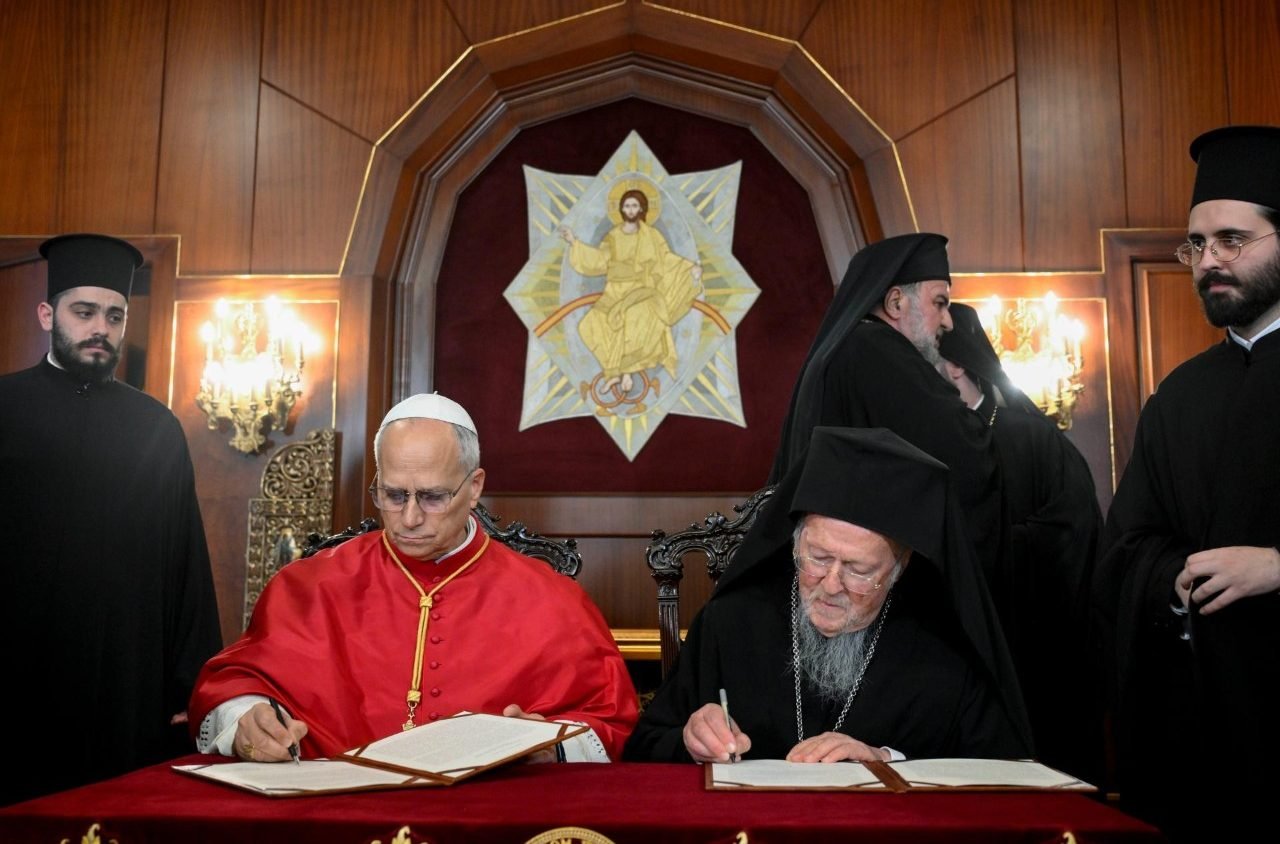
Pope Leo XIV and Ecumenical Patriarch Bartholomew I, during their meeting in Istanbul on 29 November 2025, signed a joint declaration in which they confirmed their readiness to continue the path toward the restoration of full ecclesial communion between the Catholic and Orthodox Churches, as well as condemned attempts to use religion to justify violence. On the third day of his visit to Turkey, the Roman Pontiff visited the cathedral of the Ecumenical Patriarchate, where the meeting took place.
The main issue of the talks was the declaration prepared for the 1700th anniversary of the First Ecumenical Council in Nicaea. The document emphasises the importance of the Churches presenting to the world a “renewed testimony of peace, harmony and unity.”
Pope Leo and Patriarch Bartholomew noted that the aspiration toward Christian unity goes far beyond the boundaries of internal ecclesial dialogue – it is intended to make a “fundamental contribution to peace among peoples.” They also addressed world leaders, urging them to make every effort for the immediate cessation of armed conflicts that continue to claim lives in different parts of the world.
“We reject any use of religion and the name of God to justify violence,” the declaration states.
It should be recalled that the justification of war from religious positions is actively promoted by the Russian Orthodox Church. Thus, on 19 November 2025, Moscow Patriarch Kirill Gundyaev, speaking at a session of the World Russian People’s Council, declared that “there is also a religious factor present in the current conflict,” and a year earlier he had called the Russian invasion of Ukraine a “holy war.”
As Vatican analyst Christopher R. Altieri notes in a column for Crux, there was not a single representative of the Moscow Patriarchate present at the meeting in Nicaea, and thus the Russian Orthodox Church simply did not hear the Pope’s address. The absence of ROC representatives became yet another signal that relations between the religious structures are gaining momentum. Tensions between the Moscow and Ecumenical (Constantinople) Patriarchates escalated in 2018, when Ecumenical Patriarch Bartholomew granted autocephaly to the Orthodox Church of Ukraine. And Russia’s full-scale invasion of Ukraine created further strain between Moscow and the Vatican.
Altieri notes that this situation shows that Christianity remains an important factor in global politics, and that the Russian Orthodox Church is increasingly tied to the Kremlin’s totalitarian system.
According to Pope Francis, speaking in 2022, “a patriarch cannot lower himself to become Putin’s altar boy.”
These words were spoken after Patriarch Kirill, in a 2016 conversation with the Pontiff, spent twenty minutes repeating Kremlin narratives justifying the war.
According to Christopher R. Altieri, the current pontiff, Leo XIV, is taking a different path. He is not seeking to restore relations with Moscow at any cost and is not trying to draw the ROC into his initiatives. On the contrary, he maintains a cautious distance and respects the processes taking place within global Orthodoxy.
Source: Vatican News