Recently an international conference titled “Constantinople and Moscow: the transformation of church affiliation and the influence of imperial policy” was held in Vilnius. Lithuanian elites discussed what should be done with the Moscow Patriarchate in Lithuania. Our outlet was among the organizers of the conference, and we note the strong interest shown by Lithuanian journalists in the topic and in its speakers.
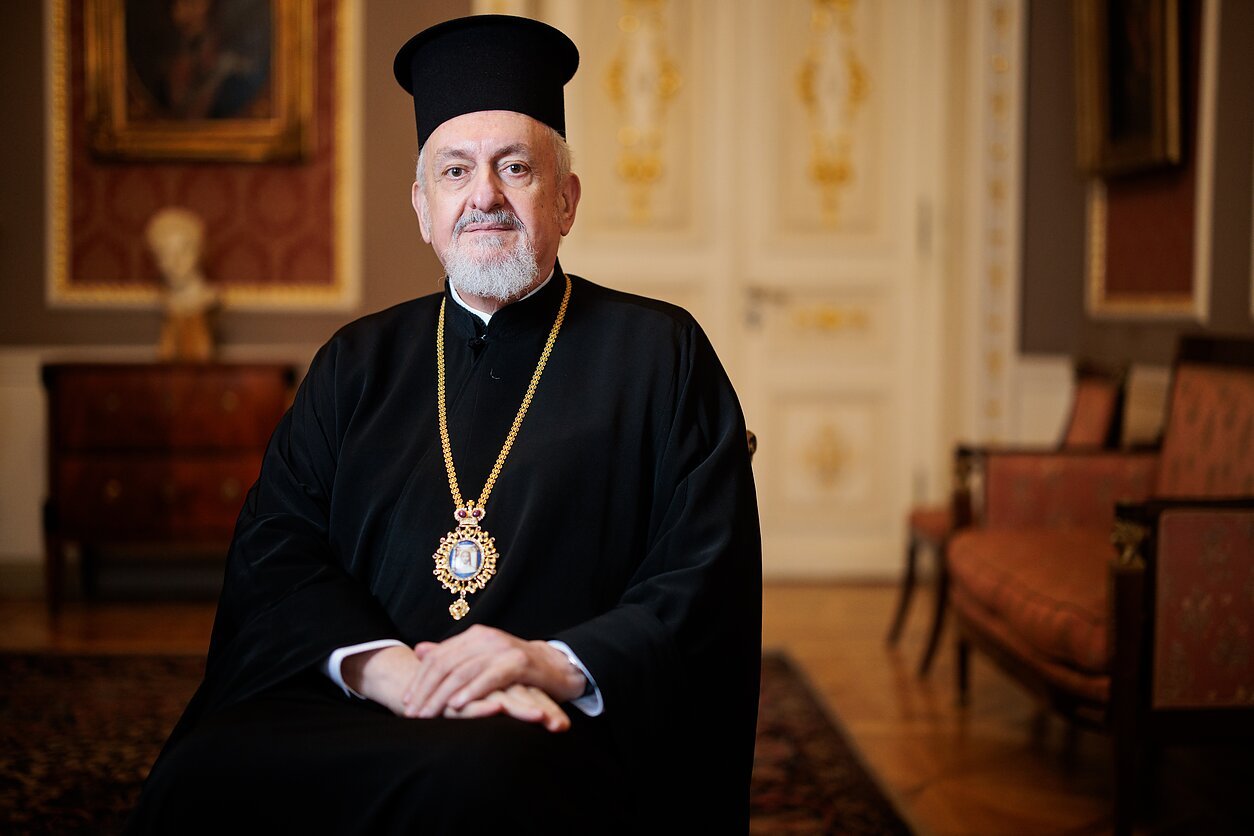
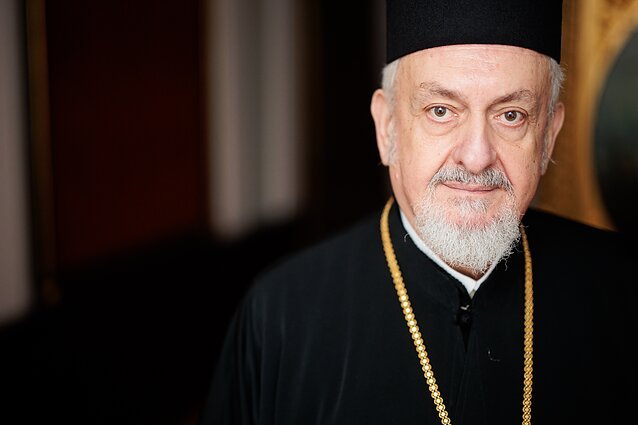
Today we republish an interview with one of the most well known religious figures of the Ecumenical Patriarchate, Emmanouil (Adamakis), which he gave to the Lithuanian state agency LRT.lt.
According to Metropolitan Emmanouil, a representative of the Constantinople Orthodox Patriarchate who visited Lithuania, the newly forming Orthodox community that openly condemns Russian aggression and distances itself from pro Russian coreligionists does not claim any property that does not belong to it.
“It will be possible to build a new church when the time comes and when finances allow,” he stressed.
DISAGREEMENTS BECAUSE OF RUSSIA
— You are visiting Lithuania. What issues are currently the most important for your community?
— As you know, we are not strangers here, because for centuries Lithuania was under the jurisdiction of the Constantinople Ecumenical Patriarchate.
Priests who were punished by the Moscow Patriarchate more than three years ago turned to the patriarch. This refers to clergy who declared that the ties of the Lithuanian Orthodox Church with Russia were unacceptable to them, according to LRT.lt. It is natural that they used such an opportunity, because the decision regarding them was unjust. The Patriarchate accepted their appeal, restored them to the sacred ministry, and thus an exarchate appeared in Lithuania. Now the community is growing. We have about twelve parishes, not only in Vilnius but also in Kaunas and Klaipeda.
A brief explanation of the problem
After the start of the war in Ukraine, a new Orthodox community appeared in Lithuania. It openly condemns Russian aggression and distances itself from the Moscow Patriarchate. It became part of the Constantinople Patriarchate.
According to Metropolitan Emmanouil, this community does not claim other people’s property.
The interviewee also believes that in Russia the church has become an instrument of manipulation by the state, and that believers should support Ukraine, which has been unjustly attacked.
I see what is happening as an opportunity rather than a polemic with the Russian Orthodox Church. We try to bear peaceful witness to Orthodox values and continue our activity in such a way that it is not dictated by foreign states.
— The emergence of a new Orthodox community causes many conflicts. Sometimes people even within one family cannot agree which jurisdiction they should belong to and with which priest to conduct a funeral. What is the future of Orthodoxy in Lithuania and how can these painful disputes be resolved?
— I do not think this is a problem. Conflicts arise in every family. Christian life is never easy. If you are a family, you must overcome disagreements. As far as I know, there are no conflicts in our community.
Of course, we are now living in a time of war. For four years an unjustified Russian aggression against Ukraine has continued. A split arises. People of the same faith fight each other. Russians are fighting Ukrainians, although both are Orthodox.
But I do not think this is the main question. The main question now is how to end the war and achieve a just peace.
— What would you advise people who feel that political disagreements are tearing apart their relationships with loved ones? This concerns not only the Orthodox.
— I think we need time. Time is the best doctor. Entire generations will be needed for all this to end. We know from the history of civil wars how long the process of healing lasts. When the war ends, the most important thing will be to heal wounds. We are human and we suffer. The main thing is to know that peace will come. Then wounds must be anointed with oil rather than new fire being kindled.
This is also the mission of the church, not to use words and not to perform actions that cause harm. We are open to dialogue and we came here not to fight.
— But in conditions of war anger arises, and many believe that one must choose a side. In Lithuania this is felt especially strongly. How should a believer in general relate to politics?
— States have already made their choice. You Lithuanians who live on the border with Russia and Belarus have experienced threats yourselves. It is obvious that a choice must be made, and you made the right choice, the same one made by most of Europe. You understand well what the war in Ukraine means.
When a country is occupied, there are always people who support the occupier. But there are also those who suffer, people who were attacked.
ORTHODOX OF THE CONSTANTINOPLE PATRIARCHATE
— So in Lithuania the Orthodox choose a side. What about other countries?
— The Moscow Patriarchate has a close connection with the Russian Federation. Our criticism is that this war in Ukraine should not be blessed by Patriarch Kirill, because it is a war against brothers and sisters of the same faith. I cannot dictate to them what to do. They know themselves. But the way they treat those who break ties is the worst part of this conflict.
We did not support the war, but we also did not break relations with Orthodox churches that disagree with our position. The decision of the Moscow Patriarchate to break communion with us because of our desire for the independence of the Ukrainian Orthodox Church is, in my view, unjustified.
We always call for people to come and sit at one table and seek solutions. They must come with dialogue, not with a monologue.
CAN ORTHODOXY IN RUSSIA BE INDEPENDENT
— Why does faith become an instrument of politicians and propaganda? How did this happen in Russia?
— I am not a politician, but we see that unfortunately in Russia the church has become an instrument manipulated by the state. I remember the words of the late Pope Francis. He said to Kirill, “Do not be Putin’s altar boy.” That speaks for itself.
— The Lithuanian diocese of the Moscow Patriarchate states that it seeks independence from Moscow. How do you assess such statements?
— We asked the same question to Metropolitan Alexander in Riga in September. We said yes, you are trying to separate from Moscow, but what kind of independence is this if you stop commemorating Patriarch Kirill during services while remaining part of the Russian Orthodox Church? It looks schizophrenic. You say that you want to separate but you continue to belong to the same church.
I am not saying that there is no desire for independence there, but such actions look like camouflage independence. They are not free.
And we are precisely offering freedom. If people want to be free from politics, from Russian influence, and from the use of religion, we are ready to offer that. Our Ecumenical Patriarchate is not a national or ethnic church. We have believers of different peoples and languages, and we do not impose language on them. For example, we do not tell Slavs to pray in Greek.
It is clear that now, when every thinking person speaks out against Russian aggression, nobody wants to associate themselves with Russia.
Discussions are currently underway about negotiations initiated by Presidents Vladimir Putin and Donald Trump. We hope that together with President Volodymyr Zelensky they will lead to positive results. However, Russia’s demands on Ukraine appear difficult to accept. They concern the transfer of part of the territory, and that is not easy for any politician or any Ukrainian to accept.
One must ask oneself whether we want the continuation of the war. No one can want that when seeing how millions of people on both sides have lost their lives.
— You say that you invite people to choose freedom, but in practice only a small part of the Orthodox in Lithuania belong to the Constantinople Patriarchate.
— There are no statistics. But our churches are full. In Orthodoxy there have been periods of crisis. For example, in the fourth century in Constantinople the Orthodox were a small group. Gradually it grew and became a large church. Therefore numbers are not so important.
The mission of the exarchate is not to become leaders. We came here not as aggressors but as witnesses of the spirit of truth and freedom. We act very peacefully, we do not make noise, and we remain open.
A service in memory of the fourth anniversary of the war in Ukraine has just ended. It took place in a Lutheran church, and a Lutheran pastor stood nearby. This shows that we are not alone. We have very good relations with official religious communities and with Roman Catholics. This testifies to our openness.
— The main subject of disagreement is the position regarding Russian aggression. Representatives of the Moscow Patriarchate in Lithuania say that they stand for peace, pray for peace, and that the church must remain outside politics. But we see that the concept of peace can also be used by the aggressor. What do you think about this?
— What is peace? The word itself is correct. But as I already said, Ukraine needs a just peace without conditions. This is very important. Everyone wants peace. This is the natural aspiration of every person.
Today there are about 160 wars and conflicts in the world, from the Middle East to tensions between Iran and the United States, which we hope will not develop into a new war.
Peace is the highest goal. In the Gospel there are the words of Jesus, “Peace I leave with you.” But what kind of peace? What peace do we want? One must understand that peace is a gift, but it requires effort. It is important not only to hear words but also to see deeds.
— So the word “peace” is used too often?
— Yes, everyone wants to live in a peaceful world. But history shows that humanity is constantly accompanied by conflicts. Peace comes from God. War does not.
The Gospel says, “Glory to God in the highest, and on earth peace, goodwill among people.” First one must glorify God so that there may be peace in the world, and in a peaceful world people may live and prosper.
— During your visit to Lithuania you will meet with politicians. In your opinion what can the state do for this new and growing community?
— The procedure for recognizing registered religious communities is very clear. We do not ask for anything beyond the law. We simply want to live in peace and act within the framework of the law.
We are not asking Russian Orthodox believers for any churches. The priests who joined us came alone. They did not bring churches with them. The churches are the property of the Russian Orthodox Church. We only want to be treated the same as others. Lithuania is a democratic state with its own laws and rules, and we are ready to obey them.
— And what about new churches?
— I do not think the state has churches that it could transfer. It is possible to build a new church when the time comes and when financial resources allow.*