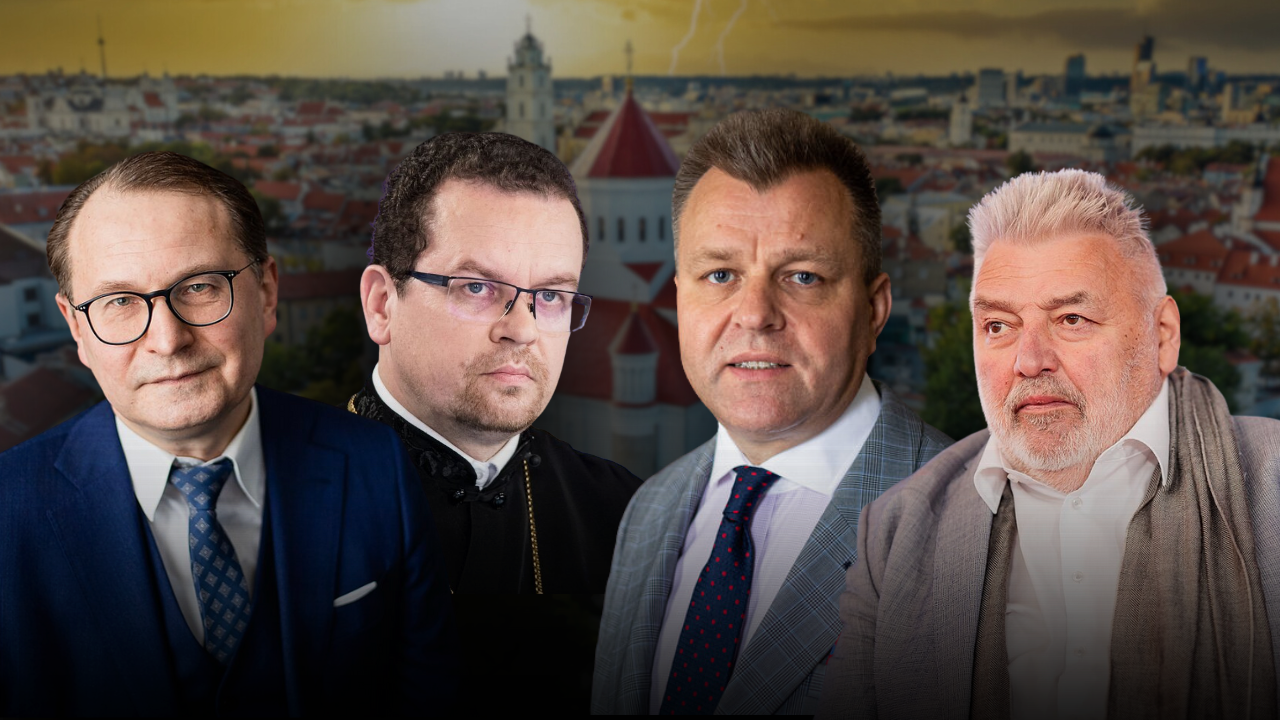
In October 2025, the Lithuanian national broadcaster LRT released a documentary titled “Moscow Reacts Sensitively to the Appeal of Lithuanian Orthodox Christians to Constantinople.” In it, producer Edmundas Jakilaitis turns to a topic that for decades remained on the periphery of public attention: the fate of Lithuania’s Orthodox sacred sites, which ended up under the control of the Moscow Patriarchate, and the legitimate efforts to return them to Lithuanian communities.
As is well known, part of the Orthodox communities in the Baltic states have taken a course toward a complete break with the Russian Orthodox Church — a trend that intensified after Russia’s large-scale military invasion of Ukraine in 2022. In Lithuania, it all began when a group of priests of the Lithuanian Diocese of the Moscow Patriarchate refused to recognize the ecclesiastical authority of ROC Patriarch Kirill Gundyaev, who had blessed Russia’s military aggression against Ukraine. Moscow’s harsh reaction followed immediately:
“They were dealt with at once,” the film says. “First they were suspended, then condemned as schismatics, and expelled.”
The group of priests, together with the Lithuanian authorities, later appealed to the Ecumenical Patriarchate of Constantinople, and in 2024 Patriarch Bartholomew officially established the Lithuanian Exarchate of the Ecumenical Patriarchate in Lithuania.
However, the acquisition of spiritual independence from Moscow did not resolve the institutional problems: the communities of the Lithuanian Exarchate still do not have their own churches and have nowhere to pray, since all Orthodox sacred sites in Lithuania have for several centuries been legally owned by the Moscow Patriarchate.
“Orthodox Christians who belong to Constantinople have their community, but they have no house of worship. All the Orthodox churches of Lithuania belong to Moscow. Should we not correct this? Should Lithuania not take measures and return to Orthodox Christians the property currently held by the Moscow Patriarchate?” asks Lithuanian historian and Vilnius University professor Alfredas Bumblauskas at the beginning of the film.
The territories of present-day Lithuania, Latvia, and Estonia are perceived by the Moscow Patriarchate as “canonical territory” of the Russian Orthodox Church. This is stated in the film by Mantas Adomėnas, philosopher, writer, and Lithuania’s Deputy Minister of Foreign Affairs in 2020–2023:
“From the perspective of the Moscow Patriarchate, Lithuania is viewed as just another Russian territory— a church territory of Russia. And the bishops of Vilnius and Trakai who operate here are directly subordinate to the Moscow Patriarch. All the propagandists who come here and point to the domes of churches saying: ‘Oh, this is part of Russian culture’ — they are lying. Because in reality, they were part of the Kyivan Metropolis.”
The problem lies far deeper than the religious sphere, notes Member of the European Parliament and former President of the Constitutional Court of Lithuania, Dainius Žalimas. According to him, the structures of the Moscow Patriarchate have traditionally been closely linked to the Russian state-ideological system. The concept of the “Russian World,” reflected in the official documents of the ROC, undermines the foundations of Lithuania’s democratic and humanistic values. And Moscow has no intention of relinquishing its influence, including in the religious sphere:
“As we know, there are major problems with the Orthodox Church of the Moscow Patriarchate. Essentially, it is a state church, a state organization serving the interests of another state—and moreover, interests that run counter to Lithuania’s independence. The mere fact that a subdivision of the Moscow Patriarchate exists here can be taken as evidence that the Lithuanian state is not regarded by them as fully legitimate,” Žalimas emphasizes.
In the view of the Member of the European Parliament, the return of Orthodox parishes and the restriction of the Moscow Patriarchate’s influence is not only a matter of historical justice but also one of national security for the entire Baltic region. When a religious structure promotes the hostile ideology of a foreign state engaged in aggressive policies, a dual risk arises — both in terms of property and strategic security.
“All the official documents of the Russian Orthodox Church clearly show that it is a pure embodiment of the Russian state ideology — ‘rashism,’ or the ideology of the so-called ‘Russian World.’ And through this lens the injustice becomes double — not only in terms of property, but also in terms of national security,” says Dainius Žalimas.
“Just as Lithuania, Latvia, and Estonia do not allow the spread of extremism or hostile political doctrines on their territories, the authorities of these states must likewise pay attention to religious structures through which the Kremlin’s hostile politicized rhetoric is disseminated,” — says Mantas Adomėnas in the film. He adds that the decisive factor in this matter is the choice of the people themselves, for it is the Orthodox faithful in Lithuania who must determine whether they want to preserve their own spiritual freedom or continue attending churches where political messages are voiced that contradict the values of independent states.
“Just as we do not allow the preaching of jihad in Lithuania, we cannot allow the spread of Moscow’s military propaganda. This must be stopped by concrete action. Yet above all, I believe, Lithuanian Orthodox believers must themselves understand: if they want to preserve their conscience, honor, and dignity, they cannot continue attending a church from which murderous, genocidal propaganda is broadcast — whose head, Patriarch Kirill, is in fact a war criminal,” Adomėnas stresses at the end of the film.
Thus, the question of the situation of Orthodox communities in the Baltic states and the limitation of the Moscow Patriarchate’s influence has long exceeded the bounds of a purely religious discussion: it concerns historical justice, property rights, and national security. For Lithuania, Latvia, and Estonia it is therefore essential to ensure that Orthodox believers have all the conditions for independent spiritual life free from Moscow’s influence. Edmundas Jakilaitis’ documentary raises this issue by showing how historical, religious, and political factors shape the current situation in the region, and why resolving it has become a task not only of the Church but also of the state.
Libertas Fidei provides access to the full version of the film with Russian and English subtitles — available exclusively on our YouTube channel.