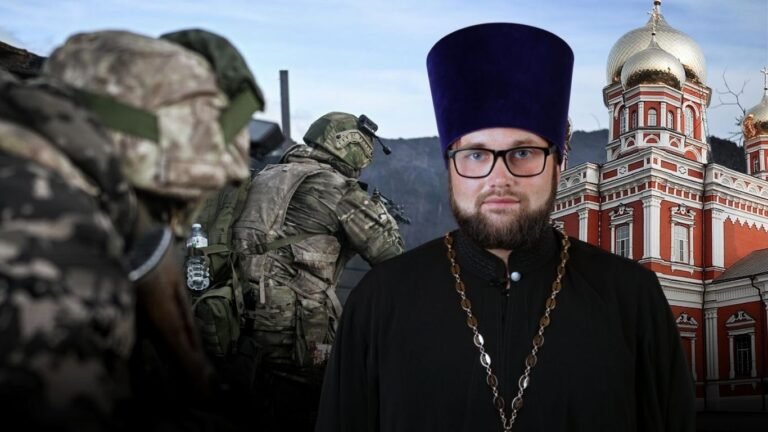
The independent Russian media outlet Meduza has published a book about the people whose ideas and actions helped Vladimir Putin prepare Russians for the attack on Ukraine.
According to the authors of the announcement article, since 2022 churches honoring war have been erected across Russia and beyond.
Presenting the book, they showed what a “warrior church,” a mosque dedicated to the “heroes of the special military operation,” and a yurt for Buddhist soldiers look like.
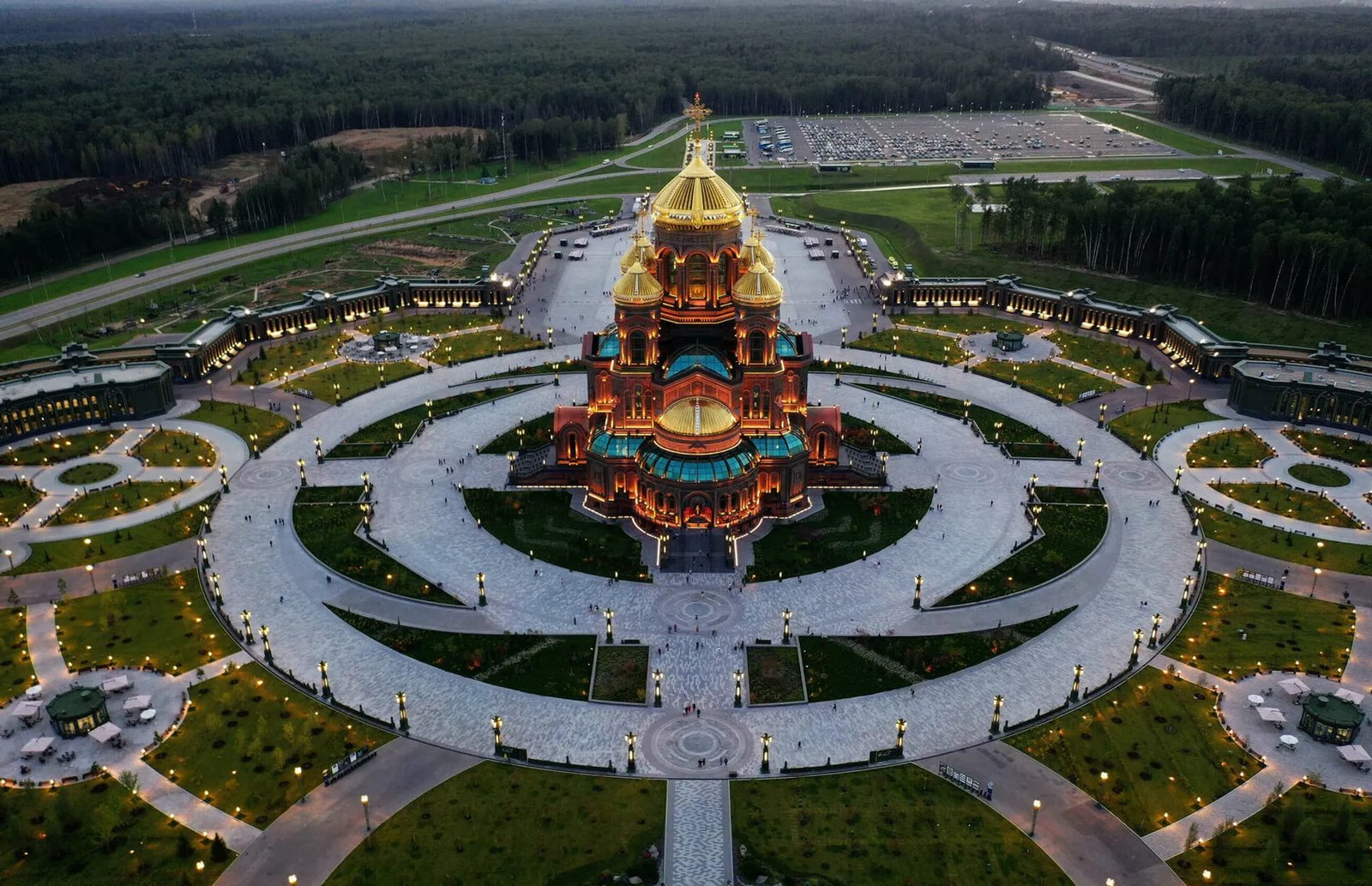
“Temple of War” is a book by historian Ilia Veniavkin. According to the author, one of the starting points for writing the book was a visit to the Main Cathedral of the Russian Armed Forces in Patriot Park. As Veniavkin writes in the preface, the church was built by decision of Vladimir Putin but “matured within Russian political culture over many years.” The historian draws an analogy with the Russian Ukrainian war. The order to begin the invasion was given personally by Putin, but the protagonists of “Temple of War” formed the public demand that made this war possible. The Main Cathedral is far from the only church in the country dedicated to war or the military. After 2022, churches began appearing across Russia not only in memory of soldiers killed in the Great Patriotic War but also of Russian servicemen killed in Ukraine. We show what the legacy of the Armed Forces cathedral looks like, from a mosque dedicated to the “heroes of the special military operation” to underground churches in combat zones.
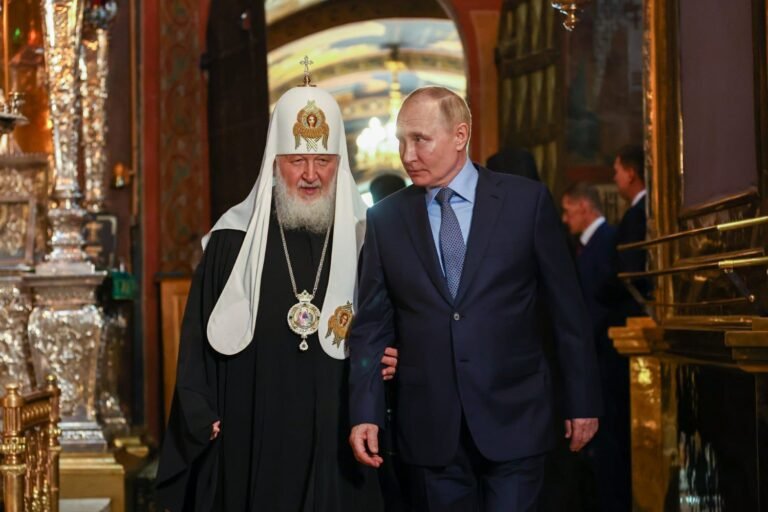
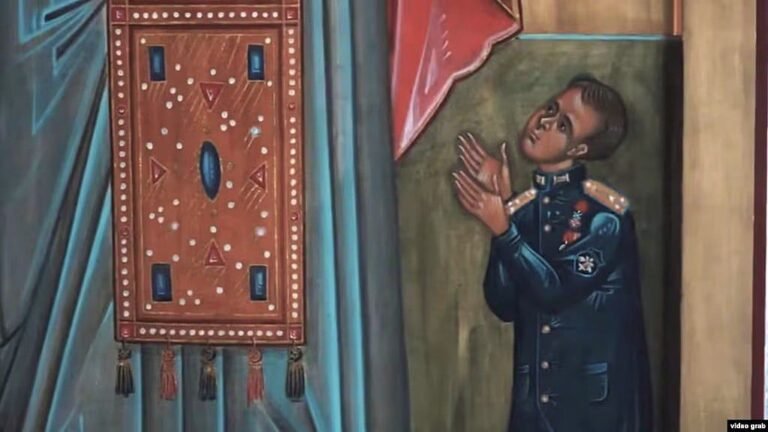
The Main Cathedral of the Armed Forces, erected in just two years, was opened in 2020 in honor of the seventy fifth anniversary of victory in the Great Patriotic War. It is one of the tallest Orthodox churches in the world. Its height with the cross reaches ninety five meters. In Moscow only the Cathedral of Christ the Saviour is taller. The complex consists of two churches, an upper and a small lower one. The upper church is decorated with large scale mosaics. Some depict Orthodox saints, others battle scenes and soldiers. The museum stores artifacts and historical exhibits, including the personal belongings of Adolf Hitler. The cathedral’s rector is Patriarch Kirill.
“German trophy weapons were melted into the steps of the church, the main icon, the ‘Saviour Not Made by Hands,’ was painted on boards taken from the carriage of an eighteenth century cannon, fastened at the back with rifle stocks. The stained glass windows show Soviet decorations, battle standards line the walls, and the inscriptions are stylized to resemble ancient Russian script.”
On 6 January 2025, the first liturgy was held in a newly opened church dedicated to the Samara Icon of the Mother of God. The church is officially devoted to the “warriors of the special military operation.” Local residents opposed the construction and at public hearings organized by the Samara administration asked for a school, a playground, or a park instead of “yet another unnecessary church.” The dome was consecrated by Metropolitan Feodosii, born Sergei Chashchin, a graduate of the Moscow Aviation Institute who served in the Strategic Missile Forces in the late 1990s.
In 2023, in Khabarovsk Krai, on the grounds of the headquarters of the Air Force and Air Defense formation of the Eastern Military District, a chapel was built in just six months. During the ceremonial consecration of the foundation stone, the local metropolitan said, “A military operation is underway, and in essence it is a war against all the evil that Western civilization has unleashed upon us, a civilization that long ago forgot God and imposes on other peoples things that are practically satanic, having departed from morality and God’s truth.”
Major General Vladimir Kulikov, acting commander of the 11th Air Force and Air Defense Army, also spoke at the laying of the first stone, noting that the church “will remind us of all those who died while carrying out combat missions during the special military operation on the territory of Ukraine.”
In February 2024 construction began on a church in Leningrad Oblast. Officials claimed that relatives of participants in the fighting in Ukraine had requested the project. The church is planned for an ordinary residential neighborhood.
Plans to build the Cathedral of the Most Holy Theotokos, dedicated to the “heroes of the special military operation and the entire Russian host,” were announced by the authorities of Krasnodar in 2025. The structure is expected to become one of the tallest Orthodox churches in Russia, with a height of seventy meters from the base to the top of the main cross.
A church in the hamlet of Kopanskoi in Krasnodar Krai will be dedicated, as stated, to “perpetuating the memory of warriors who accomplished feats of arms for the Motherland on various historical and geographical frontiers of Rus.”
In October 2024, in the Shuvakish forest park in Yekaterinburg, the first stone was laid for a mosque dedicated to the “heroes of the special military operation.” Muftis from various regions and Muslim servicemen attended the ceremony. The future mosque, with four minarets, will accommodate five hundred to seven hundred people. At the 2024 ceremony, the Moscow mufti and head of the Spiritual Assembly of Muslims of Russia, Albir Krganov, said, “Here, in this beautiful place, the mosque will remind us of the price our country paid to preserve its autocracy and sovereignty.”
Military churches are also being erected in combat zones and in occupied territories.
In 2023 the authorities of Buryatia sent a temporary Buddhist temple in the form of a yurt to the war zone for soldiers from the region. A year later, a permanent field datsan was opened at the base of the 36th Army. Mobile mosques for Muslim servicemen are also widely used in the zone of the special military operation.
Postscript LF.
This is what a dramatic visualization of the discourse on the instrumentalization of religions looks like. Manipulating the concepts of obedience, duty, and the oath is all the more frightening because it comes from churches. One of the interlocutors of our publication, Sister Vassa, called such instrumentalization a rape of conscience, in which both the state and people outside the church lose the ability to distinguish good from evil.
And this instrumentalization is bearing fruit. Over nearly four years of war with Ukraine, veterans of the special military operation returning from the front have killed, raped, and maimed more than one thousand people inside Russia itself. Most often the victims are relatives and acquaintances of the soldiers, and the crimes are committed while drinking alcohol. One can only imagine how these “veterans” will behave if sanctions on Russia are lifted and they are able to travel to Europe.