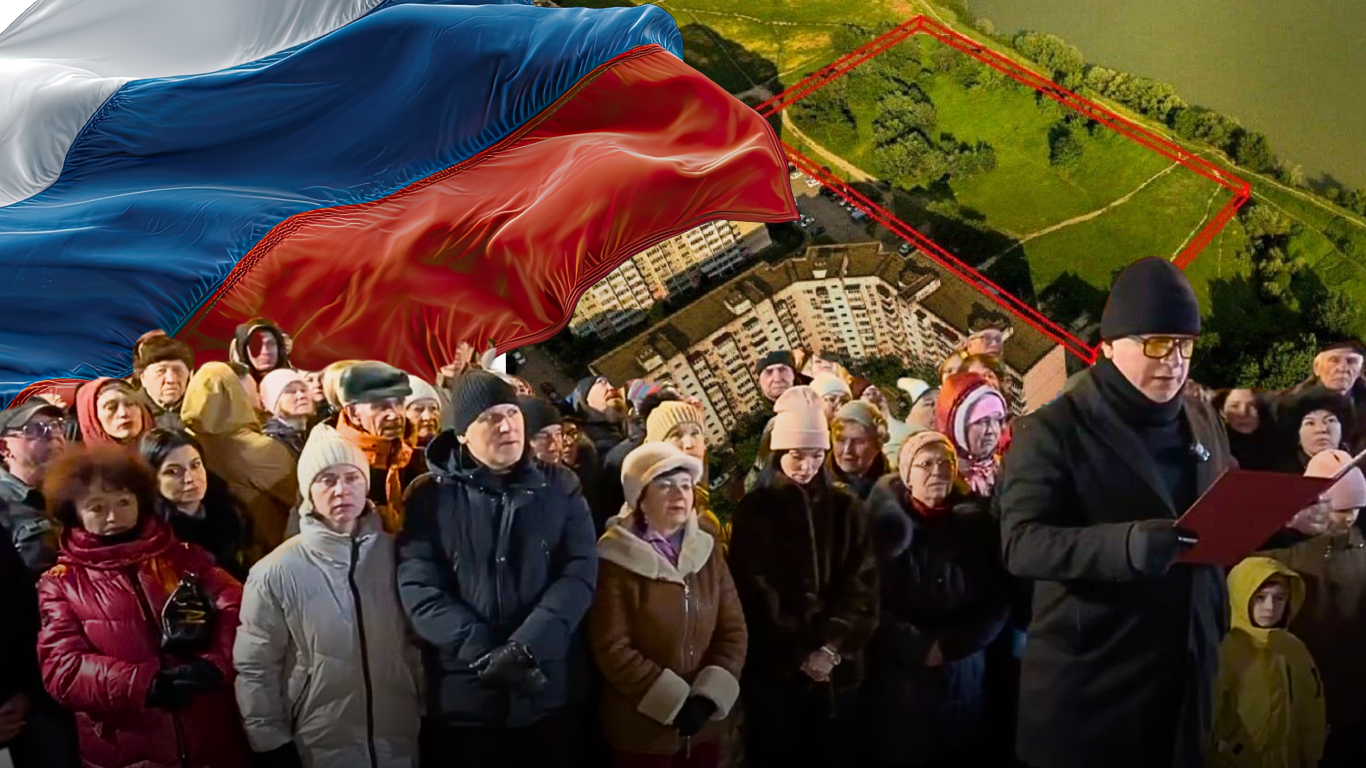
In Krasnodar, a conflict has escalated over plans to build a large church complex on Rozhdestvenskaya Embankment in the Yubileyny residential district. Despite active support for the project from the city authorities, local residents have intensified their protest: more than a thousand people recorded a video address. This came after a number of pro-government media outlets, including Orthodox ones, began accusing the protesters of “fighting against faith.”
The authorities state that the decision to proceed with construction has already been made. The site is to be dedicated to Russians who are taking part in the war against Ukraine. Local officials also present the church as a “spiritual center.”
Residents, however, argue that the chosen location is unacceptable: the project would lead to the loss of a green public area, face serious infrastructure constraints, and, in their view, may have a corruption-related dimension.
“Restore to all land plots of the Alley of the 80th Anniversary of Krasnodar Krai the status of public green space, including the 2.5 hectares already reclassified by the new master plan as land designated for religious use, as well as the plot planned for expropriation for the construction of the new church. Revoke this decision as one that violates the Development Strategy through 2030 and existing urban planning regulations,” the residents of Krasnodar insist.
What exactly is planned to be built
According to media reports, the project involves a church complex approximately 70 meters high on a site of about 3,200 square meters. Official statements about the project also mention a “500-seat hall” for meetings and events related to “patriotic education.”
Why some residents oppose it
The key argument of opponents is the anticipated loss of public space. According to them, construction would entirely occupy the green area of the embankment, which for many years has been used by residents as a place for walks and recreation.
In addition, residents point out that a large church already operates in the district, along with other religious facilities. In their view, there is no shortage of churches in the area.
A separate set of grievances concerns a possible corruption component of the project. Among opponents, a version is widely discussed according to which financing for the church complex would be provided by a private “patron,” who in return could receive preferences from the city authorities, including land plots for high-rise residential development. Residents link this version to past experience with the development of waterfront areas and to the lack of transparent information about the project’s financing.
How the authorities explain the decision
On December 5, 2025, the governor of Krasnodar Krai, Veniamin Kondratyev, said on the air of the television channel Kuban 24 that the church would be built and dedicated to participants in the so-called “special military operation”. He linked the project to appeals from Russian servicemen and emphasized that it was about creating a “spiritual center,” including a 500-seat hall.
In the autumn, the conflict began to rapidly acquire a political dimension. In early November, residents launched a signature campaign calling for the resignation of Krasnodar mayor Yevgeniy Naumov, accusing him of “splitting society along religious lines”.
After a protest action on November 30, rhetoric about a “protest against God” intensified in the public sphere. Boris Korchevnikov, генеральный director of the Spas television channel, called the residents’ gathering “a feeble Krasnodar Maidan” and a “coven”.
“A church is the only thing that makes Russia as Russia, and Russians as Russians,” Boris Korchevnikov said.
In December, following statements by the authorities, the conflict was effectively shifted from a discussion about the location and parameters of construction into a debate framed as “for or against memory and war.” Under these conditions, any protest against the project begins to be perceived not as an urban planning dispute, but as a political stance.
Why this conflict goes beyond a dispute over “just another church”
The story of the Yubileyny district illustrates a situation typical of Russian cities: public urban space — an embankment and green area — collides with a large symbolic project that the authorities promote as “value-based” and “patriotic”.
Once the project is given the status of a “church in honor of the heroes of the special military operation,” an urban planning dispute turns into a moral test of loyalty. Disagreement with the project begins to be interpreted as ideological deviation rather than as the position of city residents defending their right to a livable urban environment. As a result, discussion about transparency of decision-making, development interests, and the preservation of public spaces is replaced by a division between “ours” and “theirs,” which effectively blocks the possibility of compromise.