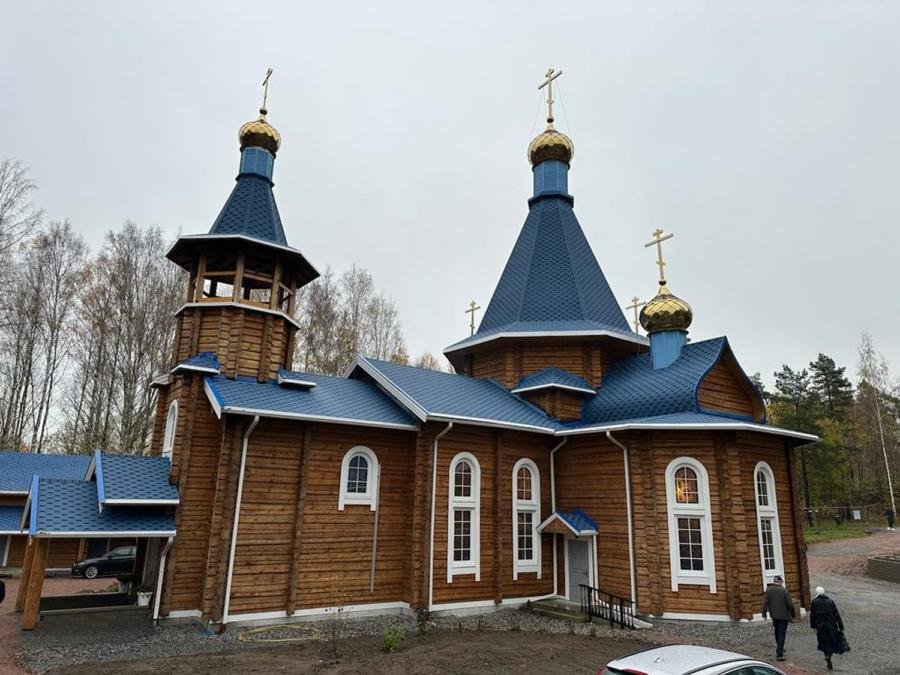
In the Swedish city of Vasteras, a conflict continues over an Orthodox church of the Moscow Patriarchate. City authorities regard the church as a potential threat to national security and have initiated proceedings for its compulsory expropriation. This was reported in an article by Dagens Nyheter.
The case concerns a parish of the Russian Orthodox Church of the Moscow Patriarchate, whose church was opened in 2023 near the local airport, approximately 300 metres from the runway. After Sweden joined NATO, the airport was granted reserve status and is used in military exercises, which, according to politicians, increases the risks.
The municipality has submitted a petition to the government for the expropriation of the building.
Elisabeth Unell, a member of the municipal council from the opposition Moderate Party, stated that the concern is not the religious community itself but its ties to Russia and the strategic location of the church.
In 2024, the Swedish Security Service, Sakerhetspolisen (SAPO), noted in its assessment that Russia uses structures of the Moscow Patriarchate as platforms for intelligence gathering and influence. Following this, communities of the Moscow Patriarchate in the country lost state funding.
The city’s mayor, Social Democrat Staffan Jansson, acknowledged that the building permit granted in 2017 had been issued in conditions of insufficient information. According to him, the current security situation differs substantially from that which existed before Russia’s full scale war against Ukraine and Sweden’s accession to NATO.
It is known that in 2021 to 2023 funds for the construction of the parish house were provided by a foundation linked to the Russian state corporation Rosatom.
Additional attention was drawn by reports that the rector of the church, Pavel Makarenko, allegedly received a medal from Russia’s Foreign Intelligence Service. A photograph of the award appeared on a website associated with the Moscow Patriarchate but was later removed. The priest himself denies both receiving the medal and any involvement in espionage activities, claiming that the photographs may have been the result of a hacking attack.
Representatives of the parish state that they are engaged exclusively in religious activities and have no connection to politics or special services. According to them, among the approximately 300 active members of the community are citizens of various countries, including Ukraine.
The case is under consideration by the Government of Sweden. If the expropriation is approved, the owners must be paid compensation in the amount of the market value of the property plus 25 percent.
The situation in Vasteras has become an example of a broader dilemma for European countries, namely how to reconcile the protection of national security with guarantees of freedom of religion in the context of hybrid warfare conducted by Russia.
As LF reported, the Russian Orthodox Church in Sweden began showing interest in building a church in this area in 2012. Despite the fact that in a city of 160,000 residents the Moscow Patriarchate has only around 100 parishioners, the land for the construction of the church was nevertheless obtained.
Earlier, according to LF, the Russian Orthodox Church intended to build a chapel on the Norwegian island of Vardo, in close proximity to a NATO radar station. Representatives of the diocese asserted that the site was indicated by God, while local authorities and experts viewed the initiative as an instrument of Russian presence in a strategically important region.