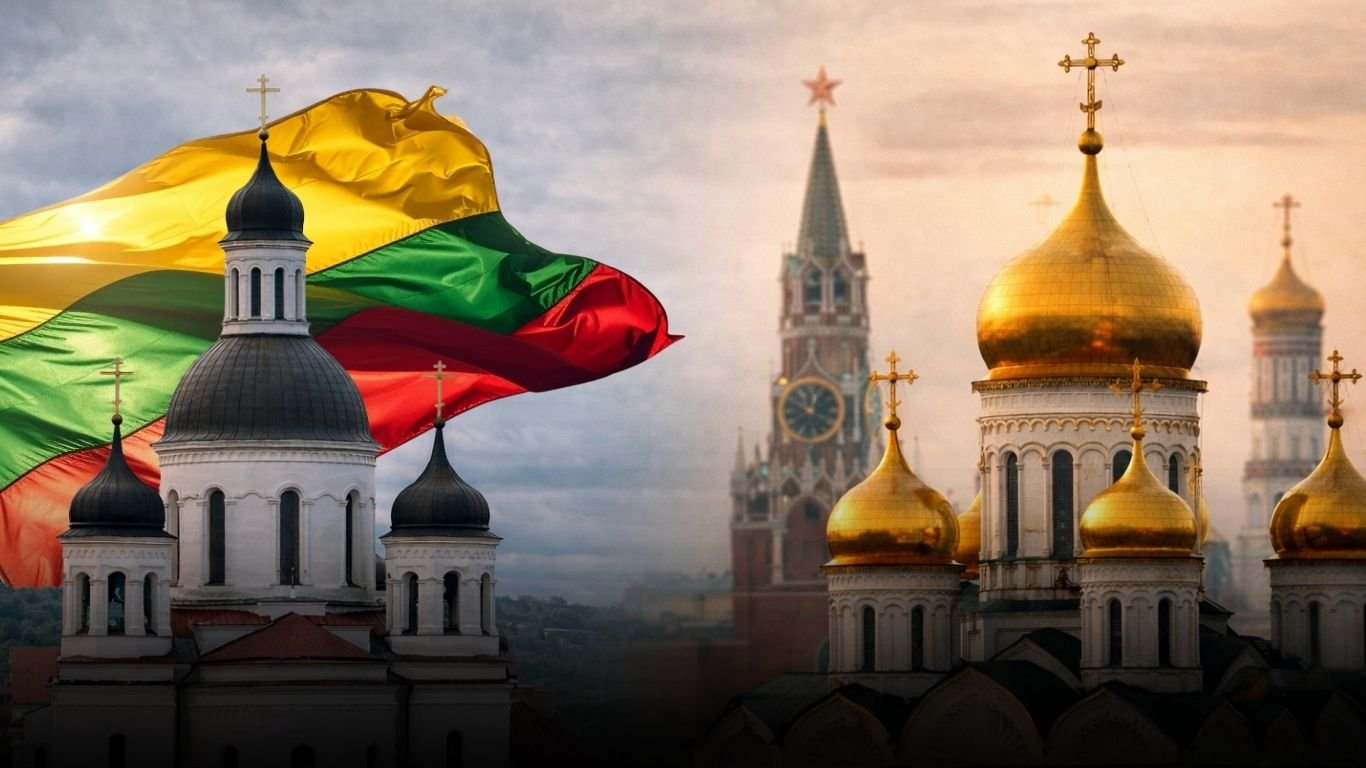
The Vilnius and Lithuanian Orthodox Diocese remains dependent on the Moscow Patriarchate despite its declared aspiration for independence.
This is indicated in the latest national security threat assessment prepared by Lithuania’s intelligence services and presented on March 6, the publication Delfi reports.
According to the intelligence services, by using these dioceses, Russia spreads its ideological influence within the Lithuanian Orthodox community. Although, as stated, the leadership of the diocese has officially expressed a desire to seek greater independence from the Moscow Patriarchate, such a status would not allow it to make decisions independently.
“The leadership of the diocese has officially expressed a desire to achieve greater independence and appealed to the Moscow Patriarchate with a request to grant it the status of partial self governance. Contrary to the claims of representatives of the diocese, such a status is not exceptional and does not provide the possibility to make decisions independently. If the diocese is granted the status of partial self governance, the patriarchate will retain influence over the most important administrative decisions. It will approve the appointment of the head, the formation of governing bodies, judicial decisions, and all decisions of the patriarchate will remain in force,” the published national security threat assessment states. The assessment was prepared by the State Security Department of Lithuania and the Second Investigation Department under the Ministry of National Defence of Lithuania.
“According to the intelligence assessment, the Vilnius and Lithuanian Diocese is seeking the status of partial self governance in order to avoid public criticism of its dependence on the Moscow Patriarchate while remaining fully under its influence,” the presented assessment emphasizes.
It is noted that the issue of the subordination of the Vilnius and Lithuanian Diocese has already been considered at the Holy Synod of the Moscow Patriarchate. However, the patriarchate has allegedly not yet taken any decisions granting the diocese greater autonomy.
“On the contrary, the leadership of the patriarchate responded to the public statements of the diocese about the desire to achieve greater independence by creating a new division responsible for supervising dioceses operating abroad and subordinated to the patriarchate,” the intelligence agency reports.
At the same time, it is stated that the creation of a church subordinate to the Ecumenical Patriarchate of Constantinople in Lithuania strengthened the clergy of the Vilnius and Lithuanian Diocese that remained under Moscow’s control and encouraged them to work more actively to retain believers and attract new members of the community.
“The leadership of the Moscow Patriarchate is monitoring the development of the newly created church subordinate to the Ecumenical Patriarchate of Constantinople and considers this process a threat to its interests. Therefore it will seek to limit its activities and preserve its influence over the Vilnius and Lithuanian Diocese,” the threat assessment says.
According to the intelligence assessment, by using its dioceses Russia spreads ideology and thereby strengthens its influence abroad.
“The Orthodox Church occupies an important place in shaping and supporting the ideological narratives of the Russian regime. Russia uses the Orthodox Church to spread the idea of the ‘Russian world’ and to strengthen its influence in foreign countries, especially in those where large Orthodox and Russian speaking communities live. Due to its strictly hierarchical structure, the Moscow Patriarchate has significant influence over the dioceses subordinated to it abroad. The Vilnius and Lithuanian Orthodox Diocese operating in Lithuania belongs to the patriarchate, which gives Russia the opportunity to spread its ideological influence within the Lithuanian Orthodox community,” the country’s intelligence services state.
“The support by Patriarch Kirill of Moscow for Russia’s war against Ukraine prompted some clergy of the Vilnius and Lithuanian Orthodox Diocese subordinate to the Moscow Patriarchate to express their disagreement with the military aggression against Ukraine. In response to pressure from the public and believers, the leadership of the diocese publicly condemned the war and repeatedly declared its aspiration for greater independence from the Moscow Patriarchate, but no substantial changes have occurred in this area,” the national security threat assessment emphasizes.
After the intelligence report appeared, the Lithuanian Orthodox Archdiocese issued a comment emphasizing that it is not a branch of any foreign religious organization, LRT reports.
“The connection of our community with the Moscow Patriarchate is canonical in nature. Through it our religious community is linked with the universal Orthodox Church. This is a matter relating to the thousand year canonical traditions of the Church and has nothing to do with the modern politics of any state. It is also a matter of church traditions and religious identity,” the archdiocese stressed. According to it, the request to grant the status of a self governing church is an attempt to align the canonical status of the religious organization with the current situation.
“This issue is currently under consideration. However already today all decisions in the Lithuanian Orthodox Archdiocese are made only in Lithuania and fully independently, and any opposite claims do not correspond to reality. Through the activities of the Lithuanian Orthodox Archdiocese the teaching of Jesus Christ is spread, not the ideological influence of a neighboring state,” the comment states.
P.S. Lithuanian intelligence services, the State Security Department and the Second Investigation Department under the Ministry of National Defence, annually present to the public an assessment of national security threats. This document examines events and processes that have the greatest impact on the national security situation in Lithuania. On their basis and taking into account long term trends affecting national security, assessments are presented of the most important threats and risk factors that may arise for Lithuania’s national security in the near future up to two years. Assessments of long term trends are presented in the review with a perspective of up to ten years.
LF Commentary:
The reaction of the Lithuanian archdiocese does not withstand either the expertise of theologians and historians or the simplest fact checking by those who were expelled from there for their anti war position and their desire to distance Lithuanian Orthodoxy from Moscow.
Dozens of interviews given by representatives of the already established exarchate of the Ecumenical Patriarchate confirm that subordination to the Moscow ecclesiastical leadership remains unchanged, as does the threat of risks of influence on parishioners and the formation of pro Russian sentiments in this environment. The reaction of the archdiocese to the public attack on the Ecumenical Patriarch by the Foreign Intelligence Service of Russia is symptomatic. Silence.
And most importantly. The clergy of the archdiocese speaks about alleged independence from Moscow for society and the government. At the same time, a serious canonically weighty step would be notification of all local Orthodox churches about its alleged independence. But the Moscow jurisdiction in Lithuania is not rushing. Does it not want to. Or is it unable to.