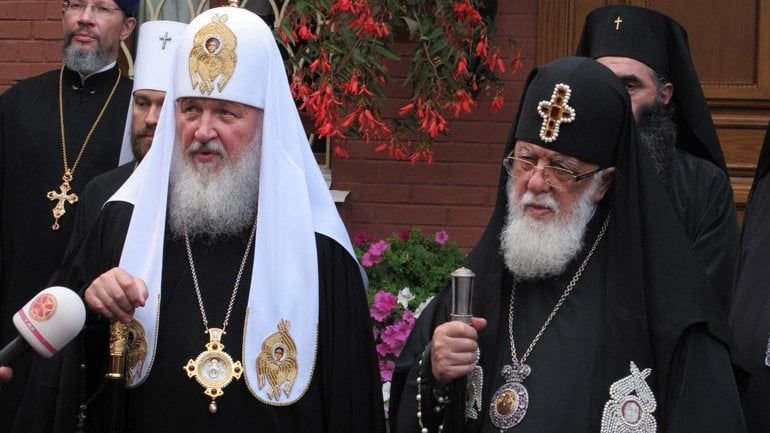
Moscow Patriarch Kirill has made a controversial statement regarding the upcoming election of a new patriarch in Georgia. In essence, he warns the future primate not to continue the process of recognizing the autocephalous Orthodox Church of Ukraine.
This was reported by Orthodox Times. The authors of the article interpret Gundyaev’s words as interference in the internal affairs of another church.
Patriarch Kirill speaks of the “interference” of the Phanar in the church life of Ukraine and notes that “some Churches” do not support the position of the Ecumenical Patriarchate.
“We hope that this will also be the case in the Orthodox Church of Georgia, which will soon elect its new primate after the death in March of this year of the late Catholicos-Patriarch Ilia II,” Orthodox Times quotes Kirill as saying.
Kirill’s statements were made during an event held several days ago at the Ministry of Foreign Affairs of Russia. However, in the text published by the Moscow Patriarchate about the meeting, this specific statement is absent, and in the video posted on the Patriarchate’s website, the relevant fragment appears to have been removed. The video recording was found on other Russian platforms.
As is known, on March 17, at the age of 93, the Patriarch of Georgia Ilia II, Iraklii Georgievich Gudushauri-Shiolashvili, passed away in a hospital. Ilia II, one of the most influential religious figures in Georgia, had held the post of Catholicos-Patriarch since 1977. His patriarchate was the longest in the history of the Georgian Orthodox Church.
As LF wrote, the Georgian Orthodox Church took an important step toward electing a new patriarch by concluding a session of the Holy Synod to nominate three candidates for the vacant Patriarchal Throne. The candidates nominated for the patriarchal throne were Metropolitan Shio of Senaki and Chkhorotsku, Mujiri, Metropolitan Iov of Ruisi and Urbnisi, Akiashvili, and Metropolitan Grigol of Poti and Khobi, Berbichashvili.
Earlier we reported that according to the Church’s 1995 statute, the election must take place no earlier than 40 days and no later than two months after the death of the Patriarch, with May 17 as the latest possible date.
The Expanded Council will include both clergy and laity, although only members of the Holy Synod have the right to stand as candidates and to vote. To be elected, a candidate must receive more than half of the votes, at least 20 out of 39. If no candidate reaches this threshold, a second round of voting is held.
As LF reported, Russia’s Foreign Intelligence Service issued a sharp statement addressed to Ecumenical Patriarch Bartholomew I, accusing him of attempts to destabilize the situation within the Georgian Orthodox Church after the death of Catholicos-Patriarch Ilia II.
Earlier, in an exclusive interview with LF, Nugzar Suaridze, a Georgian independent investigative journalist, spoke about Russian influence on the Georgian clergy and about whether the Church of Georgia is capable of overcoming it or willing to do so.
For more on what the Georgian Orthodox Church will be like without Ilia II, read the article on LF.