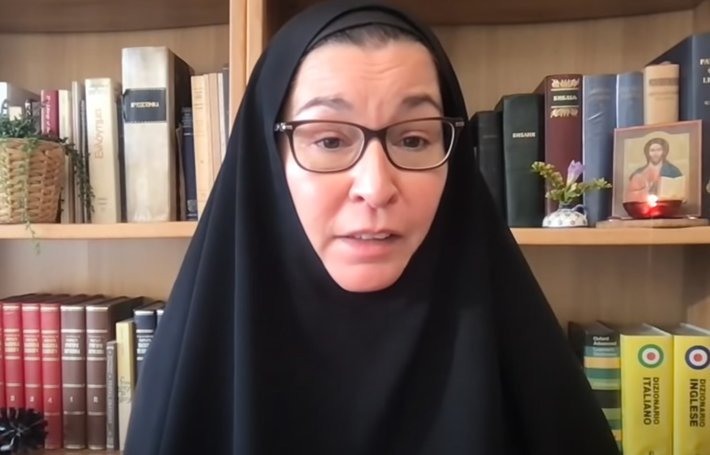
Sister Vassa Larin is the most prominent female voice in the Eastern Christian tradition. This is due to her theological education, her commitment to truth, and her work as a podcaster, her program “Coffee with Sister Vassa” airs five times a week. At the same time, she is deeply committed both to church practice and to her teaching work. Our previous interview with her touched on her monastic path as well as her bold critique of the “Russian world.” This time, we spoke about her recent trip to Lithuania, and since the conversation took place on the eve of Pascha, we also found it fitting to discuss this central event for Christians.
— Vassa, you recently returned from Lithuania. Could you sum up the results of this visit? Do you see changes in Orthodoxy in the post-Soviet space?
— I was there at the invitation of the Lithuanian Exarchate under the jurisdiction of the Ecumenical Patriarchate. They refused to move in step with the Moscow Patriarchate, which supports the war and the killing of Ukrainians, calling it a “sacred duty.” Of course, this is blasphemous. This is not about self-defense, but about aggression, to seize, to subjugate, to destroy. For part of the clergy and the faithful, such justification of war was absolutely unacceptable. They separated from the Russian Orthodox Church, although they now find themselves serving in apartments, in temporary premises, rather than in splendid, well-appointed cathedrals.
I attended a service in a church located in a former prison in Vilnius. It makes a powerful impression, barbed wire, gates, a sense of a very recent past. You can see that it used to be a prison. Now concerts are often held there, and before the service people literally set up the altar again, bringing in the Holy Table. And you see how each time the community is gathered by the efforts of people who have decided not to be part of a church tradition that supports war.
And this marginalization, because of convictions, because of faithfulness to Christian values and to the notion of truth, leads to the fact that you do not always appeal to the “successful” and the “well-settled.” You carry your cross.
As for Orthodoxy in the post-Soviet space, let us hope it will not again be captured by the Soviet mindset. I have a very positive impression that it is moving away from this Soviet legacy. It was not afraid to move into what seems like marginalization, but in fact into the canonical Ecumenical Patriarchate.
Although in the mouths of those who like to use the word “canonical,” it often has a distorted meaning. It is frequently just a buzzword used by propaganda to alarm people, even though they do not understand the term at all.
What is normal for a given society is not always what is normal for us. For us, what is normal is the crucified and risen Christ. For us, the way of the cross is normal, it is normal to say that blessed are those who are persecuted for righteousness’ sake.
So we must resist the distortion of concepts, the distortion of the very idea of the Orthodox faith, when it is presented as violence or as darkness that suppresses, rather than affirms, human conscience.
The faith of Christ is not anti-human, on the contrary. Christ went to the cross and voluntarily allowed all the forces of aggression, malice, and envy to fall upon him, entirely without cause. He took all this into himself, because he was both fully human and fully divine.
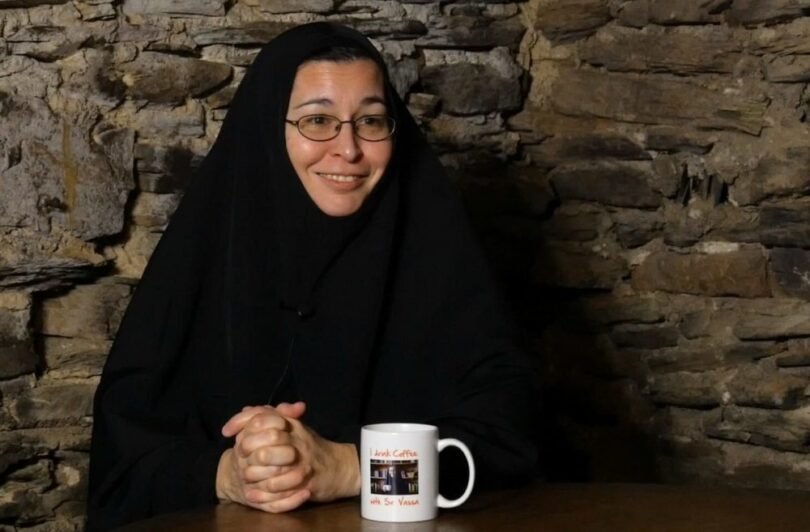
— You inspired your Lithuanian friends with your presence and your words. How do you yourself feel about this visit?
— I was very grateful for the warm reception. It seemed to me that everything went well, people listened attentively. I gave one lecture. It was not specifically political, although today everything is connected with politics. I have never believed that the Church exists outside politics. That is impossible, especially now, when everything is tied to political meaning.
Today it is impossible to avoid assessing the sides. And I am not speaking only about the war between Ukraine and Russia. At the geopolitical level there are sides that stand on fundamentally different value foundations, deeply rooted in worldview and philosophy, touching on faith itself.
On one side are regimes that serve themselves, deny human freedom, and use people as a resource, as expendable material.
On the other side are countries that, for all their imperfections, strive to place the human person at the center and to preserve human dignity. This does not mean they are ideal, but what matters is what they strive for.
On one side stand the Russian regime, the fanatical and highly aggressive Islamist regime in Iran, North Korea with its own ideological fanaticism, and China with an ideology that allows for material prosperity but completely denies human freedom. The question is, on which side is the Trump White House? There are clearly sympathies toward these regimes, although this is not characteristic of American democracy, which has not traditionally sympathized with dictators and gangsters.
These are regimes that serve themselves and deny others the right to live in freedom. They do not value the human person. They do not develop their people as their main resource, but instead develop their own power by exploiting the resources of their country and their people.
The human being there is not in first place, but is simply expendable, cannon fodder. People exist to serve the interests of a very narrow elite. On the other side, where Ukraine stands, are the free countries of the West, with well-known exceptions such as Hungary under Orban and Slovakia under Fico. But Western Europe, in any case, stands on the side of the human person. This does not mean they live in luxury simply because they value human life. It is difficult for them to make rapid military decisions. But this is both a weakness and a strength. They listen to the voice of the people. And it is important for them to preserve human freedom.
Human dignity and humanity itself are lost sight of on the other side, because for them the human being is expendable. And people who live long in such systems lose the sense that they themselves can do anything. Even churches that serve such regimes begin to speak this language. And if it is formally a Christian system, as in Russia, then the Church also speaks this language. That so-called Orthodoxy, which developed in the Soviet period, speaks a distorted language and uses Christian concepts in a distorted sense, such as obedience, meekness, and the cross, stripping them of the meaning given by Christ himself.
Christ did not come to humiliate everyone and crucify them in order to enslave them to a state or church structure, as if all must now become sheep and cease to be human. On the contrary, he came so that we would not fear those who seek to destroy the human being, and would not avoid confrontation when it is inevitable, when darkness descends. He does not say that we must seek confrontation. He himself prays to God the Father that, if possible, this cup might pass from him. In the Gospel narrative, one can find many parallels to what is happening today, both in the world and in church life.
— For example?
— Pilate’s phrase, “What is truth?”, when he makes his decision about Christ, is the same as when people today say, “It is not so simple.” No. There is good and there is evil, and evil must be resisted.
Why did Christ ascend? So that people would understand, through the image of the ascension of the flesh, the elevation of human dignity. That you are not refuse, not expendable material, you are raised above the heavens. And he said to them, “Wait, I will send you another Comforter.” This was about the Holy Spirit. It was so that we would understand that only God, becoming man, could lift us out of the mire in which we are stuck, out of our failure to understand how loved and valued we are by God.
— What will be the fate of global Orthodoxy, given the wars, the position of the Russian Orthodox Church, and its conflicts with Greek churches?
— I do not really like the term “global Orthodoxy.” In the Creed there are no words about “Orthodoxy,” there is the Church.
I think this concept must change in our minds and hearts. We need to deepen our understanding of the Church. How this will affect structures and jurisdictions, I do not know.
For now, we see two sides. The Ecumenical Patriarchate, which at this moment appears to be the healthier side, and in general the Orthodox churches connected with it. But there are also Greek churches inclined to support Moscow for various reasons, such as the Jerusalem Patriarchate, where substantial financial support from Moscow is well known.
But the Russian Orthodox Church, the largest structure, at this moment shows itself faithful to principles other than Christian ones.
Therefore, those who value their belonging to the Church of Christ, rather than to the richest or most powerful structure that insists on its own “canonicity,” should not be afraid of being accused of disobedience.
If we are afraid to disobey a church authority that itself is not afraid to disobey the Gospel, then whom do we serve? Our life on earth is not infinite. Before whom will we answer in the end? Before some synedrion or council of bishops? No, we will stand before Christ and his judgment.
Masks are falling, including from church authorities. This is an apocalyptic time, in the sense that much is being revealed.
All this forces us to go deeper, not to understand church life superficially. The Church is not necessarily where there is outward splendor, a magnificent choir, or a grand cathedral. It may be in an apartment, as I saw in Lithuania.
God is not some “little god” in the hands of a swindler in Moscow. That cannot be, otherwise it would not be God at all. We must free ourselves from such notions. God has not handed himself over as property through some backroom deal with crooks and thieves. If that is the God in our minds, then we are already serving an idol.
It is important that we ourselves understand the simplest thing, that we do not want to be on the side of these criminals. But that is not enough.
We must continue to work on ourselves, to allow God to enter our hearts, not to close ourselves off. It is very important not to fall into despair. The cross is not about hopelessness. Not at all. It is about standing firm, about remaining faithful, even when we cannot change everything.
We must support one another in spirit. Even when it seems that everything is over, Christ has died, was tortured, buried, and God seems silent. This silence is not without hope, because we know that he will rise. And each year we must live through these days again, because we are growing.
Even Christ cried from the cross, “My God, my God, why have you forsaken me?” But everything was fulfilled as it had to be, and his final word was, “It is finished.”
When a country is attacked by criminals, someone must stop them. And our soldiers and our people need support, so that they know this is not a meaningless struggle. People give their lives to protect others, their children, their homes.
But we always keep hope. We say in the Creed, “I await the resurrection of the dead and the life of the age to come.” This hope already begins to be fulfilled here, when we overcome our fears and doubts.
— Do you follow events in Africa? Russian structures are being registered there, and later we find their people fighting in Ukraine.
— There are people who truly believed in Christ and thought they had found the Church, and agreed to Moscow’s leadership. And there are those who simply wanted to earn money. Judas was like that.
Christ accepts people who can come to understand the Word of God and realize that their intentions were not pure. But if a person clings to intentions that contradict the Gospel, it can end very badly, as it did for Judas.
It is clear how Moscow operates, offering priests twice the salary they received in the Alexandrian Patriarchate. But what then? Do they build schools, churches, educate people? I have not seen that. Where the “Russian world” comes, it leaves ruins, as in the occupied territories where even water is lacking.
And in Africa, they give money. And then what? That money will run out, sooner than we think.
— Life is turbulent and full of hardship. For those who only managed a few days of fasting, how can they feel the feast?
— I do not think the good thief on the cross fasted. Whom did Christ first receive into paradise? The thief. In the Paschal homily of Ioann Zlatoust, everyone is invited, those who fasted and those who did not. Christ came to save not the righteous, but sinners.
Coming to church in search of feelings is just serving oneself. We come to say, “Thank you, Lord. I am with you as I am.” We come to show, to ourselves, to others, and to God, that we are on the side of the light.
Let us be as we are. The important thing is to remember that the Lord loves us.
Anna Jansone