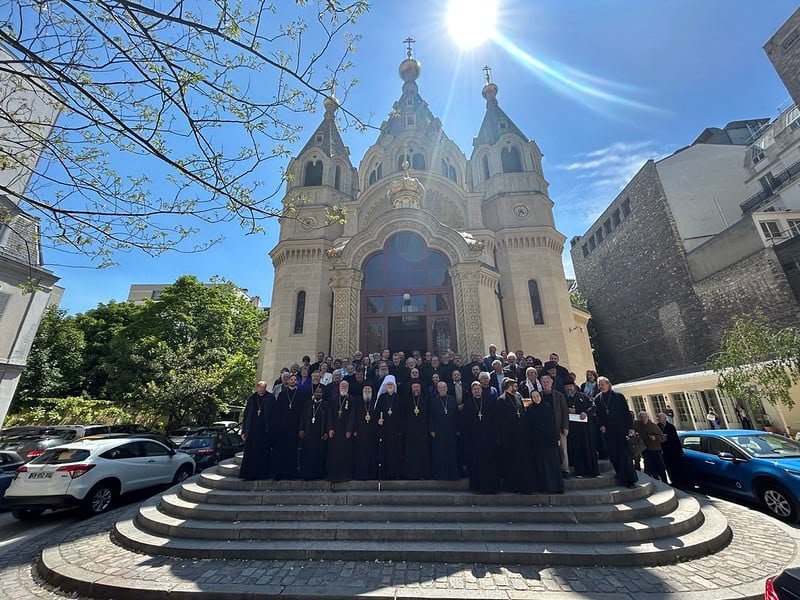
The Archdiocese of Orthodox Churches of Russian Tradition in Western Europe, which joined the Moscow Patriarchate in 2019, is accusing the Moscow Patriarchate of obstructing its activities, particularly by ignoring personnel matters.
This was reported by journalist Kseniya Luchenko on the Telegram channel Orthodoxy and Zombies.
Ahead of the diocesan assembly scheduled for June 26–27, Metropolitan Ioann of Dubna (Renneteau) sent an address to the clergy and laity of the Archdiocese. In it, he accuses the Moscow Patriarchate of blocking the normal life of the Archdiocese and proposes disregarding Moscow’s opinion when resolving important personnel issues.
Back in 2023, the Archdiocese submitted three candidates to Patriarch Kirill for the positions of auxiliary bishops. Of these, only Hegumen Avgustin (MacBeth) was ultimately approved and became auxiliary bishop for Great Britain and Scandinavia in December 2025. Moscow has failed to respond regarding the other two candidates for three years despite repeated reminders.
Metropolitan Ioann writes that the number of parishes is growing in France, Germany, and Italy, while he himself, because of age and health, can no longer adequately provide pastoral oversight across all territories. Bishop Simeon is likewise unable to cover several countries simultaneously. Bishop Elisei, in turn, is currently almost entirely inactive due to health reasons. As a result, the absence of new bishops places the Archdiocese in a “very unstable pastoral situation.”
According to the Metropolitan, Patriarch Kirill’s silence is causing concern and prompting questions about his intentions regarding the Archdiocese.
The Archdiocesan Council concluded that the three-year absence of a response effectively violates the terms of the 2019 Charter and paralyzes the mechanism for appointing bishops. Therefore, at the June 26–27 assembly, participants are being asked to vote in favor of holding elections under exceptional procedures despite the absence of a decision from the Moscow Patriarchate. If the assembly supports this proposal, voting is expected to take place on the two candidates originally submitted in 2023: Archimandrite Viktor (Kretsu) and Archpriest Anatolii Negruta.
The Archdiocese notes that the Moscow Patriarchate recently resolved the issue of an auxiliary bishop for the Estonian Church very quickly. It also cites the example of the Latvian Orthodox Church, which elected a bishop in 2023 without the Patriarch’s approval while maintaining canonical communion with Moscow.
According to the journalist, there is currently no discussion of either a canonical break or withdrawal from the Moscow Patriarchate. However, the Archdiocese’s leadership is effectively declaring that it is prepared to act independently if Moscow continues to ignore its requests.
The author reminds readers that not all communities of the Archdiocese joined the Russian Orthodox Church in 2019.
“Those communities that refused in 2019 to transfer to the Moscow Patriarchate and remained under the direct authority of the French Metropolitan of the Ecumenical Patriarchate, or the Archbishop of Thyateira in Great Britain, are doing very well. Where needed, they retain both the Old Calendar and Church Slavonic liturgical language. All the traditions that Russophiles were so concerned about have been preserved. No one interferes in their internal life. Their parishes and clergy are being replenished by newly arrived emigrants from Ukraine, Belarus, and Russia. They are not required to make any political compromises,” the article states.
P.S. On June 22, it became known that the Diocesan Assembly of the Archdiocese of Orthodox Churches of Russian Tradition in Western Europe had been canceled. More precisely, it was postponed to unspecified dates “after the summer.” It appears that Moscow may have become concerned.
LF Commentary:
The Russian Orthodox Church and the Russian Orthodox Church Outside Russia, consisting of descendants of émigrés and those who rejected Soviet rule and cooperation with the Russian Orthodox Church, restored communion in 2007 with Putin’s support through the signing of the Act of Canonical Communion. Nevertheless, serious new disagreements have emerged within overseas parishes in recent years. The principal trigger has been the geopolitical crisis.
Individual parishes and clergy of the Russian Orthodox Church Outside Russia in Europe, the United States, and other countries have sharply condemned Russia’s actions. Some dioceses and bishops of the Russian Orthodox Church Outside Russia have experienced tensions arising from strict centralization and decisions of the Moscow Patriarchate, including issues concerning inter-Orthodox relations and ecumenism.
A surge in the “irreconcilable” schism has also occurred. Against the backdrop of recent events, some radical believers and clergy abroad, who never recognized the 2007 reunification and accuse the Russian Orthodox Church of “Sergianism,” have intensified their criticism. Some communities are attempting to transfer to alternative jurisdictions. The leadership of the Russian Orthodox Church Outside Russia officially states that it seeks to preserve unity while acknowledging the existence of deep internal problems caused by contemporary geopolitics and the attitudes toward it among believers in the diaspora. Officially, the Russian Orthodox Church and the Russian Orthodox Church Outside Russia remain a single structure. Nevertheless, beneath the outward preservation of unity lies a profound internal crisis of governance and communication.