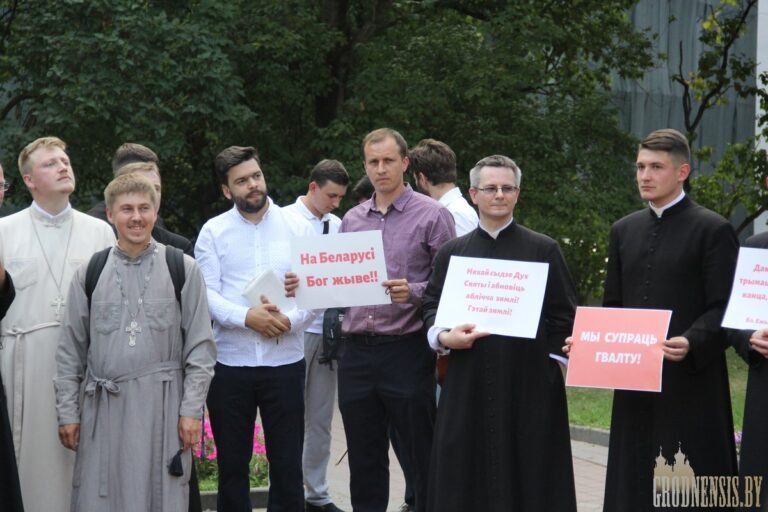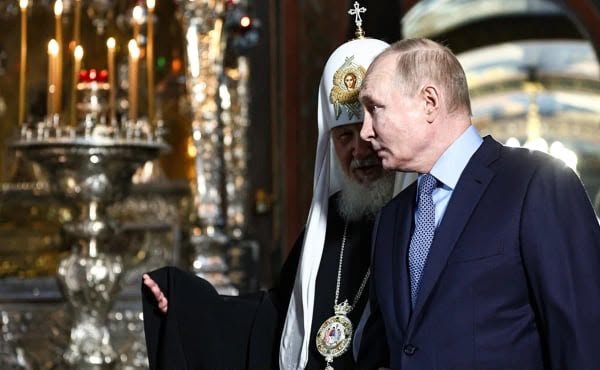
The Russian Orthodox Church coordinates with the FSB in the persecution of anti-war clergy. Evidence of this was published by religious studies scholar and former editor of the Journal of the Moscow Patriarchate Sergei Chapnin in his book Religious Communities Under Pressure: Documenting Religious Persecution in Russia in 2022–2026, published in English, reports Agents.
According to the author, well-known cases demonstrate “striking patterns of operational coordination between state and church authorities.”
This is evidenced by the joint use of evidence. Wiretapped telephone conversations and intercepted messages appeared verbatim in church court proceedings.
In addition, the church and the FSB conduct coordinated media campaigns. State-controlled media and church information services consistently publish virtually identical accounts of events concerning persecuted clergy, using the same arguments to discredit them.
In many regions, FSB officers personally visited local bishops to discuss clergy members who had taken, or might take, an anti-war position.
Chapnin notes that after the start of the war in Ukraine, the FSB significantly expanded its monitoring of parish-level communications, social media groups, and correspondence between believers, enabling it to identify dissent at an early stage.
In 2023, documents from an FBI investigation became known, some of which were found on the laptop of Dmitry Petrovsky, an employee of the Russian Orthodox Church’s Department for External Church Relations. Their contents were disclosed by Andrei Soldatov and Irina Borogan, who obtained a copy of an FBI warning to American Orthodox communities. Materials partially extracted from Petrovsky’s laptop included a confidential 2009 memorandum indicating that one of Patriarch Kirill’s first initiatives in office was to restore cooperation with the Russian security services.
Among other things, the declassified memorandum authorized “coordination with the FSB counterintelligence service.” According to the FBI assessment cited by Chapnin, Russian security services use representatives of the Russian Orthodox Church as intermediaries to establish contacts with potentially valuable targets in the United States. The document states that involving Russian Orthodox Church representatives in operational work requires “only the patriarch’s blessing,” while a “special Russian Orthodox Church headquarters” coordinates interaction with security agencies, Chapnin writes.
As LF previously reported, pressure on religious communities in Russia intensified after February 2022. Priests have been stripped of their rank for prayers for peace, church and secular courts complement one another, and state and church structures jointly punish those who refuse to justify the war. This is stated in the analytical report by Russian-American journalist Sergei Chapnin, Religious Communities Under Pressure: Documenting Religious Persecution in Russia 2022–2026, which was published as a book.
The book was written in English, primarily for Western Christians who still perceive the Russian Orthodox Church as a “defender of traditional values.”
According to Regina Elsner, a researcher of Eastern Christianity and ecumenism and a Doctor of Theology at the University of Münster, the Russian Orthodox Church has become one of the key institutions of mobilization and propaganda.
We previously reported that Pope Leo XIV and Ecumenical Patriarch Bartholomew I condemned attempts to use religion to justify violence.