History knows not only thunderous ruptures, but also quiet catastrophes. Not the single moment in which a state abruptly abandons its previous course, but the slow erosion of trust brought about by a series of seemingly separate decisions, gestures, and silences. In such epochs, the external gaze ceases to be a mere “outside opinion” and becomes a mirror of our own conscience: in it we no longer see what we would like to be, but what we are gradually becoming.
Today Bulgaria increasingly stands before such a mirror. Reflected in it is not a single article or isolated foreign criticism, but the image of a state which, at key moments, chooses to delay or block common decisions, to protect figures perceived as bearers of Kremlin influence, or to speak in half-tones where the moral landscape is painfully clear. The comparison with the Hungarian model is not a judicial verdict but a warning: the road to “sovereign democracy” does not begin with leaving the community, but with normalising exceptions – by absolutising “national interest,” recasting common decisions as “pressure,” and using the right of veto as an instrument for domestic political signalling instead of as a last-resort mechanism for defending principled positions.
When a state objectively positions itself in a way that softens the sanctions pressure on a regime waging an aggressive war, its allies inevitably begin to ask: do they see a partner who shares the common responsibility and risk, or a treaty ally who inwardly distances itself from shared principles and turns them into objects of situational bargaining? This is no longer just a political question, but a civilisational one: it concerns the boundary beyond which the argument of “sovereignty” ceases to mean good‑faith dissent and starts to serve as a cover for the refusal of solidarity.
Yet war does not begin with the veto. It begins with language. First come the words that turn aggression into a “special operation,” violence into a “mission,” and victims into “collateral damage.” It is particularly dangerous when theological language is harnessed to such justifications: when the altar becomes a rostrum of state doctrine, and the peace of Christ a backdrop for political mobilisation. At the moment when war is described as a sacred obligation or a spiritual “defence of the world,” violence no longer appears as a tragic extremity but is received as a duty. From then on, any objection can be branded not only as disloyalty to the state, but as an “apostasy from the faith.”
This is why attacks against shrines such as the Kyiv‑Pechersk Lavra are not a side episode but a moral focal point of the conflict. The Lavra is not merely a complex of buildings, but part of the spiritual biography of the entire Orthodox world – born in the 11th century, when Moscow did not yet exist as a political centre and when the spiritual horizon of Kyivan Rus’ was being shaped under the strong influence of the Old Bulgarian literary tradition. In this space, the legacy of the disciples of Cyril and Methodius finds one of its most powerful historical continuations, and Saint Cyprian of Tarnovo links the Kyivan and the Moscow metropolises along the line of spiritual kinship rather than imperial control.
When blows fall upon such a place, this is not simply the destruction of walls. It is a wound upon memory. International humanitarian law has long recognised that cultural and religious monuments are objects of special protection: their destruction, save in strictly limited cases of imperative military necessity, is regarded not only as a wartime incident, but as a breach of obligations towards humanity as a whole. Law here is not an abstraction – it is an attempt to shield memory from the logic of total war.
For the Church, however, a temple is something more: not an “object,” but a place where time is transfigured into liturgy, text into prayer, and stone into witness. In this sense, the strike against the Kyiv‑Pechersk Lavra is a strike against the very spiritual body of Orthodox civilisation. It concerns us as well – if not by passport, then by memory. Bulgaria’s presence in the history of this spiritual geography is not decorative; it is woven into the very way in which the word, worship, and ecclesial identity have moved through the centuries.
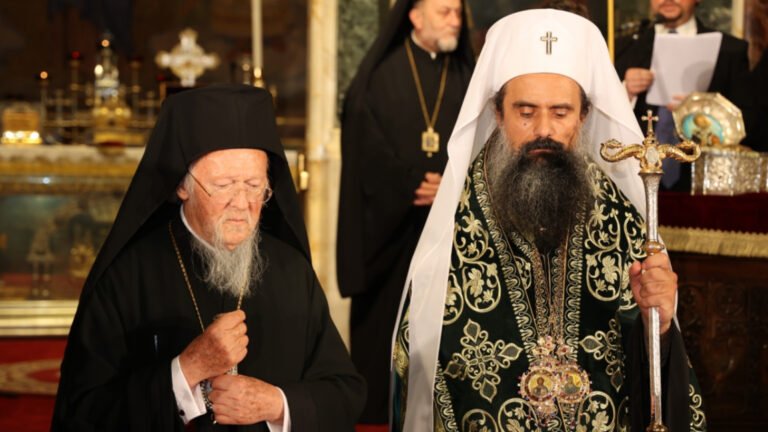
Against this background, the letter of the Bulgarian Patriarch Daniil to Metropolitan Onuphry of Kyiv cannot be reduced to a gesture of courteous solidarity. It is a document that carries weight simultaneously in canonical, legal, and political terms. It undoubtedly contains compassion for the trials of Ukrainian Orthodox Christians, yet it also exhibits a problematic blending of registers: canonical language about the “canonical” Ukrainian Orthodox Church is used as if this status were uncontested, rather than part of an unresolved inter‑Orthodox conflict; legal categories concerning registration and religious freedom are deployed as if ecclesial assessment could replace the complex balancing which every state at war is obliged to perform between freedom of religion and national security.
A legally robust position would require several clear distinctions. First, between canonical status and legal status: the Church is within its rights to indicate which community it considers canonical in a theological sense, but it cannot claim that this assessment automatically determines that community’s rights within the legal order of a sovereign state. Second, between the principle of religious freedom and the concrete legal appraisal of measures: the restriction or cancellation of a religious organisation’s registration – especially in wartime – cannot be labelled in advance as a violation without analysing the legal basis, the legitimate aim, the necessity, and the proportionality of those measures. Third, between pastoral concern and public political impact: whenever a local Church pronounces itself on internal processes in another country, it inevitably influences the political perception of those processes.
The Church has both the right and the duty to voice alarm when it sees a danger that religious freedoms may be sacrificed to political expediency. But it has no mandate to replace legal analysis with its own judgement, nor to wield canonical language in a way that erases the real legal and historical context. Still less so in a situation where the aggressor systematically instrumentalises religious structures and symbols to legitimise its political aims. In such a context, every ambiguity, every one‑sided formula, and every silence creates space for manipulation of the Church’s own word.
Beneath all this lies a deeper question: what does it mean for the Church to remain free? Not only free from the state, which invariably feels the temptation to turn her into an instrument of legitimation.
Free also from geopolitical calculations which insist that one must always choose the “lesser evil,” not “anger” the powerful, and maintain a comfortable “balance.” And free from her own desire for institutional security – a desire that can easily transform prophetic ministry into managerial prudence.
The history of Christianity knows all too many moments when the Church has lost precisely when she sought safety, and has remained true to herself precisely when she took risks for the sake of truth. Truth does not lose its power when it encounters violence; it begins to lose it when those called to bear witness to it grow accustomed to speaking of it in a half‑voice. No one is required to be a hero every day. But there are moments in which silence ceases to be humility and becomes a refusal to bear witness.
It is in such moments that the external gaze – whether that of an independent newspaper, a European partner, or Ukrainian believers under bombardment – ceases to be a “foreign interpretation” and becomes a mirror in which we clearly see the choice we ourselves have made between truth and convenience.
Ultimately, the question is not whether a given publication is “fair” to Bulgaria, nor whether a particular politician or patriarch deserves this or that assessment. The real question is what image of ourselves we are building through our decisions – political, ecclesial, civic. Are we a state capable of uniting sovereignty and solidarity, instead of pitting one against the other? Are we a Church that bears witness to Christ beyond the interests of any earthly empire? Are we a society that distinguishes peace from capitulation and compassion from comfortable indifference?
History does not judge nations solely by their victories and defeats. It judges them also by the words they have found when truth demanded testimony, and by the silences they have chosen when speech was a moral duty. Churches will be rebuilt, wars will end, the names of patriarchs and presidents will fade. But one thing will remain: whether, in the decisive moment, we preferred truth to convenience and witness to silence. It is precisely there that conscience ceases to be a private matter and becomes a responsibility before history.
Lalu Metev, 23 July 2026