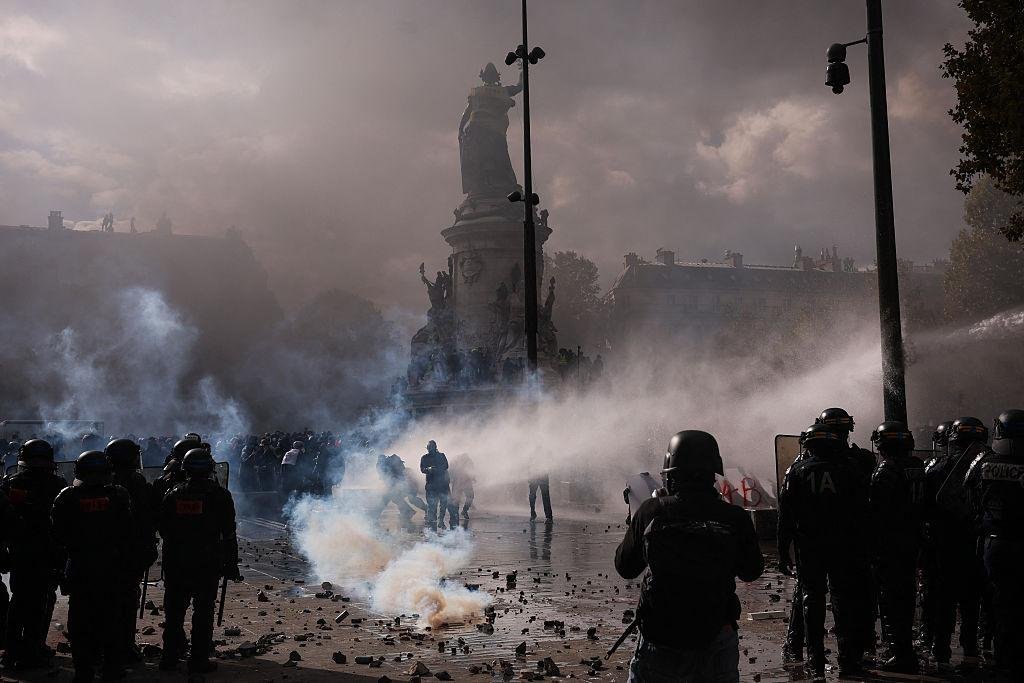
As we followed the protests in France, we were interested to see how the Catholic Church would respond to this complex situation.
Could it remain an independent moral voice in a social conflict without becoming either a defender of state authority or a religious ally of the protest movement?
This question is of particular interest to our publication. The Church’s independence is reflected not only in its ability to resist direct political pressure, but also in its willingness to assess the actions of both the authorities and society according to its own moral principles.
We analysed both individual statements by senior Church leaders and a joint statement issued by the bishops. In their collective declaration, the leaders of the Catholic Church in France condemned attacks on police officers, rioting, arson and the destruction of public property. At the same time, they stressed the need to listen to the protesters’ legitimate demands, restore dialogue and ensure justice.
Crucially, the bishops drew a distinction between lawful demonstrations and violent unrest. They did not declare protest itself immoral or illegal.
The individual statements, meanwhile, contained some particularly thought-provoking observations.
Norbert Turini, Archbishop of Montpellier, said: “The Gospel calls us not only to condemn violence, but also to hear the anger of the people and the voices of the poor… When anger grows in society, we must think not only about how to stop it, but also about what it is telling us.”
Dominique Lebrun, Archbishop of Rouen, argued that it is difficult to expect people to trust state institutions when they face unjust poverty and disillusionment, particularly when the authorities themselves fail to fulfil their obligations.
This is not an attempt to justify violence, but rather to explain the crisis of trust between citizens and those in power.
Laurent Ulrich, Archbishop of Paris, focused on the consequences of the riots for police officers, firefighters, journalists, business owners and ordinary residents of the capital.
At the same time, he acknowledged that the violence had rendered the legitimate concerns of citizens, particularly young people, invisible and unheard.
His condemnation of the rioters was therefore accompanied by a defence of peaceful protesters’ right to be heard.
François Touvet, Bishop of Fréjus-Toulon adopted particularly strong language in condemning violence. He emphasised the legitimacy of using lawful force to bring it to an end and expressed his support for law enforcement officers and firefighters.
At the same time, he acknowledged the legitimacy of expressing public anger.
His central concern was to distinguish civic protest from violent acts and to protect young people from the consequences of such violence.
Benoît Bertrand, Bishop of Pontoise, said he had personally met with 35 students from state secondary schools and listened to their concerns about the future.
He supported young people’s right to express their convictions peacefully.
He also announced the bishops’ intention to discuss issues affecting young people at their November plenary assembly in Lourdes.
This represents a concrete commitment to continuing dialogue at an institutional level, although the outcome remains unknown.
Taken together, these statements point to several clear conclusions.
First, the French bishops did not equate public order with Christian morality. While condemning the riots, they left room for criticism of state institutions.
Second, they did not give religious endorsement to the protest movement as such. The right of citizens to express discontent does not mean that all their political demands automatically become the position of the Church.
Third, there is a substantial difference between general appeals for peace and an in-depth examination of injustice. This is precisely why it is revealing to compare the statements of Turini and Lebrun with the more cautious interventions of other senior Church figures.
During the Yellow Vest movement in 2018, French bishops likewise went beyond simply condemning violence.
On 11 December, the Permanent Council of the French Bishops’ Conference called on Catholics to organise local discussions about the social crisis and convey their conclusions to elected representatives.
This raises another question:
Has the Catholic Church in France developed a consistent approach to responding to social upheaval that remains independent of party-political interests?
The French bishops demonstrated agreement on fundamental moral principles: the rejection of violence, the need to protect human dignity and respect for citizens’ right to peaceful protest.
Yet behind this shared position lie differing views of the role the Church should play during periods of social conflict.
For some bishops, the priorities are restoring order, protecting those affected and preventing further violence.
For others, the emphasis falls on the social causes of the protests, the responsibility of those in power and the need to listen to people who feel excluded from public life.
These approaches are not necessarily contradictory. Indeed, they may complement one another. But the differences illustrate just how difficult it is for the Church to speak about political crises without becoming part of the political confrontation itself.
This brings us to the central question: where does the pastoral call for peace end, and where does the Church’s duty to speak out against the injustice that fuels public anger begin?
This question extends far beyond the protests in France. It brings us back once again to the issue of religious institutions’ independence from political power and attempts to use the Church’s moral authority to legitimise government decisions.
Anna Jansone