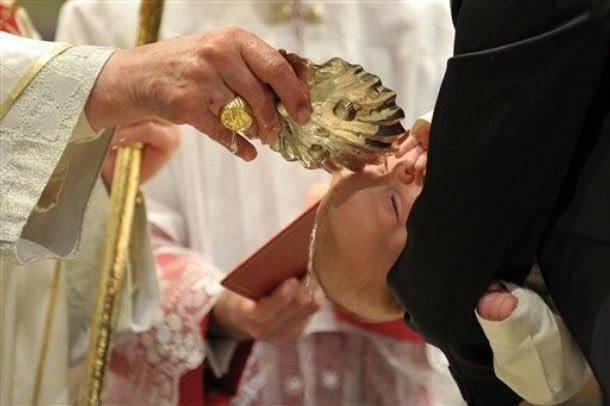
Over the past ten years, the number of Catholic baptisms on the island of Ireland has fallen by 30%. Researchers attribute this primarily to declining birth rates, as well as secularization.
This is evidenced by data from the Iona Institute, which analyzed statistics from Catholic dioceses, Credo reports.
Over the same period, the number of births on the island fell by 18.8%, by 17.9% in the Republic of Ireland and by 21.3% in Northern Ireland. According to the researchers, the demographic decline accounts for about 60% of the decrease in baptisms, while they attribute the remainder to secularization.
Census data also point to this trend. In 2016, 78.3% of children under the age of four in the Republic of Ireland were recorded as Catholic, while 9.2% were recorded as having no religion. In 2022, these figures were 65.4% and 15.6%, respectively. In 2022, 67.9% of mothers of children under the age of four identified themselves as Catholic. Based on these figures, the Iona Institute concludes that almost all mothers who identify as Catholic continue to have their children baptized.
The largest decrease among the data presented in the study was recorded in the Diocese of Meath, at 40.8%. In the Archdiocese of Dublin, the number of baptisms fell by 39.9%, while in the Diocese of Down and Connor it fell by 37.9%. At the same time, the number of baptisms in the Diocese of Elphin increased slightly, by 0.9%.
Iona Institute director Tom Finnegan stressed that the decline in baptisms cannot be explained solely by secularization. According to him, an even more important factor is the decline in the birth rate. Ireland’s current fertility rate is around 1.5 children per woman.
“This should be a cause for concern for everyone, regardless of their religious beliefs,” Finnegan said.
As LF reported, people in Moldova have the greatest trust in the Church and the least trust in political parties. The Church has the highest level of trust, with more than half of respondents, 53.5%, saying they “trust very much”, 21.8%, or “trust”, 31.7%, the institution.
As LF reported, 64% of Lithuania’s residents trust the Church. This is evidenced by the results of a survey conducted by Baltijos tyrimai.
Earlier, we reported that, according to the latest study, the Church ranks first in terms of trust among Romanian citizens. According to the survey, 63.9% of respondents said they had a fairly high level of trust in the Church, compared with 57.7% recorded in July last year.
Earlier, we reported that, according to a new study conducted by the Danish Bible Society, an increasing number of young Danes are interested in matters of faith, read the Bible, and attend church services. The findings are presented in the report God and the Danes: An Analysis of Faith 2026, published in spring 2026. The study is based on a survey of 3,000 residents of Denmark and shows that religiosity among young people is significantly higher than among older generations.
As LF reported, the number of believers is declining in traditionally Christian regions. These conclusions are contained in the report The State of Global Christianity 2026, prepared by the Center for the Study of Global Christianity at Gordon-Conwell Theological Seminary in the United States.
A study of more than 24,000 Christian churchgoers in the United States found an increase in church attendance five years after the pandemic. The report was prepared by Faith Communities Today as part of a project examining the impact of the pandemic on church communities.