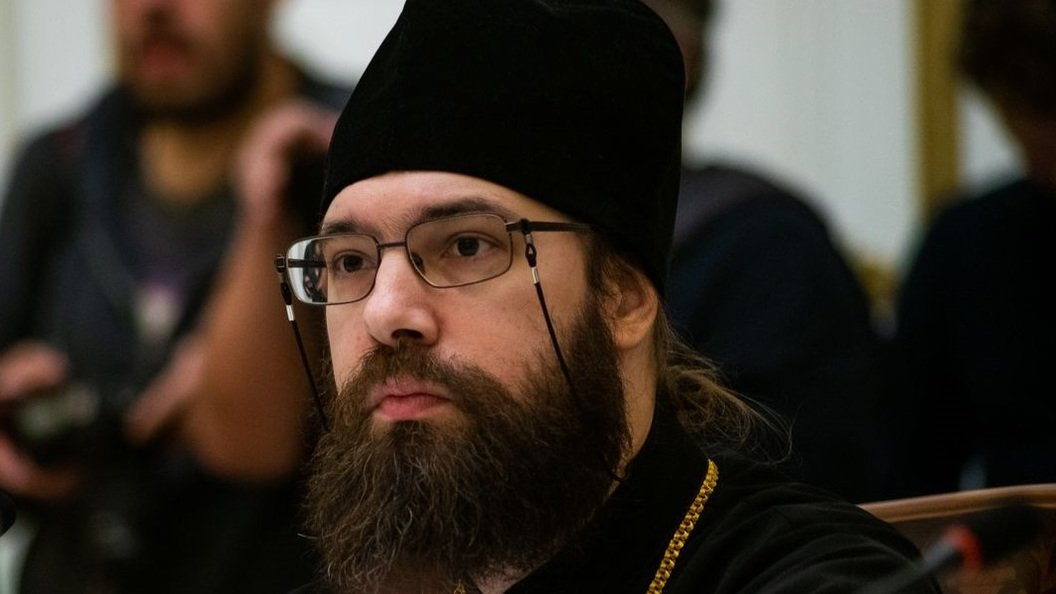
Archbishop Savva (Tutunov) of Zelenograd, one of the most prominent representatives of the nationalist wing of the Russian Orthodox Church, has formally renounced his French citizenship. Born in France, educated there and having enjoyed the legal status of a European Union citizen for decades, he has chosen to tie his political and ecclesiastical future definitively to Russia.
At first glance, this appears to be a clergyman’s personal decision. In reality, however, the story of Savva’s French passport is far more revealing.
It reflects a centuries-old contradiction at the heart of Russian imperial consciousness: enjoying the benefits of Europe’s legal order while preaching the exceptionalism of the “Russian world”, setting Russia against the West and justifying its imperial ambitions.
That is precisely why the renunciation of French citizenship should be regarded not merely as a legal procedure but also as a political gesture. There may be at least two motives behind it: removing an obstacle to further advancement within the Church hierarchy, potentially including a bid for the patriarchal throne, and eliminating a vulnerability arising from French state authorities’ interest in the activities of Russian religious and political organisations.
Not Stripped of Citizenship, but Released from It: What Happened
It is essential to clarify the legal circumstances of the case. France did not strip Archbishop Savva of his citizenship as a punishment. He initiated the renunciation procedure himself.
According to published information, his application was submitted in June 2026. On 5 August 2026, the French authorities issued Decree No. INTN2621061D. The relevant details were published on 14 August in the Official Journal of the French Republic, Journal officiel, No. 0189.
The document identifies Savva by his civil name, Serge Toutounov, born on 19 February 1978 in Villecresnes, a suburb of Paris.
The legal basis was Article 23-4 of the French Civil Code, which provides for a person holding another nationality to be released, at their request, from their legal bond of allegiance to France. In this case, the procedure was known as libération des liens d’allégeance à l’égard de la France, meaning release from the bonds of allegiance to France.
Savva himself commented on the development with conspicuous satisfaction, announcing that he had been released from French citizenship and adding: “And I congratulate myself on that.”
Notably, Tutunov had acquired Russian citizenship as early as 3 December 2007, under Russian Presidential Decree No. 1619. He therefore retained dual Russian and French citizenship for almost two decades.
As a result, he has now lost the automatic rights associated with EU citizenship, including the freedom to reside and move within the Union. However, the legal renunciation of citizenship does not imply sanctions, criminal charges or an automatic ban on entering France.
A French Upbringing and a Russian Imperial Identity
Savva’s biography is revealing. He was born into a family of Russian émigrés in France and studied at Paris-Sud University (Paris XI), graduating in 1999 with a degree in pure mathematics. He subsequently moved to Moscow, enrolled in a theological seminary and gradually joined the administrative elite of the Moscow Patriarchate.
His political and cultural identity, meanwhile, developed around the idea of a distinctive historical mission for the Russian people, Orthodoxy and Russian statehood.
The titles of his publications in Russian media are telling: “Suvorov’s Motto, ‘We Are Russians, God Is with Us’, Rings Out Loudly Once Again”, published on 18 February 2026, and “The Russian People Fought to Exist”, published on 8 May 2026.
It is particularly significant that the second statement was connected to a visit to the Main Cathedral of the Russian Armed Forces, one of the most striking symbols of the fusion of contemporary Russian militarism with official Church rhetoric.
Savva’s political commentary fits an ideological framework in which the Russian people are regarded not simply as a historical and cultural community but as the bearers of a special civilisational mission.
As early as 2023, Novaya Gazeta Europe conducted a detailed examination of his political views, nationalist rhetoric and role within the Church’s administrative system. The publication described Savva as one of the Moscow Patriarchate’s most radical ideologues.
This is where the central contradiction emerges.
Savva embraced a Russian imperial identity while retaining a French passport, a document that afforded him the privileges of belonging to Europe’s political and legal sphere.
This reflects a familiar historical pattern among Russian elites: political and ideological loyalty to the imperial centre combined with a desire to preserve personal freedom of movement and the protections offered by the West.
Dual citizenship, however, does not in itself prove hypocrisy. The contradiction lies primarily between public anti-Western rhetoric and the long-term retention of the benefits of citizenship in a country portrayed by that same rhetoric as part of a hostile political world.
The First Theory: Clearing the Path to the Patriarchal Throne
One of the most intriguing political theories is that the renunciation of French citizenship may be connected to Savva’s future career ambitions.
Within the Russian Orthodox Church, he has long ceased to be an ordinary bishop. His influence derives not only from his public statements but also from his involvement in Church administration, including the Moscow Patriarchate’s disciplinary mechanisms.
Savva belongs to a generation of relatively young Church leaders who could aspire to higher office after Patriarch Kirill’s tenure comes to an end.
The Ukrainian religious news outlet RISU, citing the Centre for Public Monitoring, has already advanced the theory that Savva is being considered among the potential candidates for the patriarchal throne. There is, however, no independent confirmation that an organised campaign in his support exists.
Formally, the Russian Orthodox Church’s charter does not prohibit the election of a patriarch who holds foreign citizenship. Yet the political reality of today’s Moscow Patriarchate differs from its formal canonical requirements.
Against the backdrop of the war against Ukraine, Russia’s confrontation with Europe and the Moscow Patriarchate’s transformation into one of the Kremlin’s ideological allies, a French passport could have become a serious liability for Savva.
Indeed, criticism on precisely these grounds had already emerged from within Russia’s own Orthodox circles. In 2023, commentator Aleksandr Voznesensky openly questioned Savva’s patriotism, pointing to the incompatibility between his nationalist rhetoric and his continued citizenship of a NATO member state.
Renouncing the passport removes a convenient target for his rivals. Savva can now demonstrate that his loyalty to Russia has no alternative, even in formal legal terms.
If Savva does indeed harbour patriarchal ambitions, relinquishing French citizenship appears to be a politically rational move: he has eliminated a weakness before his opponents could exploit it.
The Second Theory: French Intelligence Services and Possible Pressure
Another theory concerns the archbishop’s relationship with the French state.
As European security services have intensified their scrutiny of Russian influence networks, retaining French citizenship may have become not only an advantage for Savva but also a source of additional legal risks.
Journalists have suggested that French authorities or intelligence services may have signalled to the archbishop that his activities could carry legal consequences, and that voluntarily renouncing citizenship may have been a way to prevent further escalation.
The archbishop himself, however, provided grounds for speculation. Commenting on the speed of the procedure, which took less than two months from the acceptance of his documents to the signing of the decree, he suggested ironically that the French authorities might have been in a hurry to get rid of him.
The Russian Orthodox Cathedral in Paris: When a Church Became a National Security Concern
The history of relations between France and the Moscow Patriarchate already includes instances in which Church projects aroused serious suspicions among French intelligence services.
The most revealing example is the construction of the Russian Orthodox Spiritual and Cultural Centre on Quai Branly in Paris, close to the French Ministry of Foreign Affairs, government buildings and diplomatic missions.
The story began in 2007, when plans to build a new Russian Orthodox cathedral were discussed during Patriarch Alexy II’s visit to France. In 2010, Russia purchased a 4,245-square-metre plot of land for approximately €60 million.
French intelligence services, however, raised concerns almost immediately.
As reported by Le Monde, France’s domestic and foreign intelligence agencies, the DCRI and DGSE, warned as early as 2011 that equipment capable of intercepting electromagnetic signals could potentially be installed within the complex. Particular concern centred on the proximity of premises used by staff of the French presidential administration. Additional technical measures to protect communications were considered.
In 2012, the original construction project encountered resistance from the French authorities and was suspended. Officially, the objections concerned the complex’s architectural design, which was considered incompatible with its historic surroundings. The Russian side was forced to revise the project but ultimately succeeded in bringing it to completion.
The cathedral and cultural centre opened in October 2016. According to the Russian Foreign Ministry’s official description, the centre forms part of the Russian Federation’s embassy in France.
Espionage Suspicions Beneath the Golden Domes
The cathedral’s opening did not put an end to the suspicions.
In 2016, the Swiss newspaper Le Temps published an article examining the intelligence risks associated with the Russian complex. Its journalists cited concerns among French diplomats and the contents of a memorandum by a former French ambassador to Moscow, who had recommended strengthening protection against eavesdropping in the vicinity of the Ministry of Foreign Affairs.
The concerns also extended to nearby foreign diplomatic premises, including German and Swiss facilities.
Radio Free Europe/Radio Liberty likewise noted that the centre’s construction had been accompanied by fears that it could potentially be used for espionage and political influence.
There was also a broader context. A 2024 analytical report by the German Marshall Fund identifies the Russian Orthodox centre in Paris as one element of Russia’s influence infrastructure. The authors specifically draw attention to the centre’s dissemination of official Russian narratives following the launch of the full-scale invasion of Ukraine.
The Paris cathedral thus became a symbol of the dual nature of the Moscow Patriarchate’s infrastructure abroad. For believers, it remains a place of worship. For the Russian state, it also serves as an instrument of cultural and diplomatic presence. For French security services, it is a facility warranting heightened scrutiny.
Nevertheless, suspicions surrounding the cathedral cannot automatically be extended to Savva Tutunov. There is no public evidence linking him to intelligence activities.
From a French Passport to a Political Oath of Allegiance
Even so, Savva’s story fits neatly into the broader evolution of relations between the Moscow Patriarchate and the Russian state.
At one time, Orthodox communities abroad served as places where Russian religious and cultural traditions could be preserved beyond Russia’s borders. Today, the Russian Orthodox Church’s official structures overseas have become integrated into a system promoting Russian state narratives about history, identity and international politics.
Savva Tutunov is one of the most prominent representatives of this new generation of Church leaders.
His biography combines European origins, a French education, Russian citizenship granted by presidential decree and a consistent commitment to promoting an ideology of Russian national and state greatness.
That is why his renunciation of a French passport carries symbolic significance extending far beyond a personal decision.
For decades, Russia’s imperial elite sought to live in Europe and enjoy its freedoms and protections while politically proclaiming the superiority of their own civilisation over the West. Savva embodied this contradiction in a contemporary ecclesiastical form.
Now he is relinquishing one of the symbols of his European past.
Perhaps this is preparation for a contest for the highest office in the Russian Orthodox Church. Perhaps it is an attempt to eliminate potential risks in his dealings with the French authorities. Or perhaps, above all, it is a demonstration of political loyalty to the Kremlin and a response to accusations of divided allegiance that have emerged from within Russia’s Orthodox establishment.
These explanations are not mutually exclusive, but none has yet been established as the reason for his decision.
The paradox is that French citizenship did not prevent Savva from preaching the idea of Russia’s special historical mission for almost twenty years. It became inconvenient precisely when the public demonstration of unconditional loyalty acquired political value in its own right.
Savva has surrendered his French passport. But the far more important question is what future he hopes to secure by doing so, and what role he expects to play in the Moscow Patriarchate after Kirill.
One Fewer Suspected Agent of Influence. But How Many Remain?
Savva Tutunov’s renunciation of French citizenship does not mean that Russia’s ecclesiastical and political presence in France has become any less extensive or less dangerous. The history of the Orthodox centre on Quai Branly demonstrates that French intelligence services have long regarded Russian religious facilities as potential infrastructure for intelligence operations. And although there is no public evidence that Savva himself engaged in espionage, his story raises a broader question: how many other representatives of the Moscow Patriarchate who serve as conduits for Kremlin policy continue to enjoy European passports, freedoms and institutional protections?
One French passport has been returned. But that does not mean the Russian influence system itself has disappeared, a system in which religious missions, imperial ideology and Moscow’s state interests are closely intertwined. The central question for France today is not only why Savva renounced his citizenship, but also who else may be acting in the Kremlin’s interests under the cover of Church diplomacy.
The author’s views may not reflect those of the editorial team.