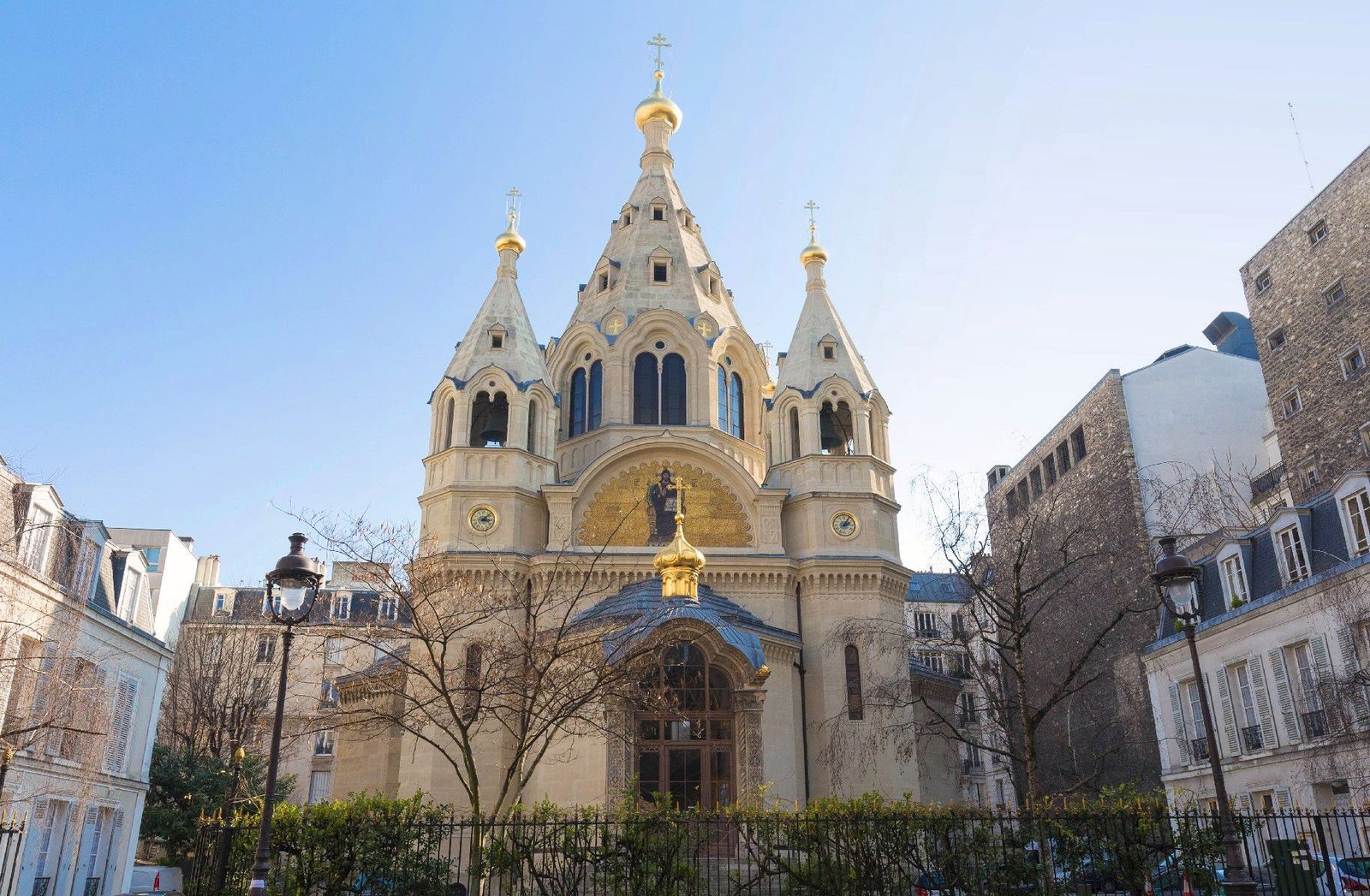
Concerns are mounting in Paris over the fate of the renowned St. Alexander Nevsky Orthodox Cathedral on Rue Daru, one of the principal spiritual and historical centres of the anti-Soviet Russian émigré community in France. Behind what appears to be an ecclesiastical dispute over the election of bishops and property rights lies a far more serious question: can the Russian Orthodox tradition in Europe preserve its autonomy, or will it ultimately fall under the control of the Moscow Patriarchate, which has become one of the ideological instruments of Russia’s ruling regime?
On 6–7 November 2026, the Archdiocese of Orthodox Churches of Russian Tradition in Western Europe is due to hold its General Assembly in Paris. Just days before this gathering, structures affiliated with the Moscow Patriarchate unexpectedly released archival documents that could be used to substantiate claims to the historic property of the émigré community, which had remained under the jurisdiction of the Ecumenical Patriarchate of Constantinople for many decades.
Following the Russian Federation’s full-scale invasion of Ukraine in February 2022, tensions between the Paris Archdiocese and the ecclesiastical leadership in Moscow intensified considerably. Metropolitan John (Renneteau) was among the few hierarchs of the Russian Orthodox Church to speak out openly against Russia’s war in Ukraine. On 9 March 2022, he addressed an open letter to Patriarch Kirill, condemning the Russian invasion and urging the Moscow Patriarch to help bring an end to the bloodshed.
Later, on 13 October 2022, the leadership of the Archdiocese once again appealed to Patriarch Kirill to call for an end to the war. It also expressed disagreement with his statements about a redemptive “sacrifice” that “washes away all sins” and guarantees a place in “paradise” for Russian servicemen killed in the war in Ukraine.
However, following these public statements, further criticism of Moscow from the Paris Archdiocese became noticeably less prominent.
Will Self-Governance Survive?
Having transferred from the jurisdiction of the Ecumenical Patriarchate of Constantinople to that of the Moscow Patriarchate in 2019, the Paris Archdiocese hopes to preserve its distinctive traditions and a degree of independence. Yet it remains under the jurisdiction of an ecclesiastical centre whose leadership is closely aligned with political regime and openly supports aggression by the Russian Federation.
That dependence now comes at a price.
Moscow intends to gradually restrict the Archdiocese’s remaining mechanisms of self-governance and fully integrate it into the Moscow Patriarchate’s centralised hierarchy. The final resolution of this question is merely a matter of time. For now, Metropolitan John, who is already of advanced age, is being tolerated in the expectation that he can eventually be replaced by a more compliant bishop.
This is the price being paid for the decision by a substantial part of the Paris Archdiocese to voluntarily enter Moscow’s “mousetrap” in 2019.
Once the trap has snapped shut, it is naive to expect the previous freedoms to survive.
The current conflict demonstrates just how illusory the self-governance promised by Moscow in 2019 may prove to be.
According to the French Orthodox publication Parlons d’Orthodoxie, the agenda for the Paris Archdiocese’s General Assembly, originally scheduled for the summer, included the question of independently electing bishops. Metropolitan John proposed two candidates, Hegumen Victor (Kretsu) and Archpriest Anatoly Negrutsu. However, according to the publication, Moscow ignored these proposals. The assembly had to be postponed until autumn, ostensibly “because of the heat”. Another candidate is now under consideration, Archpriest Matfey Leshchinsky, whom observers regard as a possible compromise with the Moscow Patriarchate.
If Moscow succeeds in imposing its own episcopal candidates and determining who will lead the Paris Archdiocese after Metropolitan John, the promised self-governance will become an empty formality.
A “Subtle Hint” or Blackmail?
Ahead of the Paris Archdiocese’s General Assembly, information about the discovery of archival documents relating to the acquisition of land and the construction of St. Alexander Nevsky Church in Paris appeared on the official platforms of the Russian Orthodox Church’s Patriarchal Exarchate in Western Europe on 31 October 2026. The documents were reportedly discovered by Alain Banon and Sylvie Dutto, founders of the Association for the Protection and Preservation of Russian Historical Heritage in France.
According to the published materials, the plot of land on Rue Daru was acquired in the nineteenth century with the involvement of the Imperial Russian Embassy, while the construction of the church was supported by Emperor Alexander II and the Holy Governing Synod of the Russian Empire.
Such a publication may be interpreted as a form of pressure, amounting in effect to blackmail directed at representatives of the Archdiocese. The implicit message is clear: if you make decisions that Moscow finds unacceptable, the ownership of your principal cathedral may be called into question.
Historic religious property is thus becoming a potential instrument of ecclesiastical and political control.
Similar mechanisms have been employed in the past in disputes over Orthodox Church property in France, particularly in the case of St. Nicholas Cathedral in Nice.
There is, however, a fundamental legal issue that Moscow prefers to overlook.
Can the Modern Russian Federation Claim Property Once Owned by the Russian Empire?
The modern Russian Federation consistently emphasises its historical and cultural continuity with the Russian Empire, particularly when it comes to former imperial possessions, monuments, church buildings and real estate abroad.
In reality, however, the Russian Federation has never formally established or recognised direct legal succession or state continuity from the Russian Empire. In its official practice, it has asserted its status as a continuator state exclusively in relation to the USSR. In such matters, the Russian Federation relies on Soviet decrees issued in 1918 repudiating succession to the obligations of the Russian Empire and annulling pre-revolutionary state debts. This approach allows Moscow to avoid accepting financial claims from creditors and liabilities arising from the imperial debts of the pre-revolutionary period.
For example, the Russian Prosecutor General’s Office recently stated RF that does not consider itself the legal successor to the Russian Empire, refusing to repay debts owed to the United States on tsarist-era bond.
However, if the Russian Federation officially refuses to recognise itself as the legal successor to the Russian Empire and to assume responsibility for all the former empire’s international debts, it consequently has no legal right to claim property abroad that once belonged to that empire. It follows that Russian claims to real estate in France, Israel and other countries have no legal foundation.
The fact that Russian emperors financed the construction of particular religious buildings abroad does not establish that either the modern Russian Federation or the Moscow Patriarchate automatically holds lawful title to the corresponding ecclesiastical property. This is particularly true of religious communities that, for more than a century, have developed their own legal institutions and independently maintained and administered church property in exile.
With appropriate legal representation, these issues could provide grounds for rejecting and/or challenging the legality of transferring church buildings and other pre-revolutionary properties in various countries to the Russian Federation.
A Fragile Opportunity
Despite its growing dependence on Moscow, the Paris Archdiocese still has an opportunity to defend its independence and demonstrate both its ability to make decisions autonomously and its willingness to depart from the Moscow Patriarchate’s “official line”, including its justification and support for Russia’s war against Ukraine.
The forthcoming General Assembly on 6–7 November will reveal the extent to which representatives of the Paris Archdiocese are capable of defending their spiritual freedom.
St. Alexander Nevsky Cathedral on Rue Daru embodies the heritage and memory of generations of anti-Soviet émigrés and stands as a symbol of their ecclesiastical freedom. The release of archival documents at such an apparently calculated moment raises a troubling question: can a religious community remain free when its property, episcopal appointments and future become potential instruments of external pressure?
Serhii Shumylo, Senior Research Fellow at the Faculty of History, Vilnius University, and Director of the Libertas Fidei Centre for Religious Freedom Studies