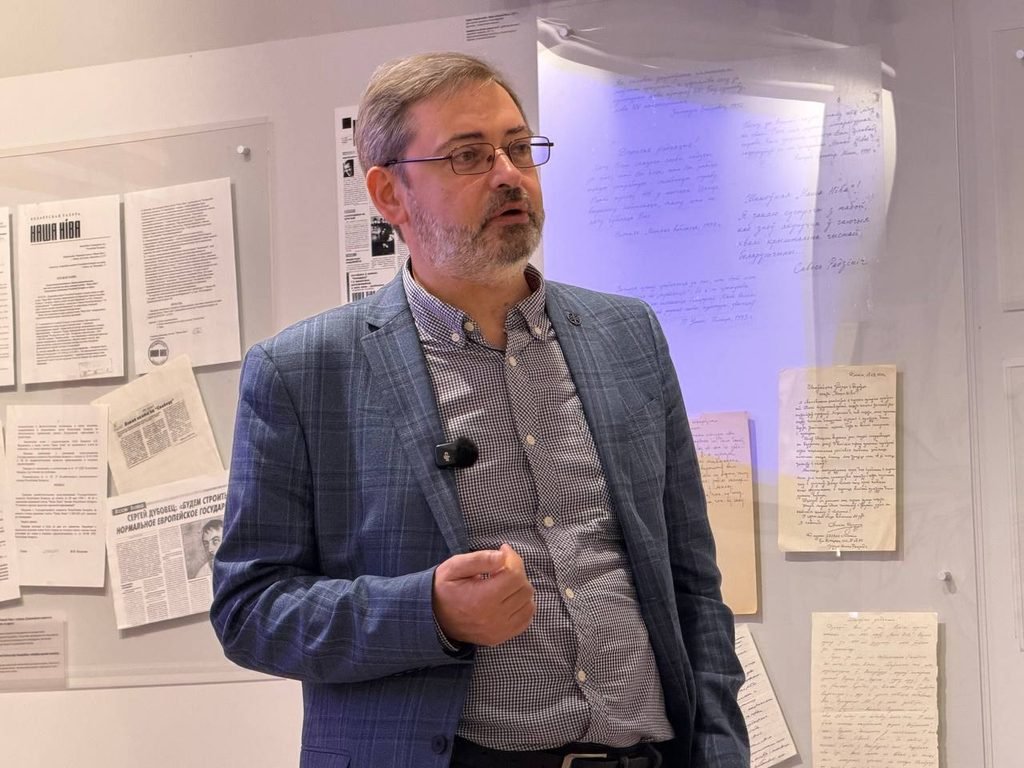
Representatives of the Russian Orthodox Church (ROC) had been helping to prepare for the war since 2005 and were involved in organising separatist activities in Crimea and Donbas in 2014. This was stated by Dr Sergey Shumilo, Executive Director of Libertas Fidei and Senior Research Fellow at the Faculty of History of Vilnius University, during a meeting entitled “Belarusians Without the Russian Orthodox Church”, held on 25 November at the Belarusian House in Vilnius.
“As early as 2005, in preparation for the invasion of Ukraine, structures of the so-called ‘Lay Front’ were being established in Ukraine under the auspices of the ROC, modelled on a network marketing system and designed to operate through parishes. This was explicitly stated in the ‘Russian Doctrine’, presented by Kirill Gundyayev, then Metropolitan of Smolensk and Kaliningrad and now Patriarch of Moscow. We witnessed first-hand the implementation of these plans in Ukraine in 2014, in Crimea and Donbas, when the first so-called ‘militias’ were organised through so-called ‘Orthodox activists’. This took place with the involvement of Russian Orthodox Church priests. For example, the terrorist Girkin (Strelkov), who organised the initial separatist activities in Crimea and Donbas, established contacts with local political and business elites in both regions specifically through representatives of the Russian Orthodox Church,” Sergey Shumilo noted.
The expert also noted that Belarusians should consider securing their own autocephaly in the future and that Belarus has its own heroes and martyrs who lost their lives at the hands of the communist regime in the 20th century for the independence of the Belarusian Church, but who are scarcely remembered even within the diaspora. According to him, following the collapse of the totalitarian regime, which will inevitably give rise to a public demand for national and spiritual revival, it will be impossible to develop an independent state based on the values and narratives of the ROC. An independent Belarusian Church of its own must therefore be at the forefront of this national and spiritual revival, and the Belarusian diaspora must already be working towards its restoration. Shumilo believes that the foundations for this are laid down in the documents of the Ecumenical Patriarchate of Constantinople, which, in both 1924 and 2018, affirmed the uncanonical nature and invalidity of the incorporation of Orthodox dioceses in the territories of present-day Ukraine, Belarus and Lithuania into the Moscow Patriarchate.
The meeting, organised by the Belarusian Christian Democracy party, headed by Pavel Severinets, brought together representatives of Belarusian, Ukrainian and Lithuanian civil society.