What was the conference of the Lithuanian Archdiocese of the Moscow Patriarchate held in Vilnius about
Europe is interfering in religious affairs, the Kremlin threat is exaggerated, the Russian Orthodox Church is harmless, Constantinople itself transferred the centre of spiritual life to Moscow. This is only a partial list of the narratives and messages voiced at a recent conference in Vilnius organised by the Lithuanian Orthodox Archdiocese of the Moscow Patriarchate.
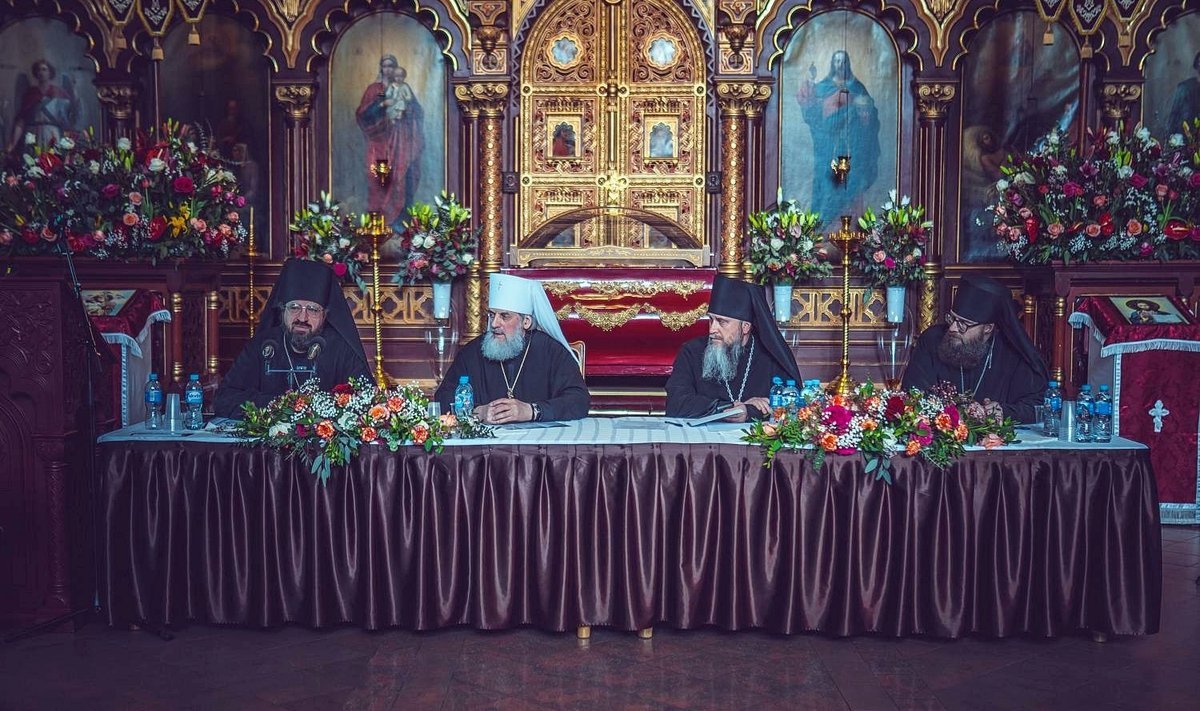
The two day event held in Vilnius on 25-26 April, announced as the Celebration of the 680th Anniversary of the Founding of the Cathedral of the Most Pure Theotokos, the main cathedral of the Moscow Patriarchate in Lithuania, included two events.
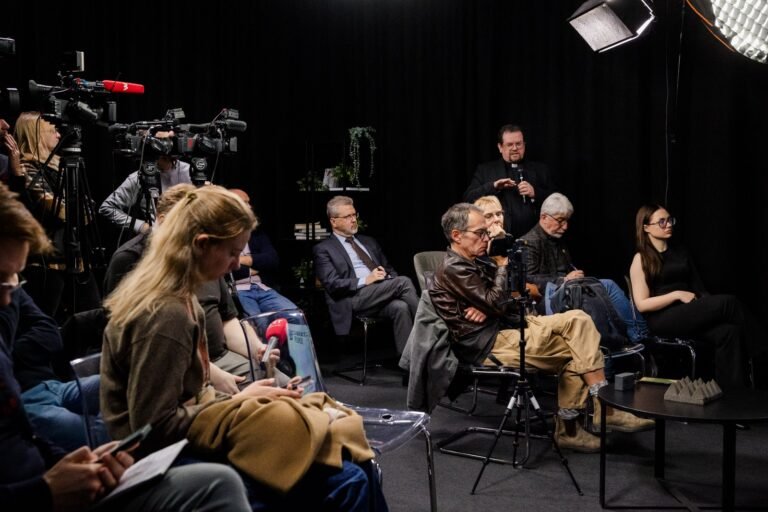
It began with a religious procession, a march of clergy and approximately two thousand believers through the streets of the Lithuanian capital to the Cathedral of the Most Pure Theotokos, where it continued as an international academic conference.
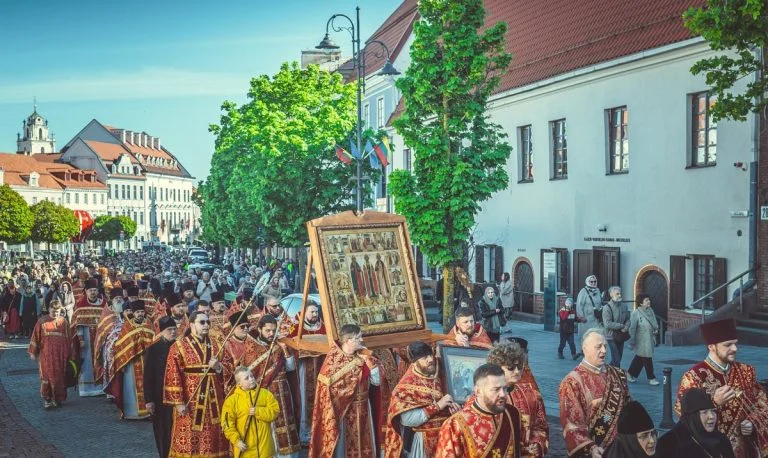
According to the organisers’ plan, the cathedral anniversary and the conference were intended as a kind of response to the Lithuanian State Security Department, VSD, which stated in its March report “Assessment of National Security Threats 2026” that the Lithuanian Orthodox Archdiocese, which has a direct connection to the Russian Orthodox Church centred in Moscow, plays an important role in shaping and supporting the ideological narratives of the Russian regime within Lithuania.
It is difficult to describe the conference as academic. There were only two scholars present, alongside publicists friendly to Russia who attempted to bring the Kremlin’s version of church history and the Russian vision of the current situation and the role of the Russian Orthodox Church in the Baltic region into the information space.
The procession of people continued at the conference as a “parade” of Russian narratives, carefully prepared but pursuing specific goals, namely to devalue Constantinople as a canonical alternative to Moscow Orthodoxy and strengthen Kremlin influence.
The Moscow orchestration of the event was intended to delve seven centuries into the past and allegedly demonstrate the inadequacy of Constantinople, meaning Ecumenical Orthodoxy, compared with Moscow, which calls itself the “Third Rome”. It then moved to seventeenth century Ukraine, presenting the transfer of the Kyiv Metropolis to Moscow as the salvation of Orthodoxy from destruction by Catholics.
The plan then was to move gently toward the Russian Orthodox Church’s fashionable topic of persecution in Estonia and Montenegro, while taking several jabs at an allegedly misguided Europe that supposedly sees threats where none exist. Finally, in opposition to the security service report, the Lithuanian authorities were reproached for paying excessive attention to the Russian Orthodox Church.
An interesting nuance emerged. Even before the conference began, reacting to media controversy, the organisers removed Aleksei Khoteev, a Belarusian historian who had called the Ukrainian Euromaidan a “coup d’état” and Crimea “Russian land”, from the list of speakers.
However, this exclusion was more symbolic than substantive, because all the other foreign speakers were representatives or supporters of Russia with even harsher publications in its defence.
THE RUSSIAN ORTHODOX CHURCH: MOSCOW AS THE “THIRD ROME” SINCE THE FOURTEENTH CENTURY?
The first presentation was delivered by church diplomat Filipp Vasiltsev, who became known during his service in Bulgaria. He was accused of splitting the parish of the Russian church in Bulgaria along ethnic lines and attempting to create a Cossack organisation attached to the church. At the time, the Bulgarian Foreign Ministry even summoned the Russian ambassador.
Archimandrite Filipp Vasiltsev is now representative of Patriarch Kirill in the Antiochian Patriarchate. He actively cooperates with former FSB chief Sergei Stepashin, who works in church affairs as head of the Imperial Orthodox Palestine Society.
In his speech, Filipp Vasiltsev addressed the development of Orthodoxy on Lithuanian lands in the fourteenth century.
He managed to recount the ecclesiastical history of these lands in the fourteenth century while barely mentioning that this was a period of serious wars between the Grand Duchy of Lithuania and Moscow.
At the same time, Vasiltsev’s main message was this: “It was difficult to withstand the Horde, decline was everywhere. Not without the influence of Constantinople, the centre of Orthodox life moved to Moscow in the fourteenth century.” In other words, Constantinople allegedly transferred the centre of Orthodox life itself.
In reality, there was no simple “transfer of the centre to Moscow”. Constantinople manoeuvred constantly, at times supporting a unified metropolis, at times reorganising it, at times recognising its division into separate dioceses, rather than simply “transferring” it to Moscow.
In fact, the idea that “Constantinople itself handed everything over to Moscow”, intended to devalue the Ecumenical Patriarchate and consequently delegitimise its exarchate in Lithuania, was repeated in the next presentation.
Hegumen Antonii, Gurinovich, from a local monastery devoted his presentation to the transfer of the Kyiv Metropolis to Moscow in the seventeenth century.
Father Antonii presented this event, which in Kyiv is called an annexation, as the salvation of Orthodoxy from “Catholicisation”. He stated that “Constantinople gave Kyiv to Moscow”. It should be recalled that the struggle against Catholics is one of the dominant narratives of the Russian Orthodox Church.
The hegumen did not stop at the seventeenth century and continued by saying that in Ukraine since 2018 this event has been subjected to “reinterpretations and falsifications”.
According to Antonii’s version, Ukrainian ecclesiastical subjectivity is reduced to an external intrigue by the Phanar against Moscow. He made no connection to the political role of the Moscow Patriarchate after 2014 and 2022, when Ukrainian security services documented dozens if not hundreds of cases of open collaborationism by clergy of the Moscow Patriarchate, including collecting and transmitting information on Ukrainian military positions and identifying pro Ukrainian residents to occupation “authorities”.
The hegumen’s core message was simple: Moscow is the defender of Orthodoxy, Kyiv is part of the single Russian Church, Constantinople after 2018 is a violator, and Ukrainian autocephaly is the result of an external intrigue rather than an independent ecclesiastical and political process. This was a soft, academically packaged version of the Moscow narrative.
AND OTHER OFFICIAL FIGURES FROM THE KREMLIN ORBIT…
After discrediting Constantinople, the following speakers moved on to the subject of “persecution” by national governments. This is a favourite topic of Patriarch Kirill and Russia’s Foreign Intelligence Service. Bishop Daniil, Lepesk, from Estonia spoke about the “infringement of believers’ rights”.
Bishop Daniil described the transfer of the Estonian Church under the jurisdiction of the Patriarchate of Constantinople in 1923 as questionable and almost illegitimate, without taking into account the political context of Estonia’s independence. Events in Estonia between 1940 and 1945 were described as the “reunification” of the Estonian Constantinople diocese with the Russian Orthodox Church, ignoring the fact that Estonia had been occupied.
The modern conflict with society was explained as a “propaganda campaign” rather than a reaction to Russia’s invasion of Ukraine and the position of Patriarch Kirill, who officially describes the war as “sacred”. The refusal to renew the visa of former head of the Estonian Orthodox Church of the Moscow Patriarchate Evgenii, Reshetnikov, was portrayed as an injustice, without mentioning that the bishop approved joint prayer services with Russians and was the subject of a report by the local security service.
The actions of the Estonian authorities were presented as the root cause of the conflict rather than a response to foreign policy and ideological challenges.
The bishop’s speech reproduced a softer form of the Russian narrative in which political positions favourable to Moscow are promoted through the language of history, canonicity, and the “defence of faith”.
Meanwhile, Serbian publicist from Montenegro Ognen Vojvodich did not even attempt to demonstrate respect for the autocephalous Church of Montenegro.
He interpreted the creation of the church as a political project, claiming that “communist cadres in Montenegro attempted to persecute clergy and confiscate the property of the Serbian Orthodox Church, spiritually close to the Russian Orthodox Church, that they denied the religious and human rights of Orthodox Christians, and persecuted residents who refused to change the name of their nationality within the framework of communist national policy aimed at fragmenting historic peoples and creating socialist, synthetic, political nations”.
Thus, according to the speaker’s logic, Montenegrins are a synthetic nation.
In his opinion, autocephalous Orthodox structures are products of special operations and politics rather than internal social development. They were created by “fanatical anti Christians” and “communist criminal clans”.
And, as always, one of the “insidious goals” was allegedly “conversion to Catholicism”.
The author separately mentioned the unadopted Law on Freedom of Religion in Montenegro from 2019 and the mass protests against it. This was one of the clearest examples of an attempt to limit the influence of the Serbian Orthodox Church, which openly leans toward Russia, and strengthen the national church. The attempt failed. It should also be noted that the Patriarch of Serbia continues to maintain close relations with Russia. In 2025 he met with Putin and Patriarch Kirill in the Kremlin.
Vojvodich then moved on to Europe, which he claimed was degenerating, failing to uphold its own principles, and applying them selectively, while historic Christian minorities were allegedly politically marginalised and Christian principles expelled from public life. “An anti Christian agenda,” the Serbian publicist concluded.
HOW A SPEAKER FAILED TO NOTICE THE SERIES OF RUSSIAN ORTHODOX CHURCH SPY SCANDALS IN EUROPE
The final speaker was Roman Ianushkevichus, a Lithuanian professor of mathematics who, under the guise of a legal discussion about the limits of security and religious freedom, effectively promoted the thesis that any interference in the activities of a church structure canonically linked to the Moscow Patriarchate is unacceptable.
His argument amounted to the claim that such a connection is “purely spiritual” and has no legal or political significance. Therefore, any suspicions directed at the Lithuanian Orthodox Archdiocese community are inadmissible without individually proven violations.
The speaker effectively blurred the issue of Moscow’s real influence and shielded the Lithuanian diocese’s institutional ties to the Russian Orthodox Church from criticism. He referred to practices in Western countries. “In Germany there is the Berlin German Diocese of the Russian Orthodox Church of the Moscow Patriarchate. There are no problems in Germany. In France there is the Korsun Diocese of the Russian Orthodox Church. In the United States there is the Russian Orthodox Church.” The author spoke about the alleged prosperity of the Russian Orthodox Church in Europe and the United States while failing to mention the series of scandals associated with it.
For example, when prompted by French intelligence services, the authorities demanded revisions to the construction project for a spiritual centre in Paris because of concerns that the Russian side might use the new building to place listening devices.
Also, just days ago, German authorities refused to issue a Schengen visa to Archimandrite Simeon, Tomachinskii, of the Russian Orthodox Church, known for openly supporting the Russian invasion of Ukraine and comparing fallen Ukrainian defenders to “sinners in hell”. Authorities justified the refusal by stating that he posed a threat to public order and German security.
The conference made no mention of the April resolution by the Parliamentary Assembly of the Council of Europe declaring that the Russian Orthodox Church under Patriarch Kirill is used by the Kremlin regime as an instrument of Russian influence and is complicit in war crimes. The resolution had been adopted three days before the conference.
Not once during the presentation was Russia’s invasion mentioned. Not once was any of the dozens of spy scandals involving the Russian Orthodox Church in European Union countries mentioned, nor the information that Russia often builds its churches in Europe near strategic facilities, airports, bridges, and radar stations.
For four hours the organisers created a “space of legitimacy” for the Moscow Patriarchate, attempting to reduce sensitivity to possible political risks.
At the same time, the behaviour of Moscow affiliated structures over the past four years is revealing. After Russia’s invasion of Ukraine began in 2022, the Lithuanian Archdiocese of the Russian Orthodox Church expressed quiet but public disapproval of the aggression.
However, only a few months later a major scandal erupted within the diocese. When some clergy opposed the war and refused to mention Moscow Patriarch Kirill in prayers because he supported the aggression, church leadership suspended them from ministry and stripped them of clerical rank. These were the same five priests who later participated in the establishment of the Exarchate of the Ecumenical Patriarchate in Lithuania.
And now, in 2026, representatives of the diocese decided to respond to their mention in the report of the Lithuanian security service. In response to the VSD, the Lithuanian Orthodox Archdiocese of the Russian Orthodox Church organised an Orthodox procession through the capital, demonstrating mass participation and unity, and held a conference whose purpose was to justify ties with Moscow and legitimise its presence in Lithuania.
Across Europe, structures of the Russian Orthodox Church responding to justified criticism regarding their dependence on the Moscow centre often choose the tactic of a “besieged fortress”: “state interference”, “enemies everywhere”, “persecution of the church”.
In Lithuania there is not yet a fortress. But construction of one has already begun.
Anna Jansone for Delfi
Republished from Delfi.