Serbian director Emir Kusturica plans to release a film about Patriarch Kirill Gundyayev of Moscow to mark his 80th birthday.
The director told TASS about the project.
“We have finished shooting the film about Patriarch Kirill. I think we will release it by the end of the year,” he said, noting that work on the film is currently underway in Serbia.
It was previously reported that filming for the movie about Patriarch Kirill took place at the Kirillo-Belozersky Monastery in Vologda Oblast.
In an earlier interview, Emir Kusturica said that “Russia occupies an enormous place in his life and work and is, for him, a cultural foundation in every respect.”
After the occupation of Crimea, he travelled to Yalta to perform, where he said that he regarded Crimea’s incorporation into Russia as a natural process and the peninsula itself as part of the Russian Federation.
Emir Kusturica is known to be planning to obtain Russian citizenship and says that he “already considers himself Russian.”
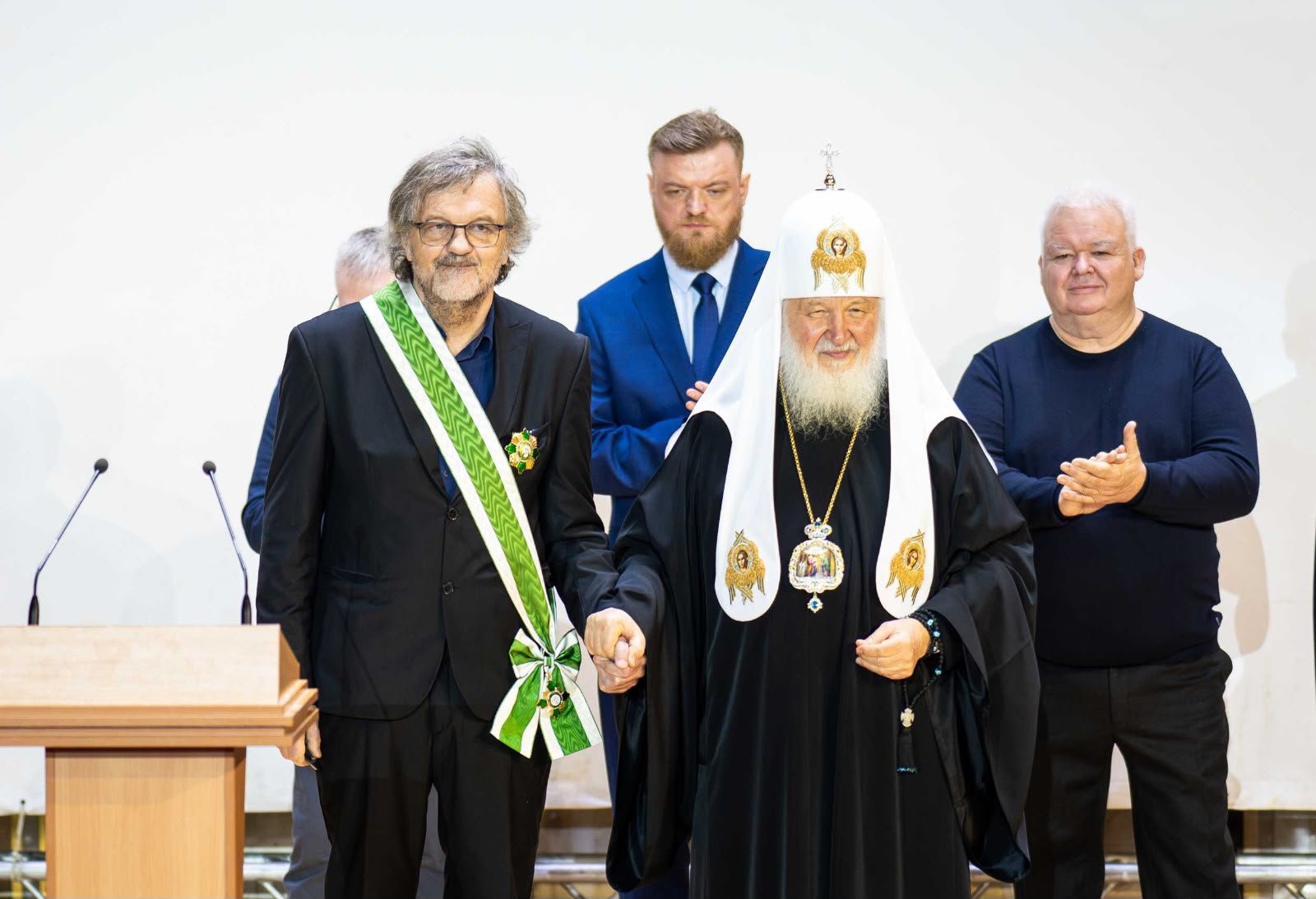
It was previously reported that the director became a co-author of the film People of Christ. Our Time, which justifies the war and depicts alleged “persecution for faith” in Ukraine. For this project, Patriarch Kirill awarded Kusturica the Order of St. Seraphim of Sarov, First Class.
LF Afterword:
European cultural history offers numerous examples of prominent artists placing their talent and reputation at the service of authoritarian power. Nazi Germany provides some particularly striking cases.
Emil Jannings, the first winner of the Academy Award for Best Actor, became one of the stars of Third Reich cinema after Hitler came to power. He appeared in films used by Nazi propaganda, and Joseph Goebbels bestowed on him the title of State Actor. After the war, the Allies barred Jannings from working in his profession. He never returned to the screen.
Another celebrated German actor, Heinrich George, appeared in such propaganda films as Hitler Youth Quex, the antisemitic Jud Süß, and Kolberg, which was made during the final months of the war. His biography, however, was more complicated than the simple image of an “artist-Nazi.” Before 1933, George had links to left-wing circles, and later, while running a theatre, he helped some artists who were critical of the regime. After the fall of the Third Reich, he was arrested by the Soviet authorities. He died in the Sachsenhausen special camp in 1946. In 1998, the Russian Prosecutor General’s Office rehabilitated him.
Another illustrative case is the Swedish actress and singer Zarah Leander. From 1936 to 1943, she was one of the biggest stars of the German film industry and worked for UFA. After returning to Sweden, her past in Germany became the subject of controversy for many years. For a time after the war, she was unable to perform in Sweden, Germany or Austria, although she eventually succeeded in resuming her career.
These stories show that when a prominent artist lends their name, talent and international standing to those in power, they inevitably become part of the public image that those authorities construct around themselves.
In Kusturica’s case, this question has acquired concrete significance. In September 2026, it emerged that he had completed filming a movie about Patriarch Kirill and expected to release it by the end of the year. The official website of the Russian Orthodox Church also identifies Kusturica as a producer of a project about the situation of the Ukrainian Orthodox Church.
The histories of Jannings, George, Leander and Gründgens are a reminder that after political regimes fall, society revisits questions for artists that may have seemed secondary while they were cooperating with those in power: what exactly did they lend their authority to, where did the boundary between art and propaganda lie, and what personal responsibility does a celebrity bear for projects to which they voluntarily lend their name.