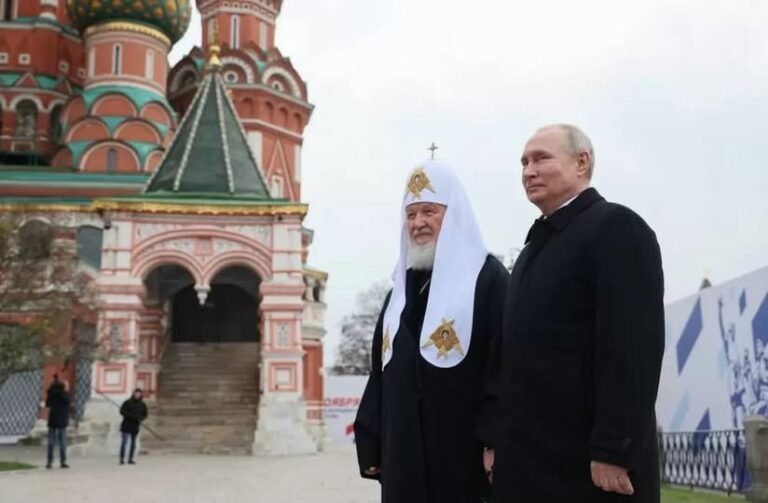
Although the EU leadership has not officially announced plans to include the head of the Russian Orthodox Church in the 21st sanctions package, reports in reputable media outlets have caused concern for the 79-year-old patriarch.
This was written by journalist and religious expert Aleksandr Soldatov in his article for Novaya Gazeta.
According to Soldatov, this is evidenced by the reaction of the official spokesperson for the Moscow Patriarchate, Vladimir Legoyda, who issued a “strong protest” against the European Union’s intention to impose personal sanctions on Patriarch Kirill Gundyayev. The proposed ban on doing business and entering EU countries, which Kirill has not visited since 2022 anyway, was described by Legoyda as “the height of absurdity.”
The author of the article stresses that after the resignation of Viktor Orbán, who had blocked EU sanctions against the patriarch of the Russian Orthodox Church, no obstacles remain to their introduction.
“Now this obstacle is gone, and other European ‘friends of Russia,’ such as Slovakia, are not intending to defend ‘Putin’s altar boy,’ as Pope Francis called Kirill,” Soldatov writes.
He also recalls that Kirill has already accumulated an impressive collection of sanctions.
“In June 2022, Lithuania banned the head of the Russian Orthodox Church from entering its territory for five years. At the same time, the patriarch became barred from entering the United Kingdom for his ‘open support for the Russian war in Ukraine.’ A month later, Canada added Gundyayev to its sanctions list alongside television presenter Yekaterina Andreyeva. The Holy See did not impose sanctions but refused previously planned meetings with him and generally reduced contacts with the Russian Orthodox Church to a minimum. In September of the same year, at the assembly of the World Council of Churches, which consists mainly of Protestant churches, Frank-Walter Steinmeier sharply criticized the Russian Orthodox Church, which proclaims as God’s will ‘imperial dreams of dictatorial rule.’
“In February 2023, Australia and New Zealand picked up the sanctions baton, followed soon after by Czech Republic. According to the Czech Foreign Ministry, Kirill ‘abuses faith.’ In June 2023, Estonia added Kirill to its sanctions list, calling the head of the Russian Orthodox Church ‘one of the largest carriers and supporters of Putin’s ideology,’” the article states.
As LF reported, the new Hungarian government stated its readiness to support European Union sanctions against the head of the Russian Orthodox Church, Patriarch Kirill, and other individuals protected by former Prime Minister Viktor Orbán. The 21st package of economic sanctions is expected to be presented in June, with final approval anticipated by July 15.
Earlier, we wrote that Brussels was preparing another package of sanctions against Russia, which could in particular target senior members of the Russian Orthodox Church and its primate, a close ally of Vladimir Putin. According to Politico, officials see an opportunity to move forward with sanctions previously blocked by the government of Viktor Orbán, the former Prime Minister of Hungary.
As LF reported, the Kremlin is attempting to justify the prolonged war against Ukraine by using longstanding false narratives claiming that “the Ukrainian government suppresses religious freedoms.” This was stated in a report by analysts from the Institute for the Study of War.
Earlier, we wrote that the President of the Russian Federation, Vladimir Putin, praised the efforts of Patriarch Kirill of Moscow aimed at supporting participants in the “special military operation.”
According to LF, in November 2025 Patriarch Kirill Gundyayev stated that military heroism is “inseparable” from spiritual heroism, and that participation in war may be regarded as a form of Christian service. This attempt to justify war through spiritual rhetoric provoked an immediate and sharp reaction within church circles.
According to Regina Elsner, a researcher of Eastern Christianity and ecumenism at University of Münster, the Russian Orthodox Church has become one of the key institutions of mobilization and propaganda.
Earlier, we wrote that Pope Leo XIV and Bartholomew I condemned attempts to use religion to justify violence.