 Gintaras Sungaila
 In recent times, in connection with developments in the life of the Orthodox Church in Lithuania, Moldova, and other countries that were previously occupied by the USSR, there has been increasing discussion about whether the trend of the faithful leaving the Moscow Patriarchate, if the political dimension is set aside, is harmful to the Church. After all, the Church is not a state, and its interests do not always coincide with those of the state. How can what is happening be understood from a Christian and ecclesiastical perspective?
The Church Is Not a Party
The first aspect to note is that, unlike secular political parties, church unity is not based on organizational unity. The Antiochian Patriarchate is not subordinate to the Alexandrian Patriarchate, and the Moscow Patriarch does not report to the Ecumenical Patriarch. Church unity is unity in the sacrament of the Eucharist on the basis of a shared faith, not membership in a single formal organization. Unlike secular social institutions, which are built primarily on discipline, subordination, and coercion, the Church is built on the principle of love, which presupposes freedom. As Protopresbyter Nikolay Afanasyev writes, citing Saint Ignatius the God-Bearer, “the Church itself is love.”
This does not mean that organizational unity is entirely alien to the Church, there is hierarchy and order in the Church, however, the principle that organizes it is not law, but the Holy Spirit. And “where the Spirit of the Lord is, there is freedom” (2 Cor. 3:17). This may sound lofty, but in practice it has a very concrete expression. To be an Orthodox Christian is not to possess a certificate of membership in the Church, a party card, but to believe in an Orthodox manner and live with Christ in the Church, in the sacraments, prayer, and communion. On the contrary, if a person has a certificate of baptism from childhood but does not participate in the sacraments and does not pray, he is like an empty vessel, the document does not make him a Christian.
In this sense, if a member of the Antiochian Church arrives in Romania, he recognizes in the members of another organization, from the point of view of secular law, the same Ecumenical Orthodox Church of which he is a member. Local clergy are in no way subordinate to the Antiochian Patriarch, and vice versa, they organize their church life freely and independently, yet this does not prevent them from being one Church.
Thus, the disruption of organizational unity in countries where the faithful leave the Moscow Patriarchate is not a violation of ecclesial, mystical unity. It is not a “schism” when people leave the Moscow Patriarchate and join, for example, the Constantinople Patriarchate, the Romanian Patriarchate, or the Orthodox Church of Ukraine. The Churches of Constantinople, Romania, and Ukraine are true local Orthodox Churches that profess one Orthodox faith, share a common Tradition, and are united in one Christ and one Eucharist. On the contrary, “schism” is the refusal of communion in the sacraments on the basis of a demand for organizational unity. The Moscow Patriarchate unilaterally broke communion with the Constantinople and Alexandrian Patriarchates, as well as with the Greek and Cypriot Orthodox Churches, thereby directly undermining true church unity in the hope of subordinating “disobedient” people who, being Orthodox Christians, do not wish to belong to the organization of the Moscow Patriarchate.
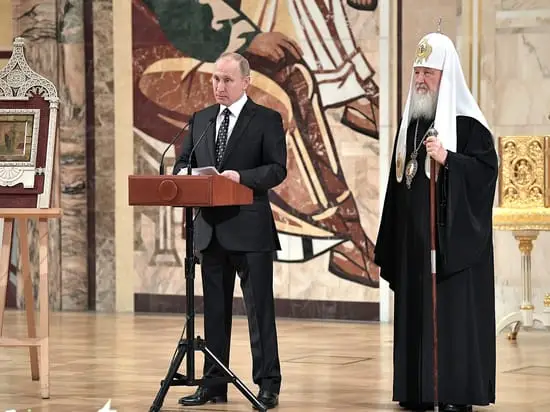
The words that the Church is not a party acquire new meaning in contemporary realities, when the Church of the Moscow Patriarchate has embarked on a path of open support for a particular political regime and ideology. When the Moscow Patriarch teaches that “Great” Russia, “Little” Ukraine, and “White” Belarus are one people and one Church, when he teaches that Moldova and other countries of the former USSR are also part of this Rus’, when he preaches about the “civilization of the Russian world,” calls Russia’s aggressive war against Ukraine a “defense of the unity of Holy Rus’,” and calls for prayers for Putin, against whom, it turns out, “our enemies have risen,” and whom he had previously invited to the Bishops’ Council. The Patriarch even promised the remission of sins to Russian soldiers dying in Ukraine. At the same time, the Moscow Patriarch repeatedly emphasized: “If anyone still has doubts about whether it is necessary to do everything that the Patriarch teaches, cast aside all doubts and strictly fulfill what I command, because I do not speak from my own wisdom, but from the wisdom of the entire episcopate of the Russian Orthodox Church.”
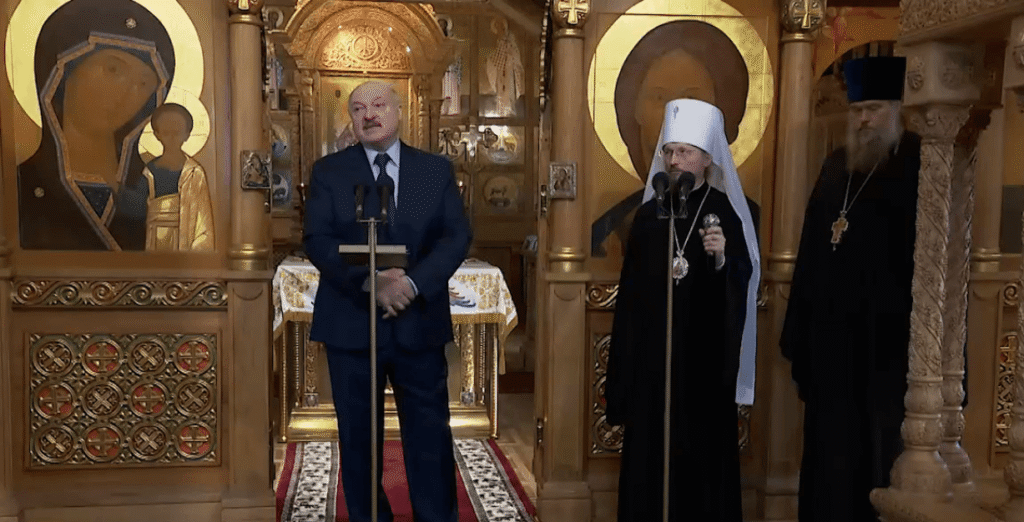
Our brothers and sisters in Belarus have seen this policy in action in their own country, when the illegitimate head of state, calling himself an “Orthodox atheist,” is allowed, like a priest, to address believers from the ambo, while church authorities turn a blind eye to violence against peaceful citizens and punish those who attempt to defend them.
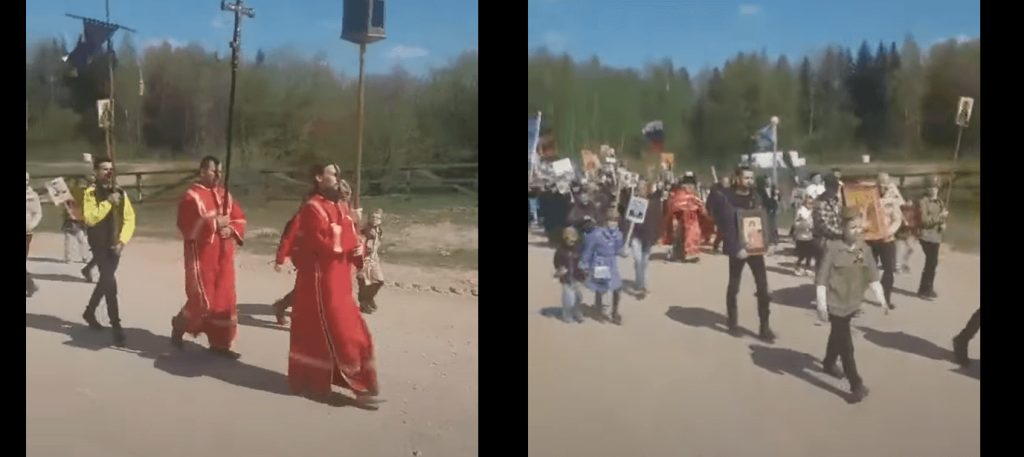
Six months ago, a video of a religious procession of the Saint Elizabeth Monastery spread across the internet, where a priest in vestments and believers with icons and banners marched to the music of the Soviet military song “Katyusha.” Some of the children were dressed as Soviet soldiers, carrying photographs of people who died in the Second World War. This not only provokes justified disgust due to the introduction of political ideology into the Church, but also because adherents of this political ideology persecuted, tortured, and killed Christians.
Thus, there is a complete substitution of concepts. Clergy and the head of a local church preach a political message about the unity of the political space of the former USSR and justify the actions of a regime recognized in Lithuania as terrorist, while people who do not wish to participate in this and, while remaining Orthodox, leave the organization and join another canonical local Orthodox Church, are declared “schismatics,” not Orthodox, not even members of the Church of Christ. As is known, in current practice of the Russian Church, believers of the Orthodox Church of Ukraine are even required to receive the sacrament of baptism again, despite the fact that they profess the same faith, believe in the same Christ, and have the same rites and hierarchy, they are not recognized as Christians simply because they chose to separate from the Moscow Patriarchate. At the same time, the Russian Orthodox Church does not require repeated baptism from Catholics or Protestants converting to Orthodoxy, as if shared faith and Tradition were less important than opposition to the “Russian world.”
The Church Consists of Local, Not National Churches
Those who no longer wish to belong to the Moscow Patriarchate are often accused of “nationalism,” of fragmenting the Church into “national apartments.” Some intellectuals even claim that “the only church that until recently preserved a certain universal supranational character was the Russian Orthodox Church.” Let us first address the claim of “supranationality.”
First of all, many local Orthodox Churches today are multinational. The Constantinople Patriarchate includes two autonomous churches with a significant number of Finno-Ugric believers, the Church of Estonia and the Church of Finland, as well as the former Ukrainian Autocephalous Church abroad, in the United States and Canada, Slavic vicariates including parishes and monasteries of the former “archdiocese of Russian tradition,” and so on.
The Alexandrian Patriarchate includes dioceses in so-called “Black” Africa, with African bishops. The Antiochian Patriarchate is also not exclusively Arab, there is a Greek diaspora in the Middle East, and in the American Metropolia of the Antiochian Patriarchate more than half of the clergy are not of Arab origin. The Orthodox Church of Ukraine includes a Romanian vicariate, while the Romanian Patriarchate includes a Ukrainian vicariate. Local Churches, following Orthodox ecclesiology, unite believers of a given country or region regardless of their ethnic origin.
The opposing view, that the Church should be divided along national lines, was condemned at the Pan-Orthodox Council of 1872 as the heresy of ethnophyletism. Adherents of this view believe that all Russians must belong to the Russian Church, all Bulgarians to the Bulgarian Church, and so on. This denies the words of Holy Scripture that in Christ “there is neither Greek nor Jew” (Col. 3:11). Orthodox teaching on the Church, by contrast, affirms that the Church is divided by countries, regions, and territories, but not by nationalities.
According to ancient church practice, in administrative division into autocephalous and autonomous churches, metropolises, dioceses, and exarchates, it is customary to follow the political boundaries of states. The 38th canon of the Council in Trullo states: “The rule laid down by our Fathers we also observe, namely, that if a city has been newly founded or shall be founded by imperial authority, the ecclesiastical organization shall follow the civil and public divisions.” In his interpretation, Saint Photius explains that church administrative boundaries should follow civil boundaries. It is known that there are exceptions connected with ancient cities of special significance for Christians, but it is precisely on the basis of this ancient practice that in the nineteenth and twentieth centuries the Ecumenical Patriarchate granted autocephaly to the Orthodox Churches of newly formed independent states, Greece, Serbia, Bulgaria, Romania, Albania, Poland, the Czech lands, Georgia, and in the twenty first century, the Church of Ukraine. Earlier, in the sixteenth century, on the same basis, the Church of Russia, the Moscow Patriarchate, received autocephaly from the Ecumenical Patriarchate.
All Churches are Churches not of an ethnic group but of a region. From the point of view of canonical authority, the Serbian Church is the Church of Serbia, not the “Church of Serbs.” In this regard, a separate issue is the pastoral care of the Orthodox diaspora in countries where there is no local Church, which was discussed at the Pan-Orthodox Council in Crete in 2016, but exceptions do not change the rule. The Moscow Patriarchate also originally had specific boundaries, as canonist Protopresbyter Georgios Tsetsis notes:
“the boundaries of the Orthodox Church of Russia in 1593 were established by the Great Council of Constantinople, and they coincided with the borders of the Russian state. Therefore, the head of the Church of Russia was recognized only as ‘Patriarch of Moscow and All Russia and the northern lands.’ At that time, neither Poland, nor Finland, nor the Baltic countries were part of the northern lands. It should not be forgotten that when the Russian Church acquired autocephaly, half of Estonia belonged to Sweden and the other half to Poland.”
It is worth noting that although the name “Russian Orthodox Church” had been used for a long time, it became official only in 1943, before that the local Church of Russia called itself the “Russian Orthodox Church” or “Greco Eastern Russian Church” in similar variations. In Soviet times, the change of name was most likely due to the fact that the Russian Orthodox Church united not only Orthodox believers of the RSFSR but of the entire USSR, yet the term “Church of the Soviet Union” would have sounded too provocative. At the same time, the situation at that time was logical, the Russian Orthodox Church united believers of one state, the USSR. The problem arose after the collapse of the USSR, there was no longer any union, so “Holy Rus’” and the “Russian world” were invented. In reality, there is no salvific significance in belonging to the Moscow Patriarchate rather than any other Patriarchate.
Protopresbyter Pontiy Rupyshev, who founded the Mikhnovo community and is venerated by many as a saint, later serving in the Polish Autocephalous Church, said of this: “As for autocephaly, it is a matter of no importance for our salvation, it does not concern faith or piety.” From a Christian point of view, it is completely unimportant to which Patriarchate or autocephalous Church a person belongs, the most important thing is that he profess the Orthodox faith and live accordingly.
The Ecumenical Church Is Not a Confederation but a Family
The Ecumenical Orthodox Church is also not an abstract aggregate of separate local Churches. Although there is no administrative subordination between them, there exists a canonical order of primacy and the Ecumenical Patriarchate, which coordinates the life of the entire Orthodox Church. The Ecumenical Patriarch convenes meetings of primates and Pan-Orthodox councils, the most recent being the Holy and Great Council in Crete, mediates in interchurch disputes, considers petitions for the granting or revocation of autocephaly, and hears appeals from clergy of the entire Orthodox Church in special cases when they do not find justice in their local Church. Archbishop Elpidophoros Lambriniadis writes of primacy:
“As for the priesthood, of course all bishops are equal, but they are not equal and cannot be equal as bishops of specific cities. The sacred canons establish an order of cities, assigning some the status of metropolises and others the status of patriarchates. Among the patriarchates, some are assigned primacy, others secondary rank, and so on.
Not all local Churches are equal, both in order and in rank. Moreover, a bishop is always the bishop only of a specific city, which is an essential condition of episcopal ordination, therefore bishops also have their order. Thus, it is inconceivable that in such a hierarchy there would be no primacy.”
The apostolic principle of primacy is the main distinction between Orthodox ecclesiology and Protestantism, where the Church is often understood as a “confederation” of independent church organizations, or even as an abstract, theoretical aggregate of different confessions and denominations, an “invisible Church.” At the same time, the Orthodox understanding of primacy also differs from the Catholic one.
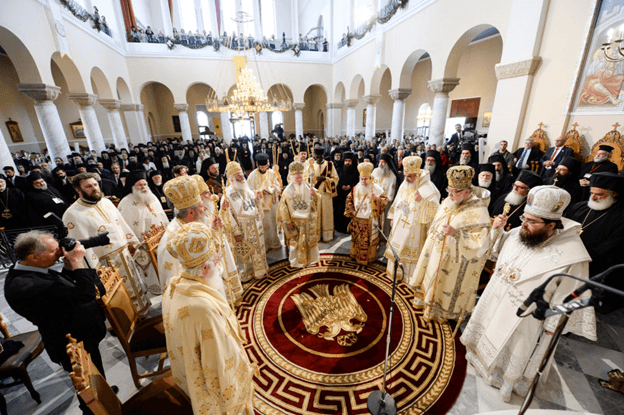
In the Orthodox understanding, unlike the Catholic, the primacy of the hierarch in the Ecumenical Church does not mean authority over every part of it. The ministry of the Ecumenical Patriarch is a primacy of love, not subordination but coordination. This ministry is always exercised conciliarity, together with the hierarchs of other local Churches. Therefore, throughout the history of the Orthodox Church, Pan-Orthodox councils have been convened, where the main issues of church life were resolved jointly.
This “soft” centralism of Orthodox ecclesiology resembles a family. In a family, the primacy of the father is based not on legal contracts, laws, and regulations, but on love, respect, and moral authority. When the letter of the law prevails over relationships of love, it is a sign that the family has problems.
Conclusion
The Orthodox Church of our time suffers from manifestations of ethnophyletism, the belief that the Church should be organized according to an ethnic principle. Ethnophyletic societies not only become closed to fellow citizens of other nationalities, but also begin to compete with local Churches on the global stage, since ethnophyletic ideology seeks to gather all representatives of its people across the world into a single structure. Such a structure becomes a kind of “international” of one ethnic group. The Ecumenical Orthodox Church condemned ethnophyletism as a deviation from Orthodoxy.
The Church also cannot serve a political regime, because then it ceases to fulfill its purpose, to unite people around Christ and to preach His Word. A Church that serves a regime not only alienates people of other political views, but inevitably compromises its conscience in order to maintain relations with rulers.
From a Christian perspective, we must understand that salvation comes not from belonging to a particular local Church, but from faith in Christ. One of the local Churches is seriously ill, it is entangled in politics that contradict the security of surrounding states, therefore it is natural for people to seek distance from politicized clergy and to look for a Church that does not engage in activities alien to its nature.
Gintaras Sungaila
The material is published with the author’s permission, Source