The suppression and instrumentalisation of religion in totalitarian regimes always bring immense suffering to ordinary people.
Our publication has written extensively about those who fled Russia to escape repression.
But we believe it is important to document the people who publicly voiced their position and remained in Russia, choosing suffering instead. We believe that, despite the apparent futility of solitary resistance to religious totalitarianism, these individuals are creating the preconditions for religious purification and reflection on what is happening. Even if that prospect still appears distant.
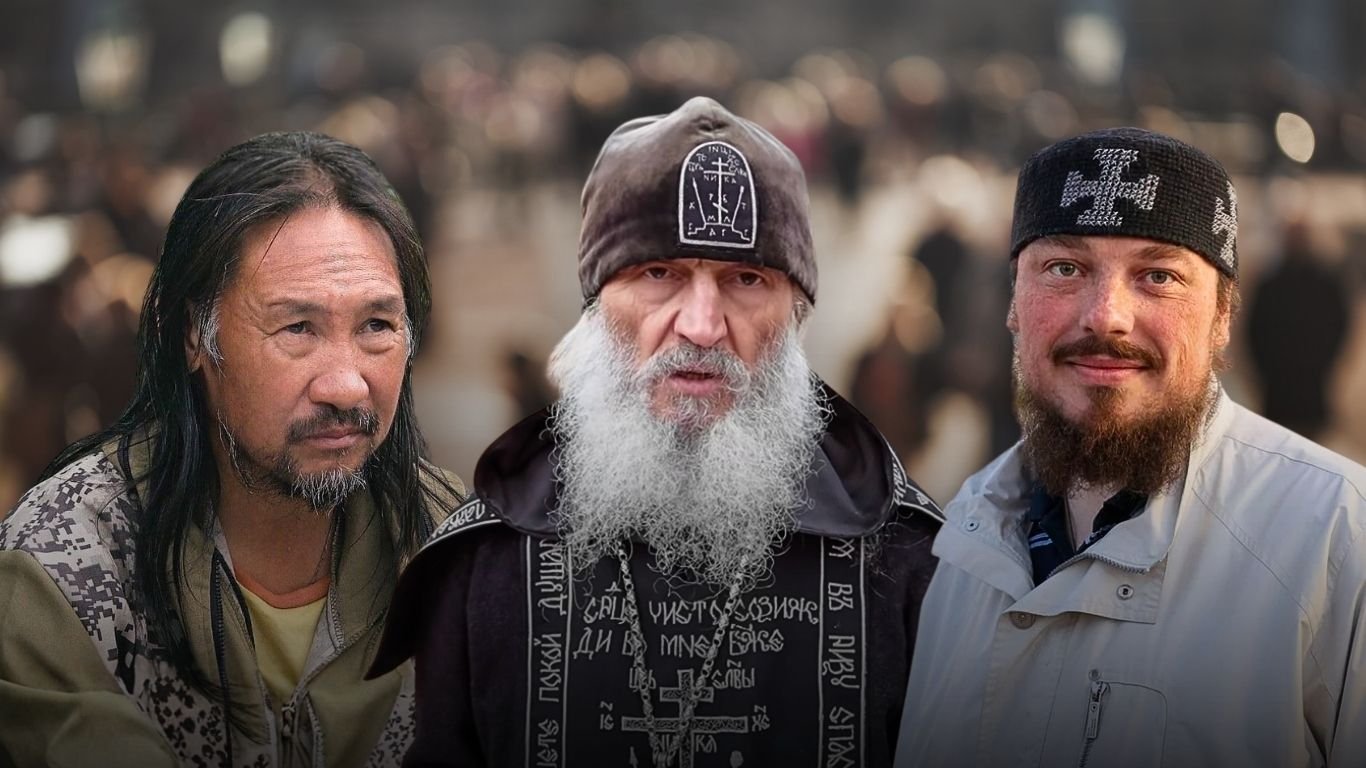
The first person worth remembering is Gabyshev, a shaman from Yakutia.
At the time of writing, 58-year-old historian, civic activist, and self-described warrior shaman Aleksandr Gabyshev is undergoing compulsory treatment in one of Russia’s psychiatric clinics.
In the spring of 2019, Gabyshev set out on foot for Moscow. Along the way he became a media figure. Supporters greeted him, journalists filmed reports about him, and a distinctive protest symbolism began to form around him.
Footage of him saying that he was going to banish Putin gained millions of views on YouTube. His statement that “Putin is not a man but a demon” became a catchphrase in Russia’s northern regions. His plan was to perform a ritual on Red Square after which Putin would resign. By the time he reached Chita, a rally titled “Russia Without Putin” had been organised in anticipation of his arrival.
Near Ulan-Ude he was met by a Buryat delegation of like-minded supporters that included journalists, opposition politicians, and activists.
Some saw him as an eccentric. Others regarded him as a symbol of resistance to the authorities. Yet there is no doubt that the authorities took his march very seriously.
He walked along the sides of highways pushing a cart loaded with essential travel supplies, including a yurt for sleeping. The fact that donations enabled him to buy a minibus, and that supporters welcomed him everywhere he went, demonstrated support for his ideas.
At first the authorities sent alternative pro-government shamans to meet with Gabyshev and persuade him to abandon the march. He was arrested and later released. But when he announced the march for the third time, special forces stormed his home and took him to a psychiatric hospital. He has now spent five years under compulsory treatment, which Soviet dissidents once called “punitive psychiatry”. And all of this was for intending to light a fire on Red Square, beat a drum, and throw horsehair into it.
But the idea of protest determined the further fate of the warrior shaman.
Another prisoner is Father Superior Sergiy of the Sredneuralsk Monastery, born Nikolai Romanov, who was defrocked in 2019 and is currently serving a prison sentence in a penal colony.
Nikolai Romanov represented the strict, almost isolationist current within the Russian Orthodox Church, attitudes that were always encouraged by church leadership. The conflict that led to the high-profile scandal and the imprisonment of the hegumen began when he started criticising Putin.
By that time Nikolai Romanov’s voice carried enormous influence, and he was a deeply respected monk in the Urals.
His problems began when he accused the authorities of creating a “fascist concentration camp of Satan”, and in June 2020 he recorded a video calling for a boycott of the vote on constitutional amendments. It should be recalled that the sweeping amendments to the Constitution of the Russian Federation adopted in July 2020 expanded presidential powers and formalised the “reset” of presidential terms, allowing Vladimir Putin to run again.
“Putin and his entourage are merely a screen. Through the constitutional amendments, through our voluntary attendance at polling stations, regardless of our agreement or disagreement, because what they need is mass participation, slave-owning power will be legalised. In other words, we will voluntarily legalise the authority of the future Antichrist and his servants. I declare to all the peoples of Russia, do not go to the polling stations!” he said.
Interestingly, Father Sergiy rejected digitalisation and modern technology, yet his monastic and personal morality allowed him to become an authority whose criticism was feared by both Putin and Patriarch Kirill. Sergiy called the patriarch and the president hidden enemies of Russia who “have brought the country to open hostility toward God, the closure of churches, and hatred of humanity, placing their own flesh above eternal life”, and said that he awaited their joint repentance. Sergiy described the protests in Khabarovsk Krai as “the first swallow”, adding that “swallows all across Russia are alive and even flying above the Kremlin”. All 150 nuns supported Father Sergiy. As a result, the monastery was closed and the hegumen received a seven-year prison sentence.
Punitive psychiatry used for religious motives has also affected another man. His trial is taking place in Kazakhstan, but it was instigated by Russia.
A court in Almaty ordered former hieromonk Iakov Vorontsov of the Astana and Almaty Diocese of the Russian Orthodox Church to undergo psychiatric evaluation in a psychiatric institution after he condemned the full-scale invasion of Ukraine by Russian troops. Since February Vorontsov has been held in pre-trial detention.
As LF reported, on the night of 13 February, Hieromonk Iakov Vorontsov, known for his anti-war stance and criticism of the Russian Orthodox Church, was detained in Kazakhstan.
He became widely known in 2023 after criticising Russia’s “special military operation” in Ukraine as well as the leadership of the Russian Orthodox Church.
In 2024 Vorontsov was suspended from ministry and defrocked. Criminal proceedings were also opened against him under Article 141 of the Criminal Code of Kazakhstan, concerning “incitement of social, national, clan, racial, class, or religious discord, insult to national honour and dignity, or insult to citizens’ religious feelings”. The investigation was later closed due to lack of evidence of a crime.
It is known that several years ago Vorontsov attempted to establish in Kazakhstan an Orthodox Church independent of the Moscow Patriarchate. He twice submitted registration documents to the Ministry of Justice and twice received refusals.
Earlier we wrote that the United States Commission on International Religious Freedom, USCIRF, included the defrocked Russian Orthodox priest Iakov Vorontsov in its international database of individuals persecuted for their faith.
These are three typical stories of how people sought, through faith and with reliance on faith, to make their country freer, happier, more transparent, and more honest. But they proved powerless before a totalitarian regime in which the only acceptable religion is one that performs a service function for the authorities.
Anna Jansone