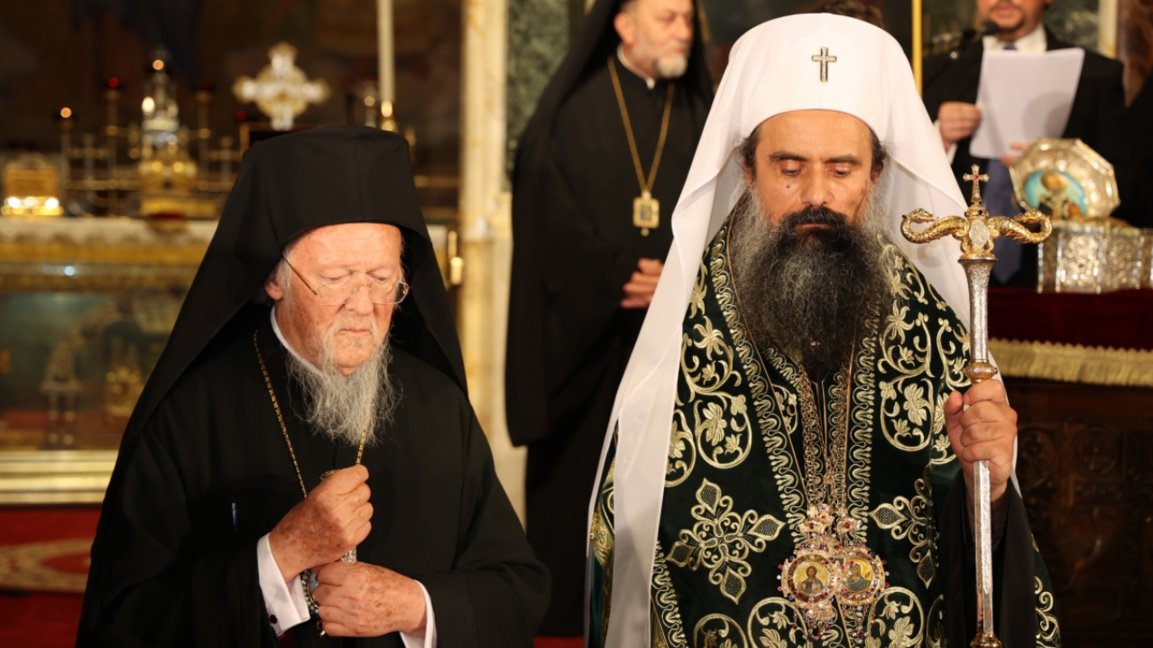
The visit of Ecumenical Patriarch Bartholomew to Bulgaria on October 17–19, 2026, was an event whose significance extended far beyond ecclesiastical protocol. It once again exposed the contradictions within Bulgarian society, where historical attachment to Russia coexists with aspirations for political independence, European integration and the preservation of a distinct ecclesiastical identity.
The protests against Bartholomew, accusations of heresy, opposition to Ukrainian autocephaly and attempts to portray Constantinople as a threat to Orthodox unity raise a question: how strong is Moscow’s hand in Bulgaria?
The answer becomes particularly revealing when several earlier events are considered: the scandal involving Patriarch Kirill in 2018, the expulsion of Archimandrite Vassian Zmeyev in 2023 and Bulgaria’s blocking of sanctions against the Moscow Patriarch in the summer of 2026.
In the last case, moreover, testimony emerged suggesting possible direct involvement by church leaders in a government decision.
Protests Against Bartholomew: Moscow’s Agenda on Bulgarian Soil
A campaign against the Ecumenical Patriarch’s visit began even before his arrival. Those involved accused Bartholomew of violating church canons, supporting the Ukrainian schism and seeking to establish his own supremacy over the Orthodox world.
On October 17, protesters gathered outside the Holy Synod headquarters in Sofia, carrying placards declaring “Bartholomew, You Are Not Welcome Here” and “Heretic and Ecumenist.”
Particular outrage was provoked by Bartholomew’s liturgical commemoration of Metropolitan Epiphaniy, Primate of the Orthodox Church of Ukraine, whose autocephaly the Bulgarian Orthodox Church has not officially recognised.
The protesters’ rhetoric closely mirrored the arguments of the Moscow Patriarchate, which has waged a fierce campaign against Constantinople’s decisions since autocephaly was granted to the Ukrainian Church in 2019.
For Moscow, the Ukrainian church question has long ceased to be merely a canonical dispute. It is bound up with the loss of influence over Ukraine, claims to the spiritual heritage of Kyivan Rus and the desire to preserve the image of Russia as the centre of a distinct Orthodox sphere.
Any conflict surrounding Bartholomew within other autocephalous Orthodox churches therefore objectively serves Moscow’s interests.
But a convergence of interests is not proof of direct control. Bulgaria has its own conservative church circles that sincerely oppose Constantinople’s decisions. Their position may reinforce Russian influence even without Moscow’s direct intervention.
The Kirill Scandal: When Gratitude Was Expected to Become Submission
In March 2018, Moscow Patriarch Kirill visited Bulgaria to mark the 140th anniversary of the country’s liberation from Ottoman rule.
The celebrations, however, turned into a diplomatic confrontation.
Kirill sharply criticised President Rumen Radev for mentioning, alongside the Russians, other peoples of the Russian Empire who had participated in the Russo-Turkish War of 1877–1878.
The Moscow Patriarch insisted that Russia’s contribution should receive exclusive recognition.
For a substantial part of Bulgarian society, such behaviour appeared to be an attempt to dictate to a sovereign state how it should remember its own history.
Radev responded that historical gratitude towards Russia could not mean abandoning national dignity. He later remarked that Kirill had been welcomed as a spiritual leader but had chosen to depart as a politician.
The episode exposed a fundamental contradiction.
For Moscow, the memory of Bulgaria’s liberation often serves as grounds for expecting special political loyalty. For the Bulgarian state, that memory remains an important part of national history, but it does not negate the country’s right to determine its own foreign policy.
The Expulsion of Vassian Zmeyev: The Limits of Church Diplomacy
In September 2023, Bulgaria went considerably further than diplomatic objections.
Archimandrite Vassian Zmeyev, who headed the Russian Orthodox Church’s representation in Sofia, was expelled from the country along with two other clergymen.
Bulgaria’s State Agency for National Security stated that their activities were aimed at influencing social and political processes in the interests of Russian geopolitics.
The Russian side rejected the accusations.
The political significance of the decision, however, was clear: the Bulgarian authorities demonstrated their willingness to examine the activities of Moscow Patriarchate representatives through the lens of national security.
The historical closeness of the two Orthodox peoples did not confer immunity from action by state authorities.
At first glance, such a decision might have suggested that Bulgaria would consistently support any European measures aimed at putting pressure on the leadership of the Russian Orthodox Church.
But the events of June 2026 revealed just how much more complicated Bulgaria’s relationship with Russia really is.
Sanctions Against Kirill: An Alleged Chain of Telephone Calls from Moscow to Sofia
In the summer of 2026, Bulgaria opposed adding Moscow Patriarch Kirill to the European Union’s sanctions list during discussions of the 21st package of restrictive measures against Russia.
Sofia’s official explanations centred on concerns that sanctions against the head of a major religious organisation could be exploited by Russian propaganda to accuse the European Union of interfering in church affairs.
However, on October 8, 2026, the Libertas Fidei website published an article in which Petar Tanev, a political adviser at the European Parliament, offered an entirely different explanation.
Speaking on the Slawa television channel, Tanev said that Sofia’s position may have resulted from a direct appeal by Moscow Patriarch Kirill to Bulgarian Patriarch Daniil.
According to Tanev, on the day the sanctions issue was discussed, Kirill telephoned Daniil and asked him to take every possible step to prevent his name from being added to the sanctions list.
The expert further claimed that the Bulgarian Patriarch then contacted Rumen Radev, who was serving as prime minister, and conveyed the request to prevent sanctions against the head of the Russian Orthodox Church.
Tanev thus described an alleged chain of influence:
Moscow — Moscow Patriarch Kirill — Bulgarian Patriarch Daniil — the Bulgarian government leadership — Sofia’s position within the European Union.
This testimony deserves particular attention.
If the sequence of events described by Tanev is accurate, the issue goes beyond historical sympathies or overlapping political interests. It raises the possibility that the church hierarchy was used as a channel for directly influencing the foreign-policy decisions of an EU member state.
In that case, the Moscow Patriarchate would have acted not merely as a religious organisation defending its own interests, but as a participant in the political process, capable of influencing EU sanctions policy through its relations with the leadership of another autocephalous Orthodox church.
It must be emphasised, however, that Tanev’s account constitutes public testimony by an expert. The contents of the alleged telephone conversations have not been corroborated by published recordings or independent documents. The sequence he described therefore cannot be regarded as a conclusively established mechanism of decision-making.
Nevertheless, it represents a specific allegation concerning a possible channel of influence, one that can be investigated and compared with the chronology of negotiations and decisions.
It is precisely this allegation that lends particular significance to the events of October 2026.
After all, the same Patriarch Daniil whom Tanev identified as an intermediary between Kirill and the Bulgarian government officially welcomed Ecumenical Patriarch Bartholomew to Sofia several months later.
Bulgaria and Its Unfulfilled Longing for Greatness
Why might such mechanisms of influence persist in a country that has long been a member of the European Union and NATO?
In an article published on Libertas Fidei on June 20, 2026, entitled “Why Did Bulgaria Not Support Sanctions Against Patriarch Kirill?”, Balkan specialist Aleksey Pavlov proposed examining Bulgaria’s relationship with Russia through the historical experience of unfulfilled national ambitions.
His central argument is that Bulgaria’s attachment to Russia reflects not only gratitude towards its liberator, but also a complex history of aspirations to greatness, disappointments and dependence on external patrons.
After liberation from Ottoman rule, Bulgaria sought to become one of the leading powers in the Balkans. Russian support played an important role in the establishment of Bulgarian statehood, but St Petersburg’s subsequent policies did not always coincide with Bulgarian national interests.
The Russian Empire pursued its own strategic objectives, cultivating relations not only with Sofia but also with Belgrade and other centres of Balkan politics.
For Bulgaria, this created a painful contradiction: the state perceived as its natural protector was simultaneously an independent imperial power under no obligation to support every Bulgarian claim.
Military defeats, territorial losses, attempts to seek support from Germany and decades of dependence on the Soviet Union followed.
In Pavlov’s interpretation, this historical experience fostered a particular form of nostalgia among sections of Bulgaria’s political elite: a desire to compensate for unrealised national greatness through closeness to a more powerful external centre.
This interpretation cannot serve as a universal explanation for the behaviour of all Bulgarians. Society is far from homogeneous, and the historical decisions of states are shaped not only by collective emotions but also by economic interests, political institutions and the international environment.
Nevertheless, Pavlov’s concept helps raise an important question: why does the historical experience of dependence on Moscow not always lead to a rejection of Russian support?
Perhaps because, for some members of the political class, Russia continues to symbolise not so much a concrete foreign-policy alternative as a lost sense of belonging to a grand historical project.
European Bulgaria and Its Historical Nostalgia
Bulgaria’s accession to the European Union marked a fundamental change in its international position.
The country gained access to European markets, institutions and financial mechanisms, while its security rests on NATO membership.
Yet institutional integration does not necessarily eliminate historical grievances and political nostalgia.
Pavlov points out that economic integration with Europe is not always accompanied by a sense of participating on equal terms in shaping European policy.
In his interpretation, a sense of peripheral status can generate demand for politicians who seek to demonstrate independence primarily by opposing decisions made in Brussels.
Here, however, it is important to distinguish principled disagreement with particular sanctions from a deliberate choice of a pro-Russian course. Opposition to restrictions targeting Kirill does not, in itself, signify a rejection of European integration or support for Russian foreign policy as a whole.
This is precisely why Bulgaria’s position cannot be reduced to the simplistic formula “Sofia Chooses Moscow.”
Rather, the country remains the scene of a struggle between competing visions of its historical identity and its place in Europe.
The Ukrainian Question as a Mirror of Bulgaria’s Contradictions
Particularly interesting is Pavlov’s proposed parallel between Bulgaria’s historical aspirations and Ukraine’s contemporary struggle for independence.
Ukraine today is defending its right to determine its own political future and free itself from the claims of a former imperial centre.
In this sense, Ukraine’s experience echoes Bulgaria’s own historical struggle for national liberation.
Yet Pavlov suggests that, for some Bulgarians, Ukraine’s struggle may provoke not only solidarity but also resentment, because it recalls their country’s own historical defeats and unfulfilled ambitions.
This is an intriguing, though debatable, psychological hypothesis. Substantiating it would require sociological research capable of distinguishing historical nostalgia from contemporary political preferences.
Nevertheless, the ecclesiastical conflict surrounding Ukrainian autocephaly has indeed become a kind of mirror reflecting Bulgaria’s internal contradictions.
Constantinople’s recognition of the Orthodox Church of Ukraine confronts the Bulgarian Church with a question extending beyond canon law: to what extent should its position be determined by historical closeness to Moscow, and to what extent by its own understanding of Orthodox unity?
Patriarch Daniil: Between Moscow and Constantinople
Bulgarian Patriarch Daniil plays a particularly important role in this contradiction.
He is known for his critical attitude towards Ukrainian autocephaly and, on several issues, holds positions close to those of the Moscow Patriarchate.
If Petar Tanev’s testimony is accurate, Daniil may have acted as an intermediary between Kirill and the Bulgarian government during discussions of European sanctions.
Yet in October 2026, the same Daniil officially welcomed Bartholomew and participated in joint religious services with him.
This event is of fundamental significance.
The Bulgarian Church has not recognised the Orthodox Church of Ukraine, but neither has it followed Moscow in breaking Eucharistic communion with Constantinople.
Bulgarian church policy therefore retains its own internal logic.
Conservative and pro-Moscow sentiments are present, but they do not automatically determine every decision made by the church leadership.
This is precisely why Bartholomew’s visit proved so sensitive for Constantinople’s opponents: it demonstrated that, despite serious disagreements, the Bulgarian Orthodox Church does not intend to turn the Ukrainian question into grounds for a complete rupture with the Ecumenical Patriarchate.
Where Does Historical Gratitude End and Political Dependence Begin?
Taken together, four events now form a more complex picture.
In 2018, Bulgaria publicly rejected Kirill’s attempt to impose a Russian interpretation of its national history.
In 2023, the Bulgarian authorities expelled a representative of the Moscow Patriarchate whose activities they regarded as a threat to national security.
In the summer of 2026, Sofia opposed European sanctions against Kirill. According to Petar Tanev’s allegation, this was preceded by an appeal from the Moscow Patriarch to Daniil, followed by the latter’s intervention at government level.
Finally, in October 2026, the Bulgarian Orthodox Church welcomed Bartholomew despite protests from supporters of Moscow’s ecclesiastical position.
These events fit neither the image of Bulgaria as Moscow’s unconditional ally nor that of a country that has completely freed itself from Russian influence.
Rather, they point to a state and society in which several historical and political forces operate simultaneously.
One is associated with European integration, national sovereignty and the independence of state institutions.
Another draws on Orthodox solidarity, the memory of liberation and cultural closeness to Russia.
A third reflects the desire of sections of the political class to exploit tensions between Moscow and Brussels to strengthen their own positions.
Direct Russian influence through religious, civic and information channels cannot be ruled out either. But claims about specific operations require verifiable evidence.
What Did Bartholomew’s Visit Reveal?
The principal significance of the visit lies not merely in the fact that the protests failed to disrupt it.
It demonstrated the limits of Russian influence over the Bulgarian Orthodox Church.
Moscow retains the ability to shape public debate, support ecclesiastical positions aligned with its own and use the Ukrainian question to deepen divisions within the Orthodox world.
But that influence does not amount to complete control.
The Bulgarian Church continues to maintain communion with Constantinople. The Bulgarian state remains part of European and Euro-Atlantic institutions. And historical sympathies towards Russia do not invariably translate into support for Moscow’s specific decisions.
At the same time, the controversy over sanctions against Kirill serves as a reminder that it would be premature to declare Russian influence definitively overcome.
It is here that Aleksey Pavlov’s analysis acquires particular significance. His concept of an unfulfilled longing for greatness suggests that Bulgaria’s ambivalence should be understood not as random inconsistency, but as the outcome of a prolonged historical search for its own role between imperial centres and European institutions.
Petar Tanev’s testimony adds another possible mechanism to this historical picture: personal contacts between church leaders which, according to his account, may be capable of influencing government decisions.
The Bulgarian paradox is that the country can simultaneously resist specific manifestations of Russian pressure while retaining a political attachment to the symbols of Russian influence.
The question of Bulgaria’s future course therefore cannot be reduced to who prevails in the next ecclesiastical dispute.
At stake is a more fundamental choice: will historical memory become a source of independent national identity, or will it remain an instrument through which external powers can influence Bulgarian decisions?
Bartholomew’s visit demonstrated that Bulgaria’s ecclesiastical independence endures despite serious internal disagreements.
But the dispute over sanctions against Kirill was a reminder that the struggle for political independence is far from over.
And perhaps the central lesson of this entire story is that national dignity is defined not by proximity to a great power, but by the ability to make independent decisions, including when those decisions displease historical patrons.
Anna Yansone