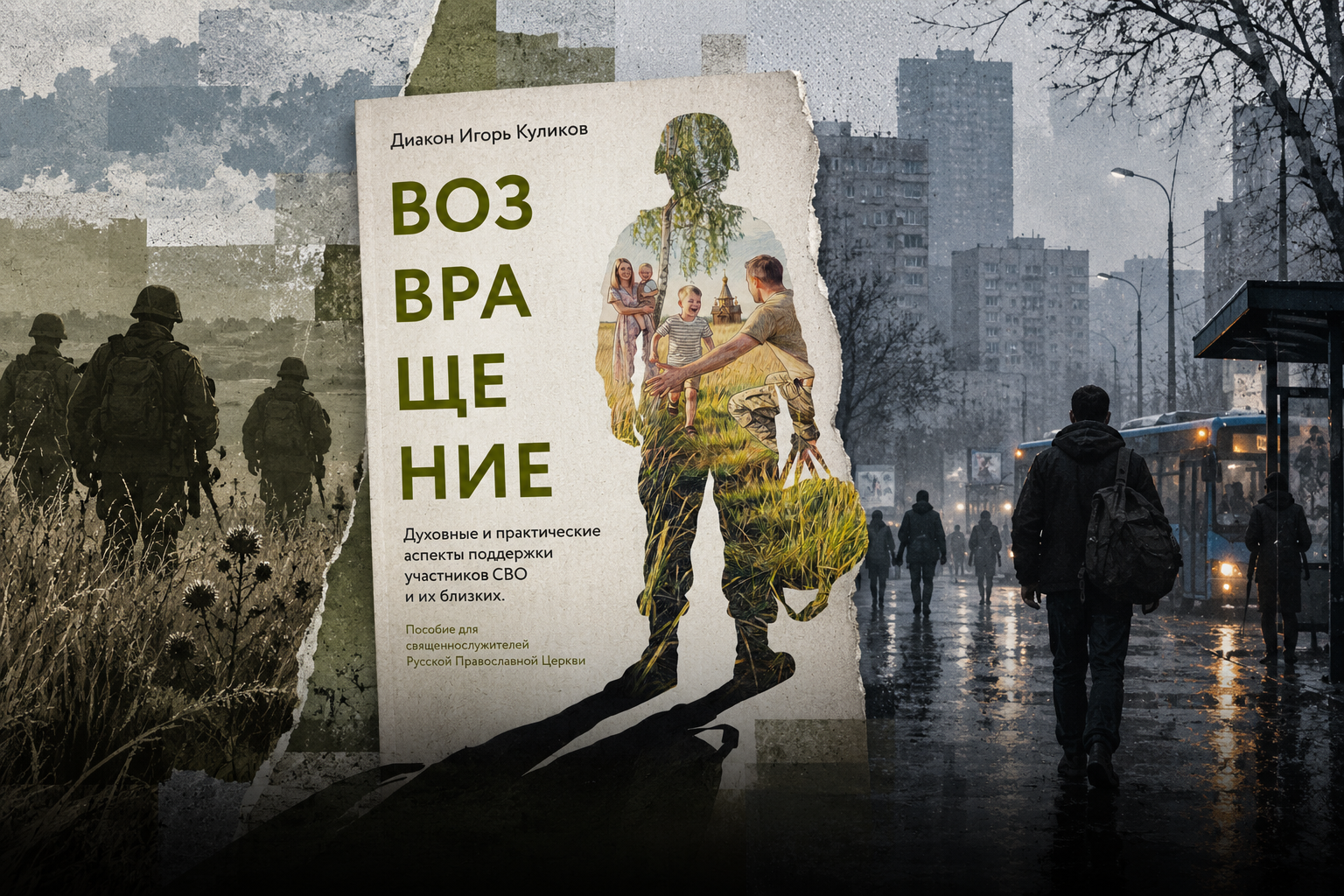
This summer, the Russian Orthodox Church published a practical guide titled “Return. Spiritual and Practical Aspects of Assistance to Participants in the Special Military Operation and Their Loved Ones.” It was intended primarily for parish priests who will encounter people returning from the front. The first version of the text was sent to several hundred priests with practical experience, after which it was revised to incorporate more than one hundred responses.
In effect, priests are being taught here to be more than spiritual advisers. They are encouraged to understand the psychological characteristics of veterans, family conflicts, and social issues, and to know where to refer people for specialized assistance. At the same time, the Church is training clergy for this work. For example, more than 3,600 clergy members registered for one of its online courses.
Can such a system actually help?
A priest does not become a clinical psychologist, psychiatrist, or lawyer simply by reading a practical guide. In cases of severe post-traumatic stress disorder, addiction, aggression, suicidal behavior, or the threat of domestic violence, spiritual support can be part of the assistance provided, but it cannot replace professional diagnosis and treatment.
The situation is further complicated by the fact that, as was already the case following the Soviet invasion of Afghanistan, participants’ emotional and psychological condition will be burdened by an awareness of the war’s dishonesty, their status as social pariahs in Europe, and their inability to travel.
All these factors intensify feelings of social isolation and inner disorientation. At the same time, European countries should exercise heightened caution with regard to this category of people. The combination of combat experience, severe psychological trauma, and deep resentment toward an outside world that has “closed its doors” makes them a potential source of serious security risks even beyond Russia.
And all of this is unfolding against the backdrop of specific and deeply alarming data on crimes committed by participants in the war after their return. Public concern is being driven not by abstract fears but by real, high-profile tragedies, such as the mass killing in the Karelian village of Derevyannoye. Igor Sofonov, who had multiple previous convictions and returned from the war after serving with the Wagner PMC, carried out a nighttime massacre in the Karelian village together with an accomplice. They broke into two separate homes, where they brutally killed six people, including an elderly person, before setting the houses on fire to conceal evidence of the crime. The case became one of the first and most prominent examples of a mass killing committed by pardoned former prisoners after they returned to their home regions.
Russia was also shaken by the brutal killing of entertainers in Krasnodar Kray and the murder of a pensioner in Kirov Oblast, both committed by pardoned former prisoners after their return from the front. A report that 33-year-old United Russia candidate and “special military operation” participant Sergey Grigoryev, a former prisoner who had been pardoned for taking part in the war, brutally killed his 30-year-old partner, Yuliya Byukovka, during a domestic dispute also caused enormous public outrage. He inflicted multiple stab wounds on her and then attempted to hide her bod
In January 2026, Novaya Gazeta Europe published a study of a large body of Russian court rulings. Its journalists reported finding more than 8,000 participants in the “special military operation” who had been convicted since 2022 of ordinary criminal offenses, meaning crimes unrelated to military service.
Around 7,000 of them were veterans who had returned home, while approximately another 1,000 were still active-duty military personnel at the time of their offenses.
According to the same study, around 900 veterans were convicted of violent crimes. The authors counted at least 423 victims who died, 61 of them in traffic accidents. Among the dead, they separately identified 52 victims of domestic violence, partners and relatives of those convicted.
The trend in the convictions identified by the journalists is also striking: around 350 cases in 2022, 2,500 in 2023, and more than 4,700 in 2024. The data for 2025 in this dataset were incomplete, so they cannot be directly compared with those of previous years.
The Church’s initiative is therefore noteworthy not so much as an attempt to turn a priest into an “Orthodox psychologist,” but as an effort to create another point of early intervention. A person may never voluntarily seek out a psychotherapist, but may go to church. And if a priest is able to recognize a dangerous situation and, instead of advising someone to “endure and pray,” promptly bring in a psychologist, psychiatrist, social worker, lawyer, or law enforcement, such a system could indeed have practical value.
But a definitive answer to the question “will it help?” will emerge only when the assistance begins to be measured by outcomes: how much crime among participants in the “special military operation” has declined and how many people have received the treatment they need.
Anna Yansone