As Russia continues its war against Ukraine, the Russian Orthodox Church (ROC) is actively expanding its international presence. Europe, Africa, Asia, international Christian organisations and Russian diaspora communities all remain areas of diplomatic activity for the Moscow Patriarchate.
The decisions adopted by the Holy Synod of the Russian Orthodox Church on 22 October 2026 reveal how church diplomacy intersects with Russian state policy and what instruments of international influence the Moscow Patriarchate employs.
Europe: Russia’s Foreign Ministry and the Church Work Hand in Hand
Journal No. 88 is particularly revealing. It describes a roundtable held in Yerevan on 3–4 September, jointly organised by the Moscow Patriarchate’s Department for External Church Relations (DECR) and the Russian Ministry of Foreign Affairs. The meeting focused on engagement with Russian compatriots living in European countries.
Participants included Russian diplomats, representatives of the Moscow city government, organisations representing Russian compatriots from 16 European countries and heads of ROC dioceses abroad. Among those attending were Archbishop Simon of Brussels and Belgium, Archbishop Elisey of The Hague and the Netherlands, Metropolitan Mark of Korsun and Western Europe, and other representatives of European church structures.
The Synod did more than simply acknowledge the meeting’s report. It also emphasised the need to develop further cooperation between the Church and state and public organisations. The coordination between Russian diplomacy and the ROC’s overseas structures is therefore not merely an assumption made by analysts, but an officially acknowledged practice.
Orthodox parishes in Europe, whose primary mission is to serve the spiritual needs of believers, may also function as platforms for maintaining Russian cultural and community ties abroad. But where does pastoral ministry end and the advancement of the state’s foreign policy interests begin?
Patriarch Kirill’s Nephew in International Church Diplomacy
The Geneva dimension deserves particular attention.
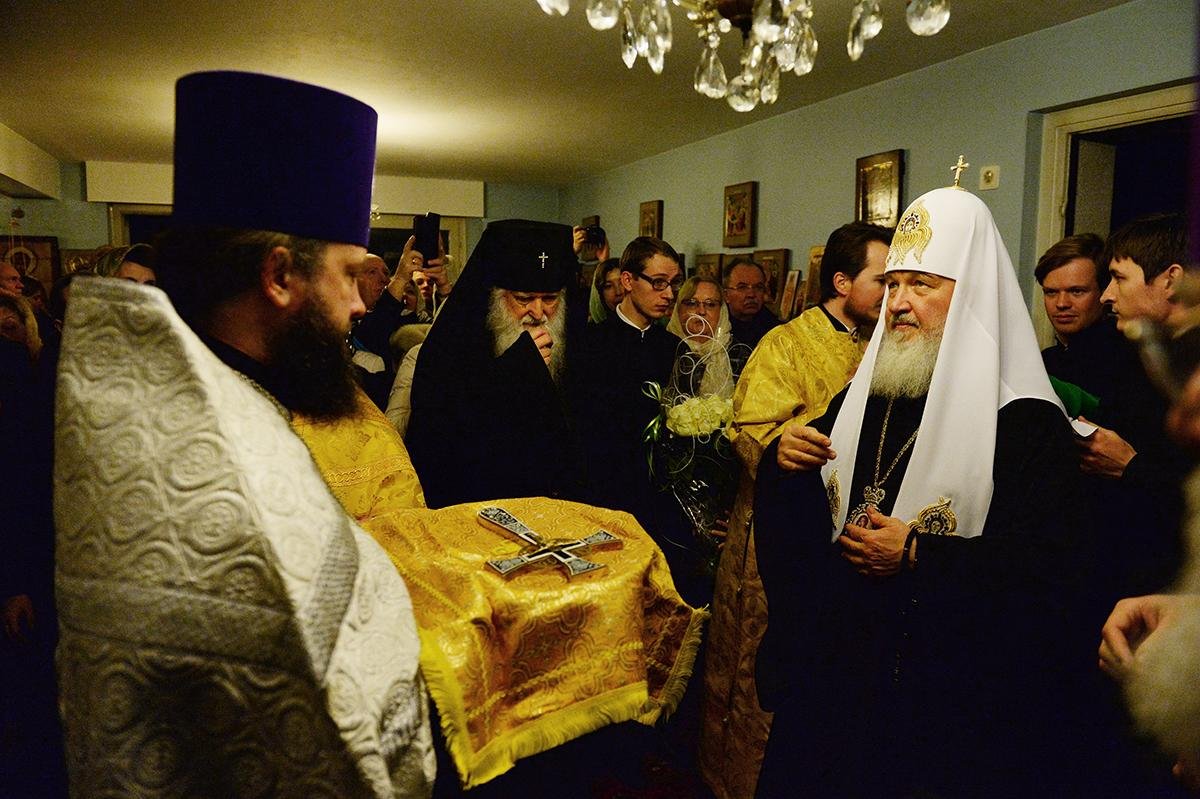
On 15 September, Metropolitan Antony, head of the DECR, met with the General Secretary of the World Council of Churches, Jerry Pillay. Also attending was Archpriest Mikhail Gundyayev, Patriarch Kirill’s nephew and the ROC’s representative to the World Council of Churches and international organisations in Geneva.
Mikhail Gundyayev has been subject to Ukrainian sanctions since January 2023. His involvement in the ROC’s international contacts demonstrates that the Church continues to maintain diplomatic channels despite political pressure and criticism of its leadership for supporting Russian aggression. The fact that talks took place with the World Council of Churches does not, of course, imply that the organisation supports the war. Nevertheless, such contacts allow the Moscow Patriarchate to remain involved in international Christian dialogue.
Cyprus and Georgia: The Struggle for Influence Within the Orthodox World
Journal No. 87 also details Metropolitan Antony’s visits to Cyprus, France and Georgia. Particularly noteworthy are his meetings with Cypriot hierarchs, Metropolitan Neophytos of Morphou, Metropolitan Nikiforos of Kykkos and Metropolitan Athanasios of Limassol.
Following the recognition of the autocephaly of the Orthodox Church of Ukraine, Moscow has sought to maintain relations with influential figures within the autocephalous Orthodox churches, including those critical of decisions taken by the Ecumenical Patriarchate of Constantinople. In this context, personal contacts acquire not only religious but also ecclesiastical and political significance. At the same time, such contacts do not in themselves prove that foreign hierarchs are politically subordinate to Moscow.
India: Why the ROC Cooperates with the Malankara Church
In Journal No. 89, the Synod examines relations with the Malankara Orthodox Syrian Church. Despite its name, this is not a church based in Syria, but one of India’s oldest Christian communities. Its historical centre is in the state of Kerala, in southwestern India. According to church tradition, the local Christian community traces its origins to the preaching of the Apostle Thomas in the first century AD.
The Malankara Church is an independent, autocephalous church belonging to the Oriental Orthodox family, alongside the Coptic, Armenian Apostolic and Ethiopian churches. It is headed by Catholicos of the East Baselios Marthoma Mathews III. It is not in Eucharistic communion with the ROC, as it belongs to a different historical branch of Eastern Christianity.
On 23–24 July 2026, the fifth meeting of the bilateral working group between the ROC and the Malankara Church took place in Kuala Lumpur. The two sides are developing theological, educational, cultural, youth and parish-level contacts.
For the Moscow Patriarchate, such cooperation represents an expansion of international ties beyond the traditional Eastern Orthodox world, towards India and its substantial diaspora abroad. However, this is an interchurch partnership, not a transfer of the Malankara Church to Moscow’s jurisdiction.
Africa: Church Diplomacy Extends Beyond Theology
Another document, Journal No. 90, addresses cooperation with the Ethiopian Church.
In September 2026, a bilateral commission met in Moscow. The proposed areas of cooperation include monastic ties, pilgrimages, academic programmes, media initiatives, cultural and social activities, and even industrial projects. Relations thus extend beyond theological discussions, creating an enduring network of institutional contacts.
Against the backdrop of Russia’s expanding diplomatic engagement in Africa, the question arises as to how independent such church initiatives are and to what extent they align with Russia’s broader foreign policy interests.
The official documents provide no grounds for claiming that the Ethiopian Church acts in the Kremlin’s interests. They do, however, offer an opportunity to examine how religious relations become part of the Moscow Patriarchate’s international presence.
A Patriarch Under Sanctions, Yet International Activities Continue
All this activity is taking place against the backdrop of serious reputational problems for Patriarch Kirill, who has repeatedly expressed support for Russia’s invasion of Ukraine.
On 16 June 2022, the United Kingdom imposed personal sanctions on the head of the ROC. British authorities explicitly stated that Kirill had publicly supported Russian aggression, thereby facilitating policies that threatened Ukraine’s sovereignty and territorial integrity.
Canada imposed sanctions on Kirill on 8 July 2022.
The European Union, however, has twice failed to agree on similar restrictions. In June 2022, Viktor Orbán’s Hungary blocked the patriarch’s inclusion in the sixth sanctions package, citing the protection of religious freedom. In the summer of 2026, the EU made another attempt to sanction the head of the ROC. Following a change of government in Hungary, opposition came instead from Bulgaria. According to European media reports, Sofia secured Kirill’s removal from the draft 21st sanctions package.
Thus, Patriarch Kirill remains subject to British and Canadian sanctions but, as of October 2026, has not been included on the EU-wide sanctions list.
This episode illustrates how sensitive the issue of sanctions against religious leaders remains, even when they openly support the actions of a state waging war.
Religion in the Service of Foreign Policy?
The Synod’s October decisions reveal two models of the ROC’s international activity. The first involves direct cooperation between church structures and the Russian state, particularly in engagement with Russian compatriots in Europe. The second involves expanding an international network of relationships through education, culture, pilgrimages, youth programmes and interchurch commissions.
Such contacts are, in themselves, a normal part of religious life. However, they take on a different political significance when church leaders publicly support a war and the Church’s overseas structures maintain institutional cooperation with government agencies of the aggressor state.
This is precisely why the Moscow Patriarchate’s activities require examination not only as church diplomacy but also as a potential instrument of Russian influence abroad.
The Synod’s documents do not justify the conclusion that all the ROC’s international partners share the Kremlin’s political objectives. They do, however, confirm the existence of an extensive network of international contacts and formal cooperation with Russian diplomatic institutions.
And the central question is not how many trips abroad Metropolitan Antony has made.
Far more important is understanding what political opportunities these visits create, who finances international programmes and where the boundary lies between independent religious ministry and the promotion of Russian state interests.
As long as Patriarch Kirill continues to justify the war while the international structures of the Church he leads continue expanding their overseas ties, the question of religion being used as an instrument of political influence remains not merely a theological issue, but a political one.
Ann Yansone
In the photo: Mikhail and Kirill Gundyayev during the latter’s visit to Geneva in 2017.