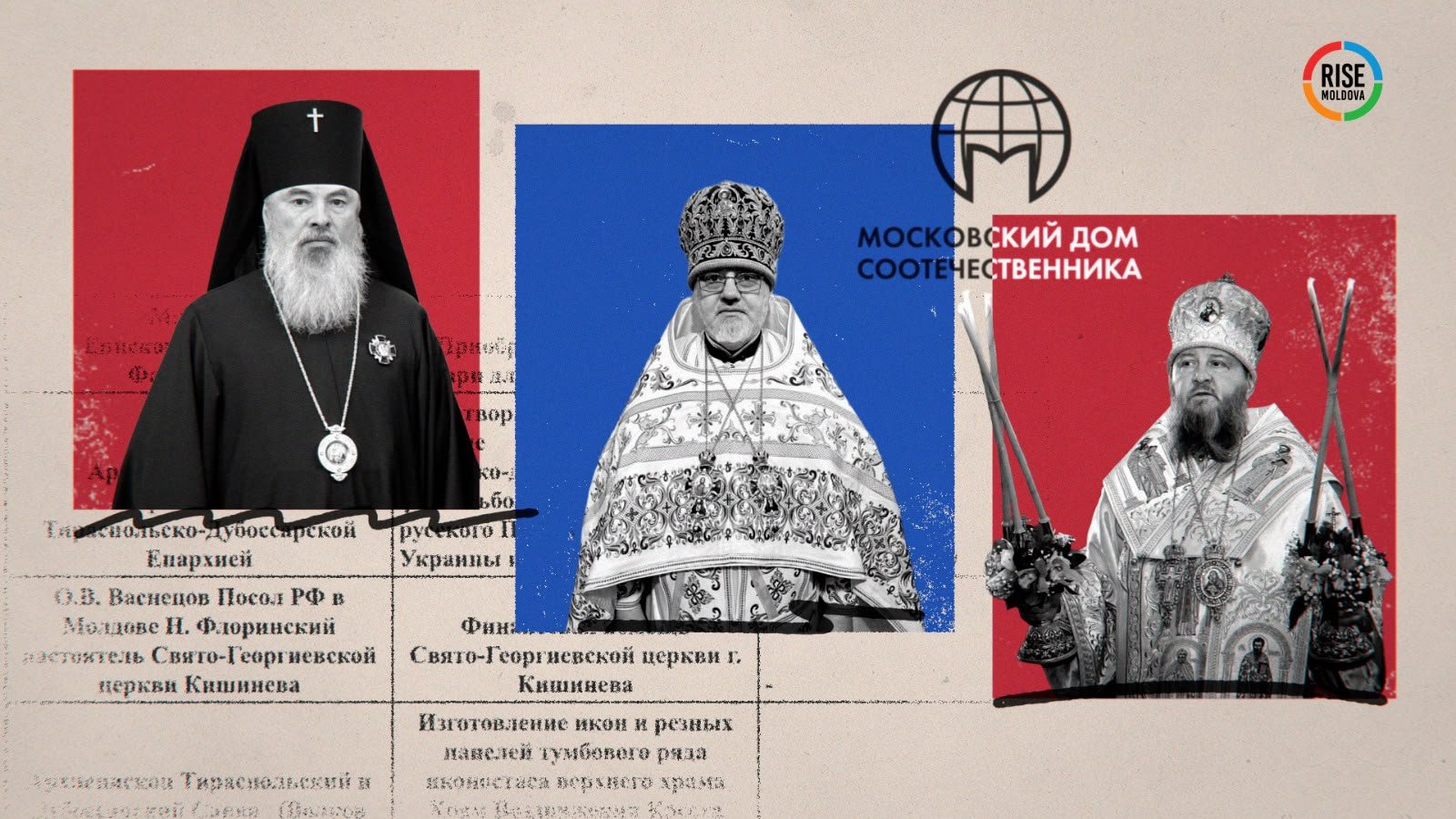
Dioceses, churches and organizations in Moldova, including Gagauzia and the Transnistrian region, requested millions of rubles from Russian entities for icons, books, church utensils and improvements to places of worship. The funding was channelled through the Moscow House of Compatriots, an organization used by the Russian authorities as an instrument of influence.
This is according to an investigation by RISE Moldova.
Documents from the Moscow House of Compatriots were reportedly leaked to the press, comprising an archive of more than 270,000 internal emails. They were obtained by journalists at Danish public broadcaster DR, which subsequently shared them with OCCRP and more than 28 media partners, including RISE Moldova.
The documents reviewed show that in 2016–2018, Russian plans included, or recorded as completed, religious projects in Moldova and the Transnistrian region with a total value of at least 8.5 million rubles, more than 2.5 million lei. Other applications were rejected or deferred, while for some there is no clear confirmation that funding was provided.
Religious projects continued to receive funding in 2019–2020, although the documents no longer specified the amounts.
Applicants named in the documents include Marchel, Bishop of Bălți and Fălești, Savva, Bishop of Tiraspol and Dubăsari, Chișinău priest Nikolai Florinsky, civic organizations and politicians.
According to the publication, the Moscow House of Compatriots is a state institution established by the Moscow government in 2003 and funded from the Russian capital’s budget.
Outside Russia, it supports projects promoting the Russian language, culture and education, Russian-language media, initiatives focused on “historical memory” and Moscow Patriarchate parishes.
Its activities, however, are not limited to cultural projects. Open sources link the institution to pro-Kremlin organizations, the promotion of Moscow’s political messaging and entities supporting Russia’s war against Ukraine.
Studies of Russian “soft power” describe the Moscow House of Compatriots as one of the entities used to engage with the Russian diaspora and promote Kremlin influence abroad.
Moscow’s funding of Moldovan churches is not solely a religious matter. This is indicated by an internal document from the Russian presidential administration that entered the public domain and was previously reported on by RISE. “Providing support to the Russian Orthodox Church in defending the interests of canonical Orthodoxy in the Republic of Moldova” is among the “strategic objectives” that Moscow planned to achieve by 2030.